


Energy companies now prioritize ESG scores in their equity reports, reflecting a shift toward sustainable investing and responsible decisions. ESG adoption in the energy sector has accelerated, with 74% of firms estimated to align with TCFD standards in 2024.
Institutional investors recognize that ESG integration delivers not only transparency but also deeper market intelligence. Companies embracing ESG reporting experience improved risk management, stronger stakeholder trust, and more resilient strategies. Sustainability analytics transform ESG metrics into actionable insights, allowing investors to make informed investment decisions and identify long-term growth opportunities. The energy sector leads in green bond issuance, demonstrating the vital connection between ESG, equity analysis, and strategic investing.
Table of Contents
Key Takeaways
ESG scores evaluate companies on environmental, social, and governance factors, helping energy firms manage risks and improve sustainability.
Energy equity reports focus on fairness in energy access, community impact, and balancing economic and environmental concerns.
Integrating ESG scores into equity reports improves transparency, risk management, and supports stronger financial performance and sustainable growth.
Energy companies should collect reliable ESG data using standardized frameworks, technology tools, and stakeholder engagement for accurate reporting.
Overcoming challenges like data quality and inconsistent standards requires investment in technology, training, and collaboration to build trust and drive long-term success.
ESG Scores & Equity Reports

ESG Scores Defined
ESG scores serve as comprehensive ratings that evaluate companies based on environmental, social, and governance criteria. Analysts in the energy sector rely on these scores to assess how organizations manage sustainability risks and opportunities. ESG ratings draw from a blend of quantitative metrics and qualitative indicators, including carbon emissions across Scopes 1, 2, and 3, climate targets, energy consumption, and resource management. Social factors such as workforce diversity, labor practices, employee well-being, and supply chain human rights reflect broader equity concerns. Governance indicators include board independence, executive compensation alignment, anti-corruption practices, and shareholder rights. Leading frameworks like ISSB, CSRD, TCFD, GRI, and SASB guide consistent reporting and disclosure. ESG scores in the energy industry often emphasize sector-specific metrics, such as emissions and workplace safety, using digital tools and structured data to meet regulatory requirements.
ESG ratings provide a multidimensional view, helping stakeholders make informed decisions and align with sustainable business practices.
Energy Equity Reports
Energy equity reports analyze how energy projects and policies impact communities, focusing on fairness and inclusion. These reports examine affordability, community participation, local pollution, and the balance between economic benefits and environmental burdens. Analysts consider geographic location and energy cost, recognizing that rising prices disproportionately affect low-income groups. Regional differences emerge due to varying fossil fuel production, regulatory environments, and investment eligibility. Community engagement and trust-building remain essential for project acceptance, especially when local impacts conflict with broader environmental goals. Scenario analysis helps stakeholders understand equity implications across different regions and futures.
Key elements in energy equity reports:
Energy affordability and access
Community buy-in and participation
Local pollution and health impacts
Economic versus environmental trade-offs
Regional regulatory and investment differences
Why They Connect
The connection between ESG scores and energy equity reports lies in their shared focus on sustainability, transparency, and stakeholder impact. ESG ratings offer indicators that complement equity analysis, revealing how environmental, social, and governance criteria influence financial outcomes and community well-being. Empirical studies show that environmental scores may not always reflect genuine improvements, sometimes correlating with firm size or appearance management rather than actual emission reductions. In energy-related real estate assets, higher environmental scores can even predict lower future equity returns and reduced financial health, while social and governance factors tend to enhance returns and operational performance.
ESG Component | Relationship with Future Stock Returns | Impact on Firm Fundamentals | Market Valuation Effect |
|---|---|---|---|
Environmental | Lower funds from operations, reduced profit ratio | Lower market valuation | |
Social | Positive association | Higher funds from operations, increased profit ratio | Higher stock performance |
Governance | Positive association | Growth in funds from operations, improved profit ratio | Not explicitly stated |
This nuanced relationship encourages energy companies to integrate ESG indicators into equity reports, fostering more informed decisions and resilient strategies. By combining ESG ratings with equity analysis, organizations gain deeper insights into both financial and social outcomes, supporting innovation and adaptability in a rapidly evolving sector.
ESG Integration Benefits

Financial Impact
Energy companies that integrate esg into their equity reports experience tangible financial advantages. Transparent esg disclosures attract esg-focused investors, leading to increased capital inflows and higher stock valuations. Companies with strong esg practices often access green financing and benefit from lower costs of capital, which supports long-term growth. Governance and social esg factors positively influence profitability and market valuation, especially in the energy sector. For example, firms like Ørsted and NextEra Energy have demonstrated that high esg performance can unlock regulatory benefits, government subsidies, and new market opportunities. Over time, research shows that companies with high esg ratings consistently outperform their peers, delivering superior shareholder returns and providing downside protection during market crises. These outcomes highlight the importance of aligning sustainability with financial performance metrics and investment strategies.
Sector | How ESG Integration Improves Financial Performance |
|---|---|
Energy | Transitioning to renewables reduces regulatory and carbon pricing risks, unlocks government subsidies, and meets growing market demand. Companies like Ørsted and NextEra Energy exemplify high esg performance leading to better financial outcomes. |
Risk & Returns
Integrating esg factors and returns into energy equity reports enhances risk management and supports resilient investment returns. Quantitative data reveals that esg integration improves risk-adjusted returns and reduces volatility across sectors. For instance, technology firms with strong esg practices outperform by 12% annually, while financial services firms focused on inclusion see 23% lower volatility. In the energy sector, esg-driven investment decisions help companies navigate regulatory compliance, climate-related risks, and operational disruptions. Recent analyses show that clean energy stocks with higher esg scores have outperformed traditional fossil fuel sectors, even amid political and regulatory challenges. Sustainable funds continue to attract significant investor interest, with global assets reaching $3.2 trillion by March 2025. These trends confirm that esg factors and returns play a crucial role in shaping robust investment returns and supporting long-term portfolio resilience.
Sustainable Growth
Sustainable growth emerges as a defining outcome of esg integration in energy equity reports. Companies that prioritize environmental indicators and esg factors achieve faster operational capacity growth, improved efficiency, and significant reductions in carbon emissions. For example, renewable energy firms have increased operational capacity by 65% and avoided over 500,000 tonnes of CO2 emissions. Enhanced supply chain traceability, community engagement, and biodiversity management further strengthen esg performance and competitive advantage. Consumer demand for sustainable products continues to rise, and esg-focused funds now manage over $40 trillion globally. Firms with comprehensive esg strategies grow 10-20% faster, reduce operational costs by up to 10%, and enjoy higher valuations.
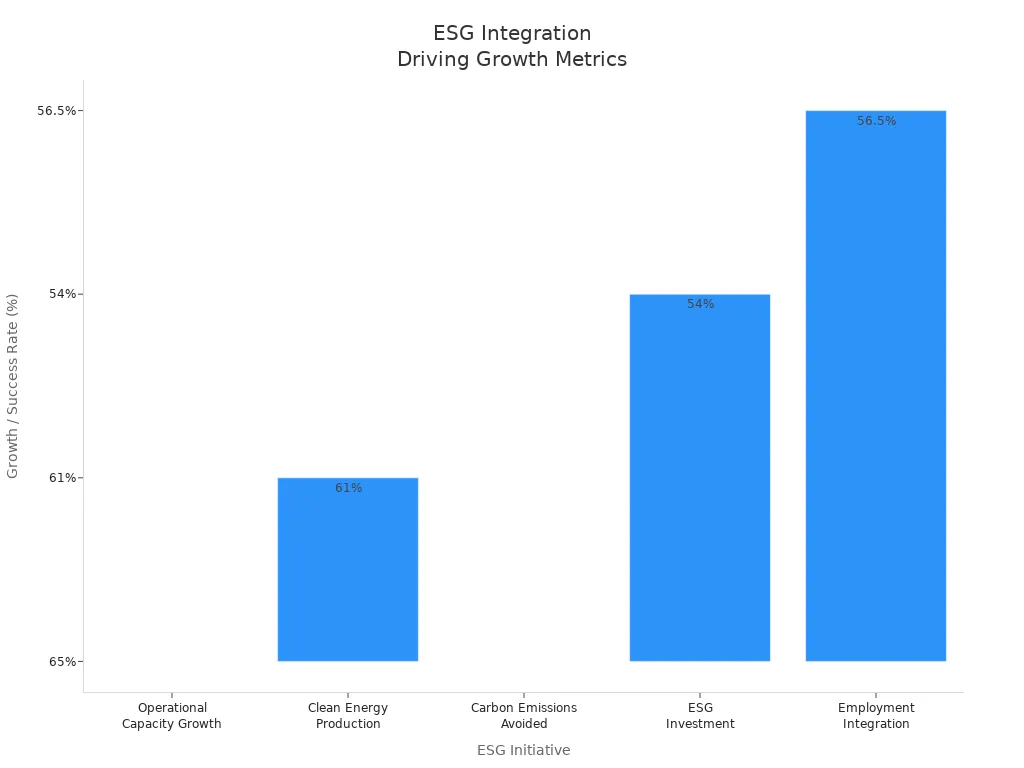
Companies that embed esg into their core operations not only meet regulatory requirements but also position themselves for future market leadership. As the energy sector evolves, esg integration remains essential for driving innovation, supporting resilient investment returns, and fostering sustainable growth.
Integration Steps
Data Collection
Energy companies seeking to integrate ESG scores into equity reports must begin with robust data collection methodologies. The process starts by structuring ESG data using standardized frameworks such as the GHG Protocol or ESRS under CSRD, which ensures comparability across organizations and reporting periods. Companies prioritize the collection of data based on materiality, focusing first on environmental and social metrics that matter most to stakeholders. This approach guarantees that the most relevant information drives decision-making.
A well-organized data collection process often includes several methodologies:
Internal tracking systems capture ESG metrics from operational, HR, and governance databases. For example, energy usage data comes from utility records, while workforce diversity statistics originate from HR systems.
Surveys and questionnaires gather both qualitative and quantitative insights from employees, suppliers, and community stakeholders, providing a holistic view of workplace culture and social impact.
External data sources, such as third-party ESG ratings and regulatory filings, offer benchmarks and transparency for peer comparison.
AI-powered ESG analysis tools extract insights from reports, disclosures, and unstructured data, improving accuracy and compliance assessment.
Centralizing ESG data in a single platform reduces fragmentation and enhances management efficiency.
Expert-validated AI models align data across frameworks, ensuring accuracy and traceability.
Key stakeholders—including executives, compliance teams, sustainability officers, and investors—participate in the process to guarantee comprehensive and reliable reporting.
Automated ESG data analysis with AI streamlines data processing and increases reporting reliability.
A leading energy company recently transformed its ESG data collection by automating workflows across multiple sites, including manufacturing and office locations. Automated data collection enabled continuous tracking, while AI-powered analytics identified risks and forecasted trends. This shift allowed the company to focus on sustainability strategy rather than manual data management, demonstrating the value of advanced methodologies in managing complex ESG data.
Transparency remains essential throughout the process. Companies disclose methodologies, use third-party verification, and acknowledge data gaps to build trust with stakeholders. Clear definitions, visualizations, and consistent reporting formats further enhance understanding and legibility.
ESG Reporting Alignment
Once data collection is complete, companies must align ESG data with recognized reporting frameworks to ensure consistency and comparability. Leading energy firms build internal ESG data collection frameworks by designating responsible teams and using centralized systems to standardize and manage information. Early engagement with portfolio companies proves vital; organizations communicate expectations, share reporting metrics, and provide training to ensure consistent methodologies across all entities.
Data quality and validation take center stage in this phase. Companies implement robust internal review processes, often leveraging carbon accounting software to automate calculations and detect anomalies. Some organizations engage third-party auditors to further ensure data integrity. Planning the annual reporting cycle involves setting internal deadlines ahead of submission dates, conducting regular check-ins with portfolio companies, and performing post-submission reviews to identify trends and areas for improvement.
Adopting a programmatic mindset helps organizations integrate ESG reporting into a comprehensive sustainability program. This approach aligns with global frameworks such as GRI, SASB, and TCFD, ensuring adaptability to evolving regulations and methodologies. Consistent alignment with these frameworks not only supports regulatory compliance but also enhances the credibility and comparability of ESG disclosures in energy equity reports.
Analysis & Modeling
With high-quality ESG data and aligned reporting, energy companies turn to advanced analysis and modeling methodologies to integrate ESG scores into equity reports. Industry analysts play a pivotal role, employing both traditional and cutting-edge techniques to extract actionable insights.
Machine learning has become a cornerstone of ESG analysis in the energy sector. Analysts use models such as random forests, decision trees, and neural networks to predict ESG scores and financial performance. For instance, random forest algorithms applied to company financials and sector-specific data have achieved high accuracy in ESG score prediction. Deep learning models, particularly those using natural language processing, classify ESG-related news articles and predict financial outcomes with impressive precision. These methodologies enable pattern recognition in large ESG datasets, early identification of risks and opportunities, and continuous refinement of predictions. Analysts also use machine learning to automate ESG scoring, detect real-time controversies, analyze supply chain risks, and perform sentiment analysis, all of which contribute to more objective and forward-looking ESG assessments.
In addition to AI-driven approaches, companies employ a variety of modeling techniques to integrate ESG factors into equity analysis:
Directed graph neural networks model ESG-driven industrial value chain dynamics, capturing complex interrelations in the energy sector.
Fuzzy-based multi-criteria decision-making (MCDM) models, incorporating AI techniques such as M-SWARA, QPFR, and VIKOR, evaluate ESG factors under uncertainty.
Hybrid fuzzy methods like SF-AHP-WASPAS combine fuzzy logic with analytic hierarchy processes to handle uncertainties in ESG evaluations.
Discounted Cash Flow (DCF) models adjust cash flow projections and discount rates to reflect ESG risks and opportunities.
Relative valuation methods incorporate ESG premiums or discounts in valuation multiples, such as price-to-earnings or price-to-book ratios.
ESG factors are integrated into the Weighted Average Cost of Capital (WACC), influencing borrowing costs and equity premiums.
Scenario analysis uses ESG-related scenarios to test impacts on cash flows and terminal values.
Probabilistic forecasts and multi-criteria decision tools like Fuzzy-TOPSIS provide robust frameworks to address ESG complexity and sector-specific materiality.
Analysts who combine active fundamental strategies with ESG risk and opportunity assessment, supported by AI and machine learning, deliver more nuanced and forward-looking equity analysis. This integration of methodologies ensures that ESG considerations are embedded in every stage of the investment process, from data collection to final valuation.
By embracing these methodologies, energy companies and analysts can transform ESG data into actionable intelligence, supporting innovation, adaptability, and strategic growth. The integration of ESG scores into energy equity reports not only enhances transparency and risk management but also positions organizations for long-term success in a rapidly evolving market.
ESG Challenges
Data Quality
Energy companies face persistent challenges with data quality when integrating esg scores into equity reports. Many practitioners express skepticism about the reliability and standardization of esg data, especially when environmental criteria play a critical role in valuation. Survey results reveal that 31% of organizations use multiple esg data providers to cross-validate information, while 66% have developed internal esg scoring systems due to dissatisfaction with external methodologies. The lack of standardized approaches for collecting, measuring, and reporting esg metrics leads to comparability issues across firms. This fragmentation reduces confidence in esg’s impact on firm valuation, particularly in sectors where environmental factors drive strategic decisions. Companies often struggle to gather precise esg data, with 83% expecting difficulties due to complex processes spanning multiple departments and locations. Standardizing measurement tools and leveraging automation technologies such as AI can improve data accuracy and streamline management. Staff training, regular audits, and third-party verification further enhance the credibility of esg disclosures.
Reliable esg data forms the foundation for meaningful equity analysis and supports informed decision-making in the energy sector.
Standards & Consistency
Organizations encounter significant obstacles in maintaining consistency across esg standards, especially when operating in diverse energy markets. Regulatory requirements differ by region, and evolving frameworks add complexity to esg reporting. Companies address these challenges through several strategies:
Adoption of globally recognized esg reporting standards such as GRI, SASB, and ISSB ensures consistent and comparable disclosures.
Implementation of esg compliance software consolidates key metrics, automates data collection, and aligns reporting with global regulations.
Rigorous assessment of regional regulatory requirements helps organizations proactively manage esg risks and avoid penalties.
Development of clear esg policies and sustainability goals embeds esg principles into business operations.
Regular audits, stakeholder engagement, and investment in esg training programs build internal expertise and support continuous improvement.
The regulatory landscape continues to evolve, with initiatives from authorities in the UK, Japan, and Brazil driving companies to harmonize esg practices globally. These approaches help mitigate challenges posed by lack of standardization and ensure reliable esg disclosures.
Overcoming Barriers
Energy companies face several barriers when integrating esg scores into equity reports. High costs, tight deadlines, and uncertainty about applicable esg frameworks often overwhelm internal staff. Collecting accurate and relevant esg data presents additional challenges, while fear of negative publicity from poor esg performance can discourage transparency. Companies overcome these obstacles through careful planning and prioritization of essential esg metrics. Many utilize free or low-cost resources and templates, seek advice from industry associations, and collaborate with peer organizations. Leveraging established esg reporting frameworks such as GRI and SASB provides structure and clarity. Internal audits and supplier engagement ensure comprehensive data collection, while embedding esg into business operations supports strategy alignment and sustainable practices. Centralizing esg data in a single hub and democratizing access improves integration and usability. Automated data quality checks, robust governance, and alignment with regulatory frameworks such as CSRD enhance compliance and reduce risk.
Start small and secure sponsorship for esg initiatives.
Define clear KPIs and leverage proven platforms for quick wins.
Invest in technology solutions like AI and blockchain to improve data accuracy and transparency.
Overcoming esg challenges requires a commitment to continuous improvement, collaboration, and innovation. Companies that address data quality, standardization, and operational barriers position themselves for strategic growth and resilient equity analysis.
Best Practices in ESG Reporting
Case Examples
Industry leaders in the energy sector have demonstrated that integrating esg into equity analysis requires a holistic approach. One multinational energy company established a board-level esg committee, aligning esg principles with its core business strategy. This committee prioritized community well-being, focusing on projects that improved energy access and reduced energy poverty. The company transitioned to low-carbon fuels and invested in renewable energy sources, which enhanced domestic energy security and created long-term economic value.
Another firm adopted recognized frameworks such as GRI and SASB to ensure consistency in esg disclosures. By setting clear, measurable esg goals, the organization tracked progress and demonstrated commitment to stakeholders. The use of centralized technology platforms enabled real-time esg data management, automated workflow mapping, and streamlined risk integration. These practices supported transparent esg reporting and built trust with investors and communities.
Companies that integrate esg into their business objectives and leverage technology platforms achieve operational efficiency, reduce emissions, and foster stakeholder engagement.
Best Practice | Example Implementation |
|---|---|
Community Well-being | Energy access projects in underserved regions |
Accountability & Transparency | Board-level esg committees and public disclosures |
Sustainable Production | Transition to renewables and low-carbon fuels |
Operational Efficiency | Methane reduction and carbon capture initiatives |
Resource Management | Use of recycled water and responsible sourcing |
Lessons Learned
Successful esg integration in energy equity reports reveals several key lessons. Companies must define the scope and material topics by identifying stakeholders and relevant sustainability issues. Comprehensive esg data collection across environmental, social, and governance pillars addresses fragmentation and improves analysis. Aligning disclosures with recognized standards such as CSRD, TCFD, ISSB, SASB, and GRI ensures comparability and regulatory compliance.
Benchmarking esg performance against internal goals and industry standards helps organizations understand their relative standing and prioritize improvements. Transparency remains essential; firms should provide quantifiable, verifiable esg metrics and engage stakeholders in materiality assessments. Linking esg goals to executive incentives drives accountability and strategic focus.
Experts recommend leveraging AI-powered tools to automate compliance, enhance data completeness, and generate strategic insights. Companies that embrace innovation and stakeholder collaboration position themselves for resilient growth and market leadership.
A reflective takeaway emerges: Energy companies that embed esg into their core strategies, invest in technology, and foster transparent stakeholder engagement create lasting value. These practices not only support robust equity analysis but also drive sustainable progress in a rapidly evolving sector.
Integrating esg scores into energy equity reports delivers measurable benefits, including improved transparency, risk management, and strategic alignment. Companies achieve these outcomes by establishing consistent data collection, setting clear esg KPIs, and leveraging technology for real-time tracking.
Key steps include:
Adopting global esg frameworks
Engaging stakeholders
Automating esg data management
As esg reporting evolves, organizations that prioritize comprehensive, actionable, and transparent esg integration will lead the way in sustainable growth and market trust.
FAQ
What are ESG scores, and why do they matter in energy equity reports?
ESG scores measure a company’s performance in environmental, social, and governance areas. Analysts use these scores to evaluate sustainability risks and opportunities. Strong ESG scores help energy companies build trust, attract investment, and support long-term growth.
How do energy companies collect reliable ESG data?
Energy companies use internal tracking systems, surveys, and third-party ratings. They often centralize data on digital platforms and apply AI tools for accuracy. Regular audits and stakeholder engagement improve data quality and transparency.
Tip: Consistent data collection builds credibility and supports better decision-making.
Which ESG reporting frameworks do energy firms prefer?
Most energy firms align with global standards such as GRI, SASB, TCFD, and ISSB. These frameworks provide structure for disclosures and ensure comparability across regions. Adopting recognized frameworks helps companies meet regulatory requirements and investor expectations.
What challenges do companies face when integrating ESG scores?
Companies encounter issues with data quality, inconsistent standards, and high costs. They address these by investing in technology, training staff, and collaborating with industry peers. Overcoming these barriers strengthens equity analysis and supports sustainable business practices.
Reflective takeaway: Companies that embrace ESG integration foster innovation and resilience, shaping a more sustainable future for the energy sector.
ESG Integration: Shaping Sustainable Market Strategies
In today’s evolving investment landscape, long-term wealth creation isn’t just about chasing returns—it’s about understanding the deeper forces shaping markets and aligning with them strategically. Nowhere is this more evident than in the energy sector, where the integration of ESG scores into equity reports has transformed how companies are evaluated and how investors assess opportunity and resilience. With 74% of firms expected to align with TCFD standards in 2024, transparency, risk management, and sustainability have moved from “nice-to-have” to central drivers of market confidence. At VASRO, we approach equity analysis with that same commitment to insight and precision—recognizing that numbers tell only part of the story. By combining rigorous market intelligence with an understanding of environmental, social, and governance dimensions, we see how sustainable practices can influence operational efficiency, stakeholder trust, and ultimately, long-term growth potential. In a sector leading the way with green bonds and renewable innovation, the connection between ESG integration and strategic investing is no longer a trend—it’s a cornerstone of resilient wealth building.
Disclaimer: The information provided on www.vasro.de is for general informational purposes only and does not constitute investment advice or a recommendation to invest in any particular asset or market. VASRO GmbH does not offer personalized investment advice, and the content on this website should not be relied upon as such. Visitors are encouraged to seek independent financial advice tailored to their specific circumstances before making any investment decisions. VASRO GmbH disclaims any liability for investment decisions made based on the information presented on this website. For the data from external sources; VASRO is not liable for accuracy.