


Imagine walking through a hospital where AI-driven olfaction instantly detects subtle changes in air composition, alerting you to infection risks before symptoms appear. You witness how perception of scent becomes data, guiding point-of-care diagnostics and improving patient outcomes. About a quarter of older adults have measurable olfactory impairment, with prevalence rising steeply in advanced age (≈40–60% in 80+). Olfactory impairment is also associated with ~2× higher risk of cognitive decline. By digitizing scent, digital olfaction transforms your perception of safety in cleanrooms and healthcare, making invisible chemical threats visible and actionable.
Table of Contents
Key Takeaways
Digital olfaction uses AI and sensors to turn scents into data, helping detect health risks and contamination early.
In healthcare, this technology enables fast, noninvasive screening/monitoring and may improve care pathways; diagnostic performance remains research-stage pending regulatory review.
Cleanrooms may benefit from real-time air quality monitoring and contamination alerts, ensuring safety and regulatory compliance.
Digital olfaction supports safer environments by making invisible chemical threats visible and actionable.
Though challenges like cost and scent control exist, advances in AI and growing industry adoption promise a bright future for this technology.
Digital Olfaction Technology

What Is Digital Olfaction
You encounter digital olfaction when machines use advanced sensors and artificial intelligence to interpret scent. This technology gives you a new way to understand your environment. For example, Ainos (NASDAQ: AIMD) describes an AI Nose platform that digitizes scents into machine-readable “Smell IDs” via a smell language model (SLM). It uses VOC sensors to detect volatile organic compounds in the air. These compounds often signal changes in health or cleanliness. For example, In women’s health, investigational VOC-based POCT concepts aim to screen for common infections by analyzing scent patterns (clinical development/validation ongoing). You see how olfaction moves beyond human perception and becomes a tool for point-of-care testing and cleanroom monitoring.
Digital olfaction bridges the gap between chemical signals and actionable data. You rely on it to make invisible threats visible, improving your perception of safety and health.
How It Works
You watch as digital olfaction transforms scent into data. Ainos states its platform uses a smell language model (SLM) to create Smell IDs for VOC patterns. This process lets you track and analyze VOC patterns in real time. You notice how olfaction becomes measurable and repeatable. In cleanrooms, digital olfaction monitors air quality and detects contamination before it spreads. In healthcare, it supports point-of-care testing by identifying VOC signatures linked to infections or disease. You benefit from AI olfaction because it enhances your perception of risk and helps you respond quickly.
Key applications you experience:
Early infection detection through VOC sensors.
Automated cleanroom monitoring for contamination.
Women’s health POCT using scent analysis.
Your perception of olfactory signals changes. You no longer rely only on human senses. Digital olfaction gives you a reliable, data-driven approach to safety and diagnostics.
Digital Olfaction in Healthcare
Early Detection
You experience a new era in healthcare where olfaction becomes a powerful tool for early disease detection. Your perception of illness changes as machines analyze breath samples for volatile organic compounds (VOCs). These VOCs act as biomarkers, revealing hidden health risks before symptoms appear. AI olfaction platforms like Ainos AI Nose use advanced sensor arrays and pattern recognition to mimic human olfactory perception. You see how this technology transforms your perception of diagnostics, making noninvasive screening possible.
You benefit from early detection because digital olfaction identifies disease-specific VOCs with high sensitivity and specificity. This approach reduces the need for invasive procedures and speeds up diagnosis.
Research-stage evidence (not regulatory-approved diagnostics): selected studies report promising performance, e.g., 89% sensitivity / 90% specificity distinguishing gastric cancer from benign disease (n=130), and 73–97% sensitivity / 80–98% specificity / 87–92% accuracy in larger validation work.
Study / Author | Sample Size | Disease Focus | Diagnostic Method | Sensitivity (%) | Specificity (%) | Accuracy (%) | Key Findings |
|---|---|---|---|---|---|---|---|
130 | Gastric Cancer (GC) | Nanomaterial sensor + DFA model | 89 | 90 | N/A | Differentiated GC from benign disease; early vs advanced GC sensitivity 89% | |
968 | Gastric Cancer, precancerous lesions | GC–MS and nanoarray + pattern recognition | 73–97 | 80–98 | 87–92 | High accuracy for noninvasive screening and monitoring of GC and lesions |
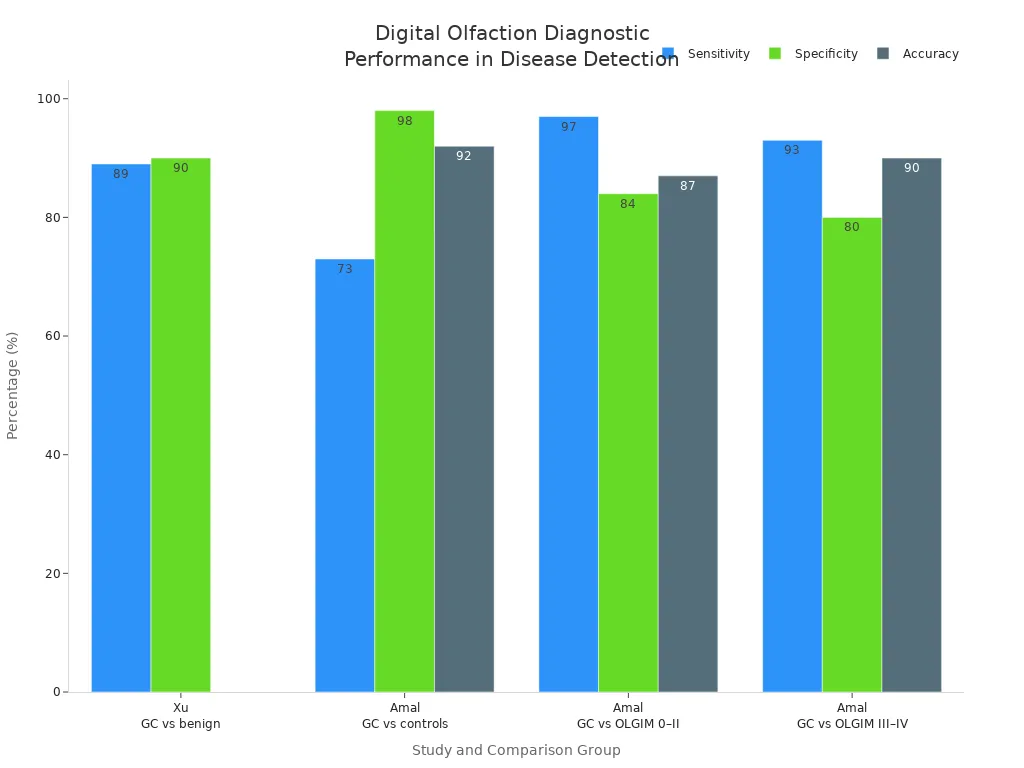
You notice that olfaction-based diagnostics deliver impressive results. Your perception of healthcare shifts as you realize that breath VOC analysis is noninvasive, cost-effective, and safe. You see how digital olfaction expands beyond gastric cancer to other diseases, making early detection accessible.
Patient Monitoring
You rely on olfaction to monitor patient health in real time. Your perception of patient care improves as AI olfaction platforms continuously analyze VOC patterns in hospital environments. Ainos reports robotics integrations (e.g., with ugo service robots) and pilots at seven industrial sites in Japan; healthcare use remains exploratory. You observe how robots equipped with VOC sensors move through patient rooms, collecting scent data and alerting staff to potential infections.
You gain confidence in patient safety because olfaction-based monitoring identifies risks before they escalate. Your perception of hygiene management becomes proactive, not reactive.
You see how olfactory perception helps track patient recovery and detect complications early. In women’s health POCT, olfaction enables point-of-care testing by analyzing scent profiles for infections. Your perception of care quality rises as you witness faster response times and improved outcomes.
Diagnostic Accuracy
You trust olfaction to enhance diagnostic accuracy in clinical settings. Your perception of medical testing changes as AI olfaction platforms interpret complex VOC patterns with precision. Ainos AI Nose uses a smell language model to assign unique Smell IDs to different olfactory perception profiles. You see how this process makes diagnostics measurable and repeatable.
Benefits you experience:
Reliable identification of disease biomarkers.
Consistent results across different environments.
Reduced diagnostic errors due to objective olfactory perception.
You appreciate how olfaction-based diagnostics support point-of-care testing and cleanroom monitoring. Your perception of healthcare becomes data-driven, with machines providing actionable insights. You see how digital olfaction bridges the gap between chemical signals and clinical decisions, improving patient outcomes.
Olfaction in Cleanrooms

Contamination Detection
You step into a pharmaceutical cleanroom. You expect the highest standards of cleanliness. Even a tiny contaminant can disrupt production or compromise safety. Your perception of risk changes when you use AI olfaction platforms like Ainos AI Nose. These systems use VOC sensors to detect invisible chemical signals in the air. You no longer rely only on visual inspections or manual sampling. Instead, you trust olfaction to identify contamination in real time.
Your perception of the environment becomes sharper. The AI Nose platform digitizes scent signatures and assigns unique Smell IDs to different contaminants. You receive instant alerts when the system detects abnormal VOC patterns. This rapid response helps you act before contamination spreads. In microelectronics manufacturing, even a trace of solvent or outgassing can ruin sensitive components. You use olfactory perception to catch these threats early.
Tip: You can integrate AI olfaction with automated robots to patrol cleanrooms, ensuring continuous monitoring and rapid response to contamination events.
You see how olfaction transforms your perception of cleanroom safety. You gain confidence in your ability to maintain strict standards and protect your products.
Air Quality Monitoring
You know that air quality is critical in cleanrooms. Your perception of safety depends on the ability to detect and control airborne threats. With digital olfaction, you monitor VOC levels continuously. The AI Nose platform analyzes air samples and provides real-time data on chemical composition. You use this information to adjust ventilation, filter systems, or sanitise surfaces as needed.
Your perception of air quality becomes data-driven. You no longer guess about the presence of harmful compounds. Instead, you rely on olfactory perception to track changes and spot trends. In pharmaceutical environments, you use this technology to prevent cross-contamination between batches. In microelectronics, you monitor for solvents, acids, or other chemicals that could damage products.
Key benefits you experience:
Early warning of air quality issues
Automated reporting for compliance
Reduced downtime due to faster detection
You see how olfaction supports your efforts to maintain a safe, controlled environment. Your perception of risk management improves as you make informed decisions based on real-time data.
Safety and Compliance
You face strict regulations in cleanroom operations. Your perception of compliance shifts when you use AI olfaction. The AI Nose platform helps you document air quality and contamination events automatically. You generate reports that meet regulatory requirements without manual effort. Your perception of audits and inspections becomes less stressful.
You use olfactory perception to demonstrate that your facility meets industry standards. In pharmaceutical cleanrooms, you show regulators that you monitor for VOCs linked to contamination. In microelectronics, you prove that you control chemical exposure to protect sensitive devices.
Note: Automated olfaction systems help you maintain detailed records, making compliance easier and more transparent.
You see how olfaction not only protects your products but also supports your reputation. Your perception of operational excellence grows as you adopt advanced monitoring tools.
Application Area | Olfaction Role | Example Use Case |
|---|---|---|
Pharmaceutical Cleanroom | Detects VOCs from solvents | Prevents cross-contamination |
Microelectronics | Monitors outgassing | Protects sensitive chip manufacturing |
Robotics Integration | Enables mobile monitoring | Rapid response to contamination alerts |
You realize that digital olfaction is reshaping your perception of cleanroom management. You move from reactive to proactive strategies. You trust olfactory perception to keep your environment safe, compliant, and efficient.
Real-World Impact
Case Studies
You see digital olfaction changing how you manage risk and safety in real-world settings. In semiconductor cleanrooms, you rely on AI-powered electronic noses to monitor VOC patterns. These devices, such as the Ainos AI Nose, digitize scent into Smell IDs and alert you to contamination before it disrupts production. You benefit from real-time anomaly detection and automated compliance reporting. Announced roadmap (ASE Technology Holding): Evaluation ~1,400 units → Phase 1 ~5,000 → Phase 2 up to 15,000, subject to performance and agreements.
Deployment Phase | Unit Targets | Description |
|---|---|---|
Evaluation Phase | ~1,400 units | Initial deployment at major semiconductor sites. In August 2025, Ainos announced a $2.1M order from ASE for 1,400 AI Nose units across three Taiwan sites (Kaohsiung, Zhongli, and SPIL). |
Phase 1 | 5,000 units | Integration across cleanrooms and production zones |
Phase 2 | Up to 15,000 units | Full-scale global rollout |
You notice that olfaction enables predictive safety and strengthens quality control. Machines interpret scent signals with human-like precision, supporting your perception of environmental integrity.
In women’s health, you use discreet VOC sensors for at-home point-of-care testing. These devices analyze olfaction patterns to detect common vaginal infections. You gain privacy and convenience, as the technology provides instant results and supports early intervention. Your perception of personal health management improves, and you trust the data-driven approach.
You experience how olfaction transforms both industrial and healthcare environments, making invisible risks visible and actionable.

Industry Adoption
You observe rapid adoption of digital olfaction across industries. Companies scale solutions for cleanroom monitoring, point-of-care testing, and women’s health POCT. Analyst estimates vary; one firm projects the digital-scent market could reach ~$4.04B by 2027. You see strategic partnerships driving this expansion:
Ainos collaborates with ASE Technology Holding; Kenmec Mechanical Engineering; Solomon Technology; ugo, Inc.
These alliances deploy AI olfaction in semiconductor manufacturing, robotics, and smart factories.
The company describes a ‘SmellTech-as-a-Service’ subscription model for software/analytics updates tied to deployments.
You recognize that olfaction platforms deliver continuous upgrades, cloud analytics, and scalable performance. Your perception of industry standards evolves as digital olfaction becomes essential for safety, compliance, and health monitoring.
You face adoption barriers such as integration and regulatory approval, but near-term use cases in cleanroom monitoring and women’s health POCT show strong promise.
Future and Challenges
Current Barriers
You face several challenges as you bring olfaction technology into healthcare and cleanrooms. Digital olfaction remains less mature than technologies for sight or sound. This means you may see some limits in reliability and scalability, especially when you compare it to more established sensory systems. High initial costs for scent diffusion systems and fragrance libraries can make adoption difficult, particularly for smaller organizations. You might also notice that controlling and replicating scents across different environments is not always easy. Some scents dissipate quickly or unevenly, which requires frequent adjustments to maintain accuracy. These issues can affect the consistency you need for dependable healthcare or cleanroom monitoring. Despite these barriers, you see rapid progress in artificial intelligence and machine learning. These advances promise better scent control and more precise olfaction, which could soon improve applications in mental health, wellness, and infection detection.
Trends and Opportunities
You stand at the edge of a new era for olfaction in healthcare and manufacturing. AI olfaction platforms now analyze VOC patterns to detect infections or environmental risks before they become visible. You use VOC sensors for point-of-care testing, women’s health POCT, and cleanroom monitoring. These tools help you spot problems early, protect patients, and keep production lines safe. You see more hospitals and factories adopting digital olfaction as part of their safety protocols. Cloud-based analytics and SmellTech-as-a-Service models make it easier for you to scale deployments and access real-time data. As regulatory pathways become clearer, you can expect faster approval and broader use of olfaction systems in clinical and industrial settings.
Tip: Stay alert for new partnerships and pilot programs that expand the reach of olfaction technology. These efforts will drive improvements in accuracy, reliability, and compliance.
What to watch next
You should watch for larger-scale deployments of digital olfaction in hospitals and cleanrooms. Accuracy will continue to improve as AI models learn from more VOC data. Regulatory agencies are working on clear guidelines, which will help you adopt olfaction systems with confidence. As you follow these trends, you will see olfaction become a standard tool for early detection, safety, and compliance.
Digital olfaction is changing how you approach healthcare and cleanroom monitoring. You now use VOC sensors and AI olfaction to detect infections, manage air quality, and support point-of-care testing. Ainos leads this shift with the AI Nose platform:
Digitizes scent into Smell IDs for machine analysis
Integrates multi-sensor arrays and a smell language model
Supports applications in women’s health POCT, hospital infection control, and semiconductor cleanrooms
You see adoption barriers, but near-term use cases show strong promise for safer, smarter environments.
FAQ
What is digital olfaction and how does it work?
You use digital olfaction to let machines detect and interpret scents. VOC sensors capture chemical patterns in the air. AI olfaction platforms analyze these patterns, turning them into data. This process helps you identify risks in healthcare and cleanroom monitoring.
How can VOC sensors improve point-of-care testing?
You rely on VOC sensors to detect disease markers in breath or body fluids. These sensors enable point-of-care testing by providing fast, noninvasive results. You get early warnings about infections, which helps you act quickly and improve patient outcomes.
Why is digital olfaction important for cleanroom monitoring?
You need digital olfaction to spot contamination before it spreads. AI olfaction systems monitor VOC levels in real time. You receive instant alerts about changes in air quality, which helps you maintain strict standards in cleanroom environments.
What role does digital olfaction play in women’s health POCT?
You use digital olfaction for women’s health POCT to detect infections through scent analysis. VOC sensors identify unique chemical patterns linked to specific conditions. This technology gives you privacy, convenience, and reliable results at home or in clinics.
Can digital olfaction help with regulatory compliance?
You benefit from digital olfaction because it automates air quality tracking and reporting. You generate detailed records for audits. This makes it easier for you to meet regulatory standards in healthcare and manufacturing settings.
Devices and use cases described are investigational and may not be cleared/approved for clinical diagnosis. Performance figures reference research studies and company disclosures.
Disclaimer: The information provided on www.vasro.de is for general informational purposes only and does not constitute investment advice or a recommendation to invest in any particular asset or market. VASRO GmbH does not offer personalized investment advice, and the content on this website should not be relied upon as such. Visitors are encouraged to seek independent financial advice tailored to their specific circumstances before making any investment decisions. VASRO GmbH disclaims any liability for investment decisions made based on the information presented on this website. For the data from external sources; VASRO is not liable for accuracy.