


The pharmaceutical industry is under increasing scrutiny when it comes to sustainable business practices. Investors today value transparent ESG criteria because these factors make long-term risks and opportunities visible. An ESG-driven equity report provides the opportunity to systematically include sustainability ratings in the analysis of pharmaceutical companies. Transparency in ESG reporting strengthens investor trust and supports sound investment decisions.
Key Insights
ESG criteria help investors identify sustainable pharmaceutical companies and better assess long-term risks.
Pharma companies must give equal consideration to environment, social responsibility, and good governance to be successful.
An ESG-driven equity report makes sustainability ratings comparable, supporting better investment decisions.
Companies with strong ESG performance often demonstrate better financial results and gain the trust of investors.
Consistent integration of ESG criteria promotes innovation, reduces risks, and strengthens sustainable development in the pharma sector.
ESG and Pharma

ESG Criteria
The pharmaceutical industry is at the center of societal expectations regarding sustainable business. Companies in this sector are guided by clearly defined ESG criteria that go far beyond mere environmental aspects. Key environmental criteria include waste reduction, minimizing pollution, combating climate change, and investing in renewable energy. Social criteria cover respectful treatment of employees and customers, diversity, inclusion, human rights, and fair pay. Governance criteria relate to company structure, board diversity, risk management, and adherence to ethical standards.
Environment: Waste production, carbon footprint, environmentally friendly manufacturing and transport.
Social: Fair pay, affordable drug pricing, policies against child and forced labor.
Governance: Transparency, anti-corruption policies, ethical business practices.
An ESG-driven equity report systematically considers these criteria and makes them comparable for investors. The alignment with the Sustainable Development Goals (SDGs) helps companies address ecological, social, and ethical challenges and ensure long-term sustainability. Topics such as climate protection, equality, and decent work are gaining importance and shape the expectations of investors, patients, and society.
Industry Specifics
The pharmaceutical industry differs in many ways from other sectors. Its direct impact on health and the environment makes ESG criteria especially relevant. The production of pharmaceutical ingredients is energy-intensive and generates significant amounts of waste – about 100 kilograms of waste per kilogram of active ingredient. The industry’s emissions intensity even exceeds that of the automotive sector.
Environmental aspects: Energy-intensive production, chemical and plastic waste, greenhouse gas emissions, antibiotic pollution.
Social responsibility: Access to medicines, pricing, health equity, diversity in clinical trials.
Governance: Strict regulatory requirements, transparency, ethical business practices.
Pharmaceutical companies face unique challenges. They must manage complex, global supply chains responsible for 70% of healthcare sector emissions. The reliance on ingredients from India and China poses risks due to climate disruptions. Extreme weather can cause delays and quality risks. Companies respond with process optimization, investments in renewable energy, and integration of sustainability into their organizational structures.
A thoughtful approach to ESG criteria not only opens up new opportunities for the pharmaceutical industry, but also strengthens the trust of investors and society. Those who understand ESG as a strategic lever can promote both sustainable growth and social acceptance.
ESG-Driven Equity Report in Pharma Portfolios
Integrating Sustainability Ratings
An ESG-driven equity report forms the foundation for a systematic and quantifiable integration of sustainability ratings into the analysis and selection of pharma stocks. Analysts use various ESG ratings from specialized providers like Sustainalytics and Refinitiv. Since these providers use different scales and assessment methods, experts statistically transform the data to ensure comparability.
First, ESG ratings are transformed to make them comparable on a uniform scale.
Next, analysts use Monte Carlo simulations to test the impact of key assumptions on ESG scores. They examine various aggregation formulas, such as arithmetic or geometric mean, and vary the weighting of ESG components.
Sensitivity analyses supplement this uncertainty analysis and reveal which assumptions have the greatest impact.
The choice of data provider has the strongest influence on the ESG rating, while weighting changes are only significant with major adjustments.
The analysis confirms that the “best-in-class” strategy, where only the top companies by ESG score are selected, is particularly robust.
An ESG-driven equity report uses these systematic approaches to make pharma stock selection objective and transparent. The additive aggregation method used by many providers allows full compensation between environmental, social, and governance components. However, this practice is criticized because the individual ESG areas often correlate little, potentially overlooking important risks.
Pharmaceutical companies quantify their ESG performance through industry-specific ratings such as the S&P Global Corporate Sustainability Assessment (CSA) or ISS Governance ratings. These methods combine company disclosures, media analysis, and stakeholder surveys with model-based estimates. A double materiality approach evaluates both societal/ecological impacts and company-specific value drivers. This creates a comprehensive view of ESG risks and opportunities compared to industry peers. Analysts can thus identify companies that not only meet regulatory requirements but also generate sustainable value.
The UN Sustainable Development Goals (SDGs) play a central role in pharma ESG reporting. They provide a normative framework that encourages companies to extend their reporting beyond core activities. The SDGs establish a common language and legitimate standard, fostering transparency and comparability. Pharma companies align their sustainability and health initiatives with relevant SDGs to document their contribution to global health security. Examples such as the development of COVID-19 vaccines or innovative supply chain solutions show practical SDG implementation. Still, there is potential to further standardize reporting and comprehensively incorporate all SDGs.
The SDGs help pharma companies link their sustainability activities to global health goals.
They promote transparency, comparability, and trust among investors and stakeholders.
Companies can address interconnected challenges such as antibiotic resistance or emergency preparedness via the SDGs.
An ESG-driven equity report that leverages these systematic methods and international frameworks gives investors a solid foundation for sustainable investment decisions.
ESG Performance as a Quality Factor
ESG performance is increasingly becoming a crucial quality factor in pharma stock selection. Studies show a largely positive or at least non-negative correlation between ESG indicators and financial metrics such as Return on Assets (ROA), Return on Equity (ROE), and Tobin’s Q. Companies with strong ESG performance often achieve higher stakeholder satisfaction and benefit from better long-term financial results. Stakeholder theory provides the theoretical basis: those who consider the interests of all stakeholders increase economic success.
Nearly 90% of scientific studies confirm a non-negative relationship between ESG progress and financial performance.
The positive effect remains stable over time and is supported by a value-oriented company approach.
ESG controversies can negatively affect financial performance, making effective risk management essential.
An ESG-driven equity report makes these relationships transparent and helps investors establish quality and sustainability as key selection criteria. The average ESG scores in pharma show there is still significant room for improvement. Companies that actively improve their ESG performance not only strengthen their market position but also make a vital contribution to the sustainable development of the healthcare sector.
A thoughtful approach to ESG criteria opens new perspectives for portfolio analysis. Those who consistently use an ESG-driven equity report can identify risks early, seize opportunities, and promote sustainable value creation. Integrating ESG performance as a quality factor builds trust and lays the groundwork for a future-proof investment strategy.
Opportunities and Challenges
Potential for Investors
Integrating ESG criteria into pharma portfolios opens up numerous opportunities for investors that go far beyond traditional return expectations. Systematically including sustainability in analysis allows targeted responses to future issues and enhances value creation in the portfolio. The main potentials can be summarized as follows:
Investors use materiality analyses to specifically identify key ESG risks and opportunities, such as CO2 emissions, labor practices, or governance structures.
They integrate ESG programs early after investment to train management teams and promote sustainable value creation.
Regular training and updates on regulatory requirements enhance portfolio knowledge and adaptability.
Industry-specific training and ESG conferences foster knowledge sharing and responsibility.
ESG officers at management level embed sustainability into corporate strategy long-term.
Improved risk management through consideration of ESG factors across the entire drug development process.
Innovations are driven by sustainable business models and new technologies.
Resource-efficient methods lead to cost savings and free up resources for R&D.
Responsible actions strengthen reputation and brand value.
Compliance with regulations makes market access easier and increases approval chances.
Investors gain better access to capital as ESG performance increasingly becomes a decision criterion.
Long-term value creation results from sustainable health solutions that reach disadvantaged groups as well.
Those who use ESG as a strategic lever can not only minimize risks, but also drive sustainable innovation and societal progress.
Risks and Goal Conflicts
Despite the many opportunities, risks and goal conflicts remain a central issue in ESG integration in the pharma sector. Scientific analyses show that ESG risks have significant impacts on the healthcare sector. Investors must recognize these risks early and manage them strategically. They integrate ESG aspects into risk assessment and encourage companies to pursue continuous improvement. ESG ratings such as MSCI’s Intangible Value Assessment (IVA) or the RepRisk Reputational Risk Index (RRI) offer differentiated insights into ESG risk exposure and management.
Pharmaceutical companies implement specific measures, such as CO2 emission targets, diversity in clinical trials, and increased product safety. Transparent reporting frameworks like GRI or SASB create comparability and trust. However, conflicts arise when short-term economic interests collide with long-term sustainability goals. Balancing return and responsibility remains a demanding task. Investors benefit from systematically assessing ESG risks and encouraging responsible business conduct.
Consistent integration of ESG criteria requires foresight and the willingness to openly address goal conflicts. Those who follow this path lay the foundation for sustainable success and social acceptance.
Methods and Tools

ESG Ratings
In the pharma sector, ESG ratings play a key role in making sustainable corporate governance measurable and comparable. The most influential ESG rating agencies are MSCI, Sustainalytics, ISS, and S&P Global. These “Big Four” use a materiality-driven approach, focusing on sector-specific factors like access to medicine, product quality, talent development, and human rights. Other notable providers like Bloomberg, CDP, and FTSE Russell supplement the landscape with real-time data, environmental profiles, and ESG index construction.
Sustainalytics: Focuses on ESG risks, integrated with Morningstar, covers over 15,000 companies
Bloomberg ESG Data: Real-time ESG data, alternative sources, user-friendly dashboards
CDP: Environmental and climate data, close collaboration with regulators
S&P Global: Links ESG with credit ratings, real-time monitoring
FTSE Russell: ESG index construction, influence on passive investment flows
An ESG-driven equity report uses these ratings to identify companies with strong ESG performance. High ESG scores signal ethical business practices, strong governance, and social responsibility. Investors see in them companies that pursue sustainable strategies and actively manage risks such as litigation or reputation loss.
Data Sources
The quality of ESG assessment depends largely on the diversity and depth of data sources. Pharma companies use internal documents, ESG reports, technical documentation, and interviews with key personnel. They utilize dashboards and scorecards to continuously monitor ESG performance.
Internal company documents
ESG reports
Technical documents
Interviews with key personnel
Data visualization dashboards
Stakeholder questionnaires
Quantitative data from big data analytics
Data from manufacturing, supply chain management, and regulatory fields
A two-stage double materiality approach involves internal and external stakeholders. First, employees, management, and investors identify relevant ESG topics. Then, customers, suppliers, and community partners prioritize sustainability aspects. This comprehensive perspective forms the basis for data-driven decisions and credible ESG communication.
Limits of Assessment
Despite technological progress, ESG assessments in pharma face clear limits. Different assessment standards and lack of sector-specific frameworks hinder comparability. Many companies prioritize short-term goals like product delivery and profitability, often at the expense of ESG measures.
Limited ability to pass on ESG costs
Complex testing and approval processes delay ESG innovations
Different ESG maturity levels depending on company size and location
Social criteria often underrepresented
Lack of standards for sector-specific issues such as access to medicines
Analysts address the subjectivity of ESG scores through transparency, integrating ESG goals into corporate strategy and partnering with external actors. Nevertheless, the challenge of ensuring objective and consistent evaluations remains. A thoughtful ESG-driven equity report acknowledges these limits and uses them as a starting point for continuous improvement. Accepting complexity allows targeted promotion of sustainable value creation in the pharma portfolio.
Implementation in the Portfolio
Analysis Process
A structured analysis process forms the backbone for integrating ESG scores into pharma portfolios. Analysts start by selecting and collecting relevant ESG data from various sources. They use external providers such as Sustainalytics or MSCI for an initial evaluation of governance, environmental, and social factors. Data quality and reliability are paramount. Analysts thoroughly review and verify the data to provide a solid foundation for further analysis.
Next, ESG factors are integrated into fundamental company analysis. Analysts weight and aggregate individual ESG indicators into a consistent overall score. They consider industry-specific challenges and adjust weightings to the peculiarities of pharma. Investment decisions are based on a comprehensive assessment of both ESG risks and opportunities. Analysts continuously monitor ESG scores at portfolio level and compare them to benchmarks to minimize risks and optimize returns.
An ESG-driven equity report supports this process by creating transparency and increasing comparability between companies.
Step-by-step guide:
Collect and verify ESG data from third-party providers.
Weight ESG indicators and aggregate into an overall score.
Integrate ESG factors into fundamental analysis.
Make investment decisions considering ESG risks and opportunities.
Ongoing engagement with company management to promote ESG improvements. 6. Continuous monitoring of ESG scores in the portfolio and comparison with benchmarks.
Selection Criteria
The selection of pharmaceutical companies for a sustainable portfolio is based on clearly defined ESG criteria. Analysts focus on transparency, innovation, and the ability to take on social responsibility. Companies that pursue ambitious climate goals, implement sustainable practices, or improve access to medicines receive higher weightings in the portfolio.
The following table shows examples of successful ESG integration in the pharmaceutical sector:
Company | ESG Focus and Practical Examples |
|---|---|
Johnson & Johnson | Healthy communities programs, transparent ESG goals |
Novo Nordisk | Climate neutrality targets, energy-efficient facilities |
AstraZeneca | Stakeholder engagement, diversity, responsible sourcing |
Merck & Co. | Transparent environmental and social data, materiality assessment |
Roche | Sustainable product development, access to medicines |
GlaxoSmithKline (GSK) | Access to medicines in developing countries, community initiatives |
Pfizer | Focus on health equity, data-driven ESG reporting |
These practical examples show how an ESG-driven equity report supports the selection of sustainable investments. Analysts can identify companies that not only meet regulatory requirements but also actively contribute to the sustainable development of the healthcare sector.
Those who consistently integrate ESG criteria into the analysis process lay the foundation for a future-proof and responsible portfolio.
Regulation and Trends
Regulations
Regulatory requirements for pharma companies in ESG are evolving rapidly. New rules by the US SEC require listed companies, including pharma firms, to comprehensively disclose climate-related risks. These include physical risks to assets and supply chains, industry-specific climate risks, and the environmental impacts of medicines. The SEC also plans to require investment advisors to include ESG criteria in their decisions. This increases the pressure on pharma companies to provide detailed and transparent ESG data. Disclosures on human capital management and board diversity are also in greater focus, expanding reporting obligations and increasing the risk of ESG-related litigation.
In Europe, the Corporate Sustainability Reporting Directive (CSRD) and Corporate Sustainability Due Diligence Directive (CSDD) are leading to much stricter sustainability reporting and due diligence requirements. Large EU and some non-EU companies will need to report in detail on environmental, social, and governance aspects. Implementation into national law may result in minor differences between member states, but the trend is clear: ESG reporting is becoming mandatory, not voluntary. Companies above certain thresholds for employees, revenue, or balance sheet total are subject to these requirements. The EU directives are part of the Green Deal and make ESG an integral part of corporate governance.
Pharma companies face the challenge of continuously adapting disclosure obligations to new regulatory standards while ensuring transparency and credibility.
Market Trends
The market for ESG investments in pharma is growing rapidly. Increasing environmental regulations and societal expectations are driving this development. Companies are using ESG strategies to lower costs, minimize risks, and strengthen relationships with investors and customers. Sustainable methods help reduce energy and water use, packaging costs, and waste. At the same time, they lower vulnerability to supply chain disruptions and strengthen financial risk control.
The sector is increasingly integrating ESG principles into its value chains. Since the pandemic, topics such as water and waste management, sustainable supply chains, and emissions reduction have become even more important. Improved ESG reporting and governance are key to sustainable transformation. Companies that prioritize ESG as a core strategy benefit from cost savings, better access to capital, and stronger brand reputation.
The following table illustrates the rising demand for ESG-compliant pharmaceutical products and the benefits of ESG leadership:
Indicator | Value / Statement |
|---|---|
Share of pharma investors prioritizing ESG performance | 82% |
Higher market value of ESG leaders compared to compliance only | +34% |
Improvement in employee retention for ESG leaders | +41% |
Increase in patient satisfaction for ESG leaders | +23% |
Top 10 pharma companies’ ESG investments vs. industry average | 3x higher |
Share of pharma companies with mandatory ESG reporting (2025) | 89% |
Increase in ESG reporting in Asia (2023 to 2024) | from 45% to 73% |
Value creation by ESG leadership (vs. compliance) | +2.3 billion € |
Operating cost reduction by ESG leadership | -23% |
Increase in market share through ESG leadership | +15% |
Increase in employee satisfaction through ESG leadership | +40% |
Reduction in supply chain risks by ESG leadership | -35% |
Share of pharma companies prioritizing ESG initiatives as core strategy | 82% |
Share of companies with ESG committees | 73% |
Share of executives confirming ESG responsibility | 91% |
Investment in ESG programs (2024) | 15% of annual budget (average) |
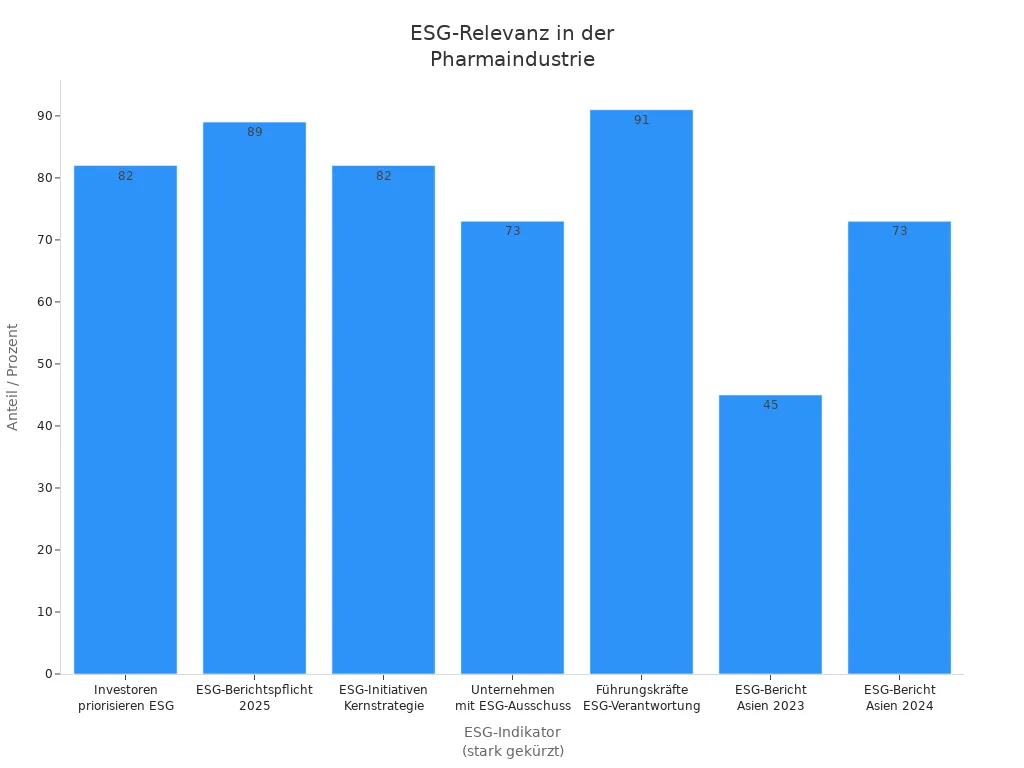
Those who recognize regulatory developments and market trends early can use ESG as a real competitive advantage and actively help shape the sustainable transformation of the sector.
Opportunities and Risks
Performance
The integration of ESG criteria into pharma portfolios has a significant impact on long-term performance. Companies actively addressing ESG challenges often achieve better results than their competitors. Analysts note that sustainable strategies not only strengthen risk management but also drive innovation and cost efficiency. Investors prioritizing ESG are more willing to accept short-term profit declines when companies focus on long-term value creation.
ESG integration promotes sustainable financial performance and value creation.
Companies that communicate their ESG plans transparently win the trust of investors and stakeholders.
A clear ESG focus helps avoid short-term thinking and prevents value-destructive actions such as cutting R&D.
Patient investors support sustainable strategies, even if short-term profits fluctuate.
Consensus-based ESG frameworks improve comparability and strategic planning in the portfolio.
ESG integration strengthens risk management, innovation, regulatory compliance, and reputation.
Companies that anchor ESG as a core part of their strategy lay the foundation for sustainable success and a stable market position.
Greenwashing
Greenwashing is one of the biggest challenges in ESG integration. Companies that only pretend to be sustainable risk significant reputational and regulatory risks. Investors must be particularly vigilant and take steps to identify and avoid greenwashing.
Transparent reporting and third-party verification increase credibility.
Critical evaluation of ESG ratings and certifications prevents misjudgments.
Continuous monitoring of ESG regulations ensures compliance.
High-quality ESG data from portfolio companies validate sustainability claims.
Clear, measurable sustainability goals strengthen accountability.
Internal ESG policies and regular audits promote integrity.
Thorough supply chain risk assessment via due diligence protects against hidden issues.
Using established regulatory frameworks such as SFDR increases transparency.
Companies engaging in greenwashing risk not only their brand image but also legal consequences and setbacks in ESG progress. Lack of comparability and incomplete data complicate assessment and can undermine investor trust in the long term.
A thoughtful approach to ESG risks and honest, transparent communication form the foundation of sustainable portfolio strategies. Those who follow these principles create not just value, but also trust – laying the foundation for long-term success.
ESG integration in pharma portfolios creates measurable benefits for investors and society. Those who systematically implement sustainability criteria not only strengthen risk management, but also drive innovation and trust. Investors achieve the best results by observing these steps:
Diagnose relevant ESG commitments using international frameworks.
Measure ESG metrics early and integrate them into corporate management.
Identify areas for improvement and set quantitative goals.
Ensure transparency through regular reporting.
Promote sustainable manufacturing processes and social responsibility.
Continuous review and openness are the foundation of sustainable success. Those who see ESG as an opportunity actively shape the future of a responsible healthcare sector.
FAQ
What does ESG mean in the pharmaceutical sector?
ESG stands for Environmental, Social, and Governance. In the pharmaceutical sector, ESG evaluates how companies assume ecological responsibility, comply with social standards, and are managed ethically. These criteria help investors identify sustainable and future-ready companies.
How do ESG criteria affect stock selection?
Analysts use ESG criteria to systematically assess risks and opportunities. Companies with strong ESG performance often demonstrate more innovation and lower reputational risk. Investors prefer such companies because they tend to operate more stably and responsibly in the long run.
What role do the UN Sustainable Development Goals (SDGs) play for pharma companies?
The SDGs provide a global framework for sustainable development. Pharmaceutical companies use these goals to align their strategies. They foster transparency, strengthen investor trust, and support the development of sustainable health solutions.
How can investors identify greenwashing in pharma?
Investors look for transparent reports, independent audits, and clear ESG goals. They check whether companies implement concrete measures and regularly document progress. A critical look at data sources and certifications helps avoid greenwashing.
What are the benefits of an ESG-driven portfolio in pharma?
An ESG-driven portfolio reduces risks, promotes innovation, and strengthens stakeholder trust. Companies with strong ESG performance often achieve better financial results and secure long-term competitive advantages. Sustainability thus becomes a driver of strategic growth.
Those who consistently address ESG questions create the basis for sustainable investments and a responsible future in healthcare.
Vision Creates Value
In a world where markets are fast-moving and uncertainties are ever-present, a sound, long-term understanding of wealth creation is becoming increasingly important. Sustainable prosperity rarely results from short-term impulses – rather, it is well-thought-out strategies based on thorough analysis and a clear view of structural developments that matter. This is where VASRO comes in: With sharp market insight and a methodical approach to equity research, VASRO helps investors think beyond the day-to-day. Especially in sustainable pharma investments, it is crucial to integrate environmental, social, and governance aspects into analysis at an early stage. Those who see ESG factors as part of comprehensive market evaluation not only better recognize risks – but also the companies that actively drive change. Long-term financial success is not based on predictions, but on precision, insight, and the courage to address trends with vision.
Disclaimer: The information provided on www.vasro.de is for general informational purposes only and does not constitute investment advice or a recommendation to invest in any particular asset or market. VASRO GmbH does not offer personalized investment advice, and the content on this website should not be relied upon as such. Visitors are encouraged to seek independent financial advice tailored to their specific circumstances before making any investment decisions. VASRO GmbH disclaims any liability for investment decisions made based on the information presented on this website.