


The current top 5 AI stocks are Nvidia, Microsoft, Meta, Palantir, and Tesla. These companies impress with their innovative strength, high market shares, and strong growth potential in the field of artificial intelligence. Nvidia and Microsoft lead with market capitalizations of around $4 trillion each, while Meta, Palantir, and Tesla stand out for their strategic investments and technological developments. The following table shows the current market situation:
Company | Market Capitalization | Recent Performance / Remarks |
|---|---|---|
Nvidia | Approx. $4 trillion | Leading in AI, “Nvidia Stock Enjoys Its $4-Trillion Crown” |
Microsoft | Approx. $4 trillion | Exceeded earnings expectations, nine consecutive weeks of gains |
Tesla | Not explicitly stated | Recent price decline, competition from XPeng, Xiaomi with record registrations |
Meta | N/A | No specific AI-related market data or performance info available |
Palantir | N/A | No specific AI-related market data or performance info available |
Companies and governments worldwide are investing heavily in AI. Between 2013 and 2024, the US alone invested around $471 billion in AI technologies. The following graphic shows the distribution of investments by countries and application sectors:
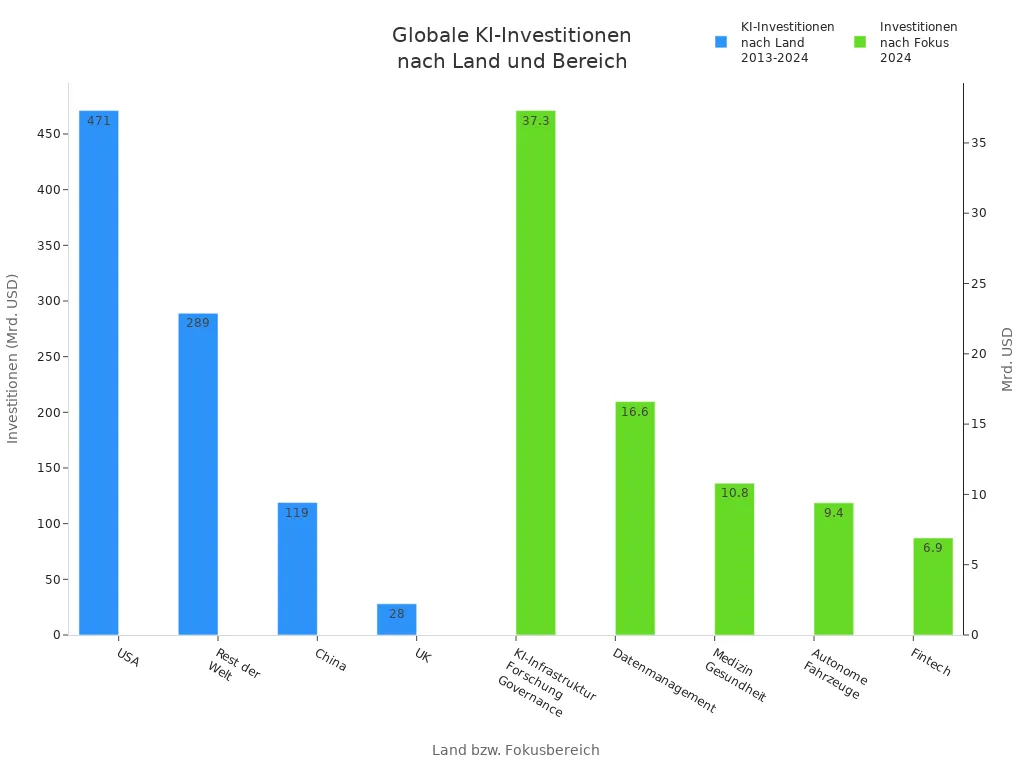
This momentum underscores the opportunities for investors in the technology sector when betting on market-leading AI stocks.
Key Insights
The top 5 AI stocks – Nvidia, Microsoft, Meta, Palantir, and Tesla – lead the market with strong innovation and significant growth potential.
Nvidia and Microsoft dominate with powerful hardware and cloud platforms, while Meta, Palantir, and Tesla stand out for specialized AI solutions and strategic partnerships.
Investments in AI technologies are rising sharply worldwide, offering investors many opportunities but also risks like high valuations and market volatility.
Each company has unique strengths and challenges, so broad diversification and a long-term perspective are important for investors.
The future of AI stocks promises dynamic growth but also requires a sound understanding of technology, market trends, and regulatory frameworks.
Top 5 AI Stocks at a Glance

Selection Criteria
The selection of the top 5 AI stocks is based on a combination of innovation, market position, and growth potential. Nvidia convinces as the dominant provider of AI hardware with a market share of over 90 percent for data center GPUs. Microsoft is heavily investing in AI infrastructure and offers one of the most comprehensive global platforms with Azure AI. Meta integrates AI services into its social networks, reaching almost a billion active users. Palantir stands out for its role as a provider of AI software and hardware for governments and companies, while Tesla is regarded as a pioneer in AI-supported electric vehicles, even though the company is currently facing challenges in growth and innovation.
Company | Key Innovations | Market Position |
|---|---|---|
Nvidia | Hopper and Blackwell GPUs, NVLink, Quantum InfiniBand | Leader in the AI hardware market |
Microsoft | Azure AI, infrastructure investments | Leader in cloud and AI services |
Meta | AI integration in social networks | Leader in AI applications in social media |
Palantir | AI software, government contracts | Innovator with strong government contracts |
Tesla | AI-powered vehicles, energy storage | Market leader with operational challenges |
The top 5 AI stocks stand out for their ability to identify technological trends early and turn them into market-ready products. Historical performance data shows that companies like Nvidia and Palantir have achieved extraordinary returns in recent years. For example, Palantir increased its share price by over 1,400 percent in three years, while Nvidia achieved a 943 percent return in the same period. This development highlights the importance of founder leadership and an innovation culture for sustainable success.
Market Trends
Current market trends are significantly shaping the development of the top 5 AI stocks:
The regulatory environment, such as initiatives like the “AI Action Plan,” creates new frameworks and can benefit large tech companies.
The semiconductor industry is experiencing strong growth due to increasing demand for AI chips for cloud computing and data centers.
Cloud computing remains a key growth driver, especially for providers like Microsoft, Amazon, and Google.
The market is increasingly shifting from developing new AI models to applying and executing (“inferencing”) AI solutions.
Software companies are focusing more on autonomous AI agents and data management, with varying stock performance in this segment.
Meta is specifically investing in data preparation and its own AI applications, highlighting the importance of data quality for AI success.
Competition from new players such as OpenAI and specialized start-ups creates additional momentum and can challenge existing business models.
The top 5 AI stocks benefit from these trends by responding flexibly to market changes and strategically deploying their innovation. This creates an exciting environment for investors that offers both opportunities and risks.
Nvidia
Strengths
Nvidia is at the center of the AI revolution and, as a market leader, is shaping the development of hardware for artificial intelligence. The company dominates with a market share of 80 to 90 percent in the field of AI accelerator chips. Especially in the data center segment, Nvidia’s strength is evident: In the first quarter of fiscal 2026, Nvidia generated sales of $39.1 billion, representing 73 percent year-over-year growth. GPU models such as the A100, H100, and the new Blackwell series are considered industry standards for training large AI models.
The comprehensive software ecosystem, consisting of platforms like CUDA, CuDNN, and TensorRT, makes work easier for developers worldwide and fosters innovation. Partnerships with leading cloud providers and automotive manufacturers further strengthen the company’s position. A gross margin of over 78 percent underlines its pricing power, while annual R&D investments of around $7 billion secure its technological leadership. Demand for Nvidia chips remains high, and production for the coming year is already sold out. CEO Jensen Huang is pursuing a visionary strategy for data-driven data centers with the concept of “AI factories.”
Strength / Area | Details / Figures |
|---|---|
Market Share AI Accelerators | 80–90% |
Revenue Data Center Q1 FY2026 | $39.1 billion, +73% YoY |
GPU Models | A100, H100, Blackwell Series |
Software Ecosystem | CUDA, CuDNN, TensorRT |
Partnerships | AWS, Azure, Google Cloud, Mercedes-Benz, Toyota |
Gross Margin | Over 78% |
R&D Investments | Approx. $7 billion annually |
Demand & Production | 2025 production sold out |
CEO Vision | “AI Factories” |
Risks
Despite its impressive market position, Nvidia faces significant risks. Export controls and trade restrictions between the US and China could lead to revenue losses, as seen with the H20 chip, where a potential loss of $8 billion looms. New tariffs and countermeasures increase supply chain costs and could cause GPU prices to rise by up to 15 percent. Competition from companies like Huawei and new AI models from China is increasing and could intensify margin pressure. Analysts also express concerns about Nvidia’s high valuation, which increases the risk of price corrections. Production bottlenecks with new chip generations like Blackwell carry uncertainties for supply capability. Geopolitical tensions and unclear regulatory developments increase volatility and complicate long-term forecasts.
Risk | Description | Impact |
|---|---|---|
US-China Trade Restrictions | Export controls, e.g., $8 billion revenue loss for H20 chip | Significant revenue losses, uncertainty |
Tariffs and Countermeasures | Increased supply chain costs, GPU price increases by 10-15% | Margin pressure |
Competition | Strong competition from Huawei, DeepSeek | Loss of market share, margin pressure |
Valuation | Risk of price corrections | |
Production Bottlenecks | Uncertainties with Blackwell chips | Delivery bottlenecks, delays |
Geopolitical Uncertainties | Unclear US-China relations, stricter regulations | Increased volatility, business model risk |
Nvidia remains a prime example of innovation and strategic foresight in the tech sector. Anyone dealing with the top 5 AI stocks will recognize both exceptional opportunities and the need to always keep an eye on risks.
Microsoft
Strengths
Microsoft is one of the key players in the global AI market, excelling through a unique combination of technological breadth and strategic depth. The Azure cloud platform forms the backbone of Microsoft’s AI strategy and acts as a global operating system for businesses. In the third quarter of fiscal 2025, Azure generated $26.8 billion in revenue, with 16 percentage points of growth directly attributed to AI services. Azure’s comprehensive service portfolio, including Azure Machine Learning, Cognitive Services, and Applied AI Services, appeals to a wide user base and offers high reliability and security.
The tightly integrated Microsoft ecosystem, consisting of Windows, Office, Azure, and Dynamics, creates high switching costs for enterprise customers. This integration fosters customer loyalty and strengthens the market position. Microsoft positions Azure as a neutral “AI supermarket” with access to over 1,700 foundation models, including OpenAI and other competitors. This openness increases flexibility for companies and reduces dependency on individual providers. Market data shows Microsoft leads with a 62% market share in generative AI enterprise projects. The AI engagement rate of 45% is well above the cloud market share of 29%, indicating a disproportionate use of AI services.
Innovations such as the “Copilot+ PC” ecosystem combine powerful hardware with AI-powered software, enabling unique, locally accelerated AI experiences. Massive investments of over $80 billion in a global, AI-optimized data center infrastructure create high barriers to entry and secure Microsoft’s long-term leadership. Analysts rate Microsoft’s platform strategy and market leadership in AI very positively.
Microsoft demonstrates how sustainable innovation, a strong ecosystem, and targeted investments shape the development of the top 5 AI stocks.
Risks
Despite its impressive market position, Microsoft faces significant challenges. The massive investments in AI infrastructure, totaling over $80 billion, represent a substantial financial risk. Building and expanding data centers and ensuring stable power supply require enormous resources and time. Demand for AI services currently exceeds available capacity, which limits growth potential in the short term.
The recent restructuring and layoffs mainly affect areas considered less relevant to the AI strategy. However, these measures can cause instability and alienate valuable talent. The focus on AI-generated code and productivity increases also carries the risk that job cuts could hinder long-term growth.
Another risk factor arises from increasing competition from new players such as the Chinese DeepSeek engine. These companies can achieve comparable AI results with lower budgets and put Microsoft under pressure to further boost innovation and efficiency.
Risk | Description |
|---|---|
Financial burden | High investments in infrastructure, slow data center expansion |
Capacity limits | Demand exceeds available resources |
Job cuts | Risk of alienating talent, potential growth drag |
Competition | New providers like DeepSeek increase innovation pressure |
Microsoft’s development in the AI sector shows that sustainable growth depends not only on technological strength, but also on strategic adaptability and risk management. Anyone seeking to understand the dynamics of the top 5 AI stocks should always keep this balance in mind.
Meta
Strengths
Meta has established itself as one of the most dynamic innovators in the field of artificial intelligence. The company uses its enormous user base of 3.4 billion daily users to implement AI-powered improvements in advertising and content recommendations. This reach creates a unique data pool that enables the development and training of advanced AI models. In the second quarter of 2025, Meta reported a revenue increase of 22 percent to $47.5 billion and a profit jump of 36 percent to $18.3 billion. These impressive figures underline the financial resources Meta is channeling into AI projects.
Meta invests between $66 and $72 billion annually in AI infrastructure, including servers and data centers.
The company offers top salaries of over $100 million to attract leading AI talent from competitors such as OpenAI and Google.
Over $14 billion went to the AI company ScaleAI, whose CEO Alexandr Wang is now shaping Meta’s AI development.
The AI strategy is based on two pillars: developing superintelligence to solve complex problems, and personalized superintelligence for everyday life.
Analysts praise the balance between profitability and investments, as Meta maintains a conservative debt ratio of 15.58 percent despite high spending.
Share prices reacted positively to the recent quarterly results and rose by more than 10 percent.
This consistent focus on innovation and talent development gives Meta a strong position among the top 5 AI stocks. The ability to combine financial strength with visionary technology sets the company apart in global competition.
Risks
Despite its impressive progress, Meta faces significant challenges in the AI market. Risks range from technological and ethical issues to strategic and cultural uncertainties.
Meta is reducing disclosure of its most advanced AI models for security and ethical reasons. This aims to prevent misuse and loss of control but could hamper external research and innovation.
Technological challenges affect the development of powerful deep learning algorithms, advanced language processing, and computer vision. The complexity of these tasks increases the risk of failure.
Ethical risks arise from potential biases, misuse, and unintended consequences of powerful AI systems. Meta is investing in safety protocols and ethical reviews.
High turnover and a “culture of fear” within the company make it harder to integrate research findings into market-ready products.
Massive investments in infrastructure and talent are heavily dependent on the advertising business. A drop in ad revenues could jeopardize the financial sustainability of Meta’s AI initiatives.
Meta is pursuing several technological paradigms at once, which can lead to a lack of focus and potential misinvestments.
The risks show how challenging the path to an AI-driven future remains. Meta must balance innovation and responsibility to be successful in the long term. Anyone tracking the development of the top 5 AI stocks can see that sustainable growth depends not only on technology but also on corporate culture and strategic clarity.
Palantir
Strengths
Palantir has established itself as one of the leading innovators in artificial intelligence and data analytics. The company is notable for its ability to integrate and analyze massive and complex datasets from a wide variety of sources in real time. The Foundry and Gotham platforms enable companies and government agencies to analyze data at the petabyte level and extract actionable insights. The ontology, a semantic layer, sets Palantir apart from other providers. It ensures that AI solutions are not isolated but are deeply embedded in customers’ operational processes.
An impressive example is the collaboration with BP. With Palantir Foundry, BP was able to optimize its oil and gas operations, leading to $1 billion in savings. The platform enabled predictive maintenance and a significant increase in efficiency. Such case studies demonstrate how Palantir, through advanced analytics and intelligent data integration, not only reduces costs but also elevates decision-making to a new level.
In Q1 2025, Palantir recorded impressive revenue growth of 71 percent in the US commercial sector, driven by the launch of the Artificial Intelligence Platform (AIP). The strategy of partnering with hyperscalers like AWS and offering cloud-agnostic solutions strengthens its position as a neutral and secure partner for companies worldwide. Among the top 5 AI stocks, Palantir plays a special role as a bridge-builder between data, AI, and operational excellence.
Palantir demonstrates how technological depth and practical solutions help companies generate real value from data.
Risks
Palantir’s business model and AI strategy also carry specific risks:
Strong dependence on AWS with obligations of $1.95 billion per year poses the risk of vendor lock-in and complicates scalability.
Compared to other tech companies, Palantir invests only 17 percent of its revenue in R&D, which could impair long-term innovation.
General administrative expenses are about 20 percent of revenue, well above the industry average, indicating efficiency issues.
High customer concentration – 45 percent of revenue comes from the 20 largest customers – makes the company vulnerable to the loss of major contracts, even though many government contracts are considered stable.
Political and regulatory risks arise from close collaboration with governments. Changes in the political landscape or stricter data protection requirements could lead to contract losses or adjustments.
The stock is valued at 56 times expected sales. This assumes that Palantir will achieve extraordinarily strong growth for years, which seems ambitious.
Anyone considering Palantir as part of the top 5 AI stocks should focus not only on innovation but also on structural challenges and dependence on political frameworks. A thoughtful approach to opportunities and risks is essential to use the potential of AI investments responsibly.
Tesla
Strengths
Tesla is one of the most innovative companies in AI-powered mobility. Recent advances show how consistently the company is pursuing its AI strategy. The partnership with xAI in particular sets Tesla apart from other players. This collaboration enables the use of advanced AI models that optimize sensor fusion and the processing of sensor data from cameras, radar, and ultrasound. The integration of adaptive energy management algorithms based on reinforcement learning provides predictive battery management and increases range by up to five percent.
Tesla uses a hybrid AI architecture that processes latency-critical tasks like emergency braking directly in the vehicle, while extensive analyses are performed in the cloud.
The experienced Tesla AI team works closely with xAI researchers to continuously improve autonomous driving features, voice assistants, and predictive maintenance.
Pilot projects from 2023 show concrete progress: 12 percent fewer interventions during lane keeping in difficult lighting conditions, eight percent better detection of hidden vehicles, and a 0.3-second faster response time for adaptive cruise control.
These improvements were achieved solely through software updates, underlining the flexibility and scalability of Tesla’s AI solutions.
The multi-phase implementation plan includes proof of concept, pilot fleets, scaled integration, and continuous optimization using federated learning.
The partnership with xAI allows Tesla to diversify its technology base and open up new revenue streams through AI-powered vehicle functions.
Tesla demonstrates how continuous innovation, strategic partnerships, and an agile development team secure its position among the top 5 AI stocks.
Risks
Tesla faces significant challenges in autonomous driving. The technological complexity remains high, as former AI head Andrej Karpathy also points out:
Andrej Karpathy, former head of Tesla AI, warns that autonomous driving is not solved yet and fully autonomous vehicles are not expected in the near future. His expertise underlines the technological challenges Tesla faces.
Liability risks arise because accidents with autonomous vehicles are inevitable. The decision to rely solely on camera sensors could have legal consequences.
There is uncertainty whether the camera-only strategy is based on sound data or driven more by leadership decisions. This could affect the safety and effectiveness of the technology.
Competitors such as Waymo and Uber rely on multi-sensor fusion and have broader partnerships. This gives them advantages in interpreting complex traffic situations.
The legal landscape is developing more slowly than the technology. This creates uncertainties for the launch and operation of autonomous vehicles.
Stock performance shows that Uber has outperformed Tesla since the start of Tesla’s robotaxi pilot program. This demonstrates increasing competitive pressure in the market for autonomous mobility.
Tesla remains a pioneer, but the road to fully autonomous vehicles is fraught with uncertainties and risks. Anyone following the development of the top 5 AI stocks will recognize that technological leadership alone is not enough. A thoughtful approach to regulatory, ethical, and market-specific challenges will determine long-term success. The future of mobility demands innovation and responsibility—and the willingness to learn from setbacks.
Comparison
Key Figures
A structured look at the most important financial metrics helps objectively compare the top 5 AI stocks. The following table summarizes key metrics such as revenue, growth, and P/E ratio, showing how different the companies are in terms of size, valuation, and momentum:
Company | Revenue (Q1 2025) | Revenue Growth (YoY) | Net Profit | P/E Ratio | Remarks |
|---|---|---|---|---|---|
Meta | 16% | $16.6 billion (35% increase) | 28 | High investments in AI, strong cash position | |
Palantir | N/A | approx. 31% annually | N/A | 261–690 | Very high valuation despite growth, risky |
Nvidia | N/A | N/A | N/A | approx. 56 | Industry standard for semiconductors, AI demand drives P/E |
Microsoft | N/A | N/A | N/A | N/A | High AI spending, no specific figures |
Tesla | N/A | N/A | N/A | N/A | No detailed financial data available |
The table shows that Meta impresses with solid profits and a moderate P/E ratio, while Palantir stands out for its strong growth but very high valuation. Nvidia benefits from AI demand but has a high industry-standard P/E. Microsoft and Tesla offer less transparent financial data, making comparison harder.
Unique Features
Each of the top 5 AI stocks has unique features that set it apart from competitors:
Company | Unique Features / Competitive Advantages |
|---|---|
Meta | Open-source LLM Llama 2, AI studios for advertising, in-house chips, focus on AI content |
Tesla | Leader in autonomous driving, Dojo supercomputer, robotics, licensing FSD software |
Nvidia | Market leader in AI hardware, strong partnerships, comprehensive software ecosystem |
Microsoft | Azure as AI supermarket, integration of OpenAI, strong cloud infrastructure |
Palantir | Deep data integration, ontology technology, strong government contracts |
Different investor types can focus on different aspects. Investors with a long-term horizon and high risk tolerance will find Meta, Nvidia, and Microsoft attractive, as these companies impress with innovation and strong quarterly results. Those aiming for exceptional growth and willing to accept valuation risks can consider Palantir. Tesla appeals to visionary investors who believe in the future of autonomous mobility and can tolerate short-term fluctuations.
A thoughtful look at key figures and unique features helps find the right stock for your own portfolio. The diversity of the top 5 AI stocks creates opportunities for different strategies and risk profiles.
Opportunities and Risks
Opportunities
The development of AI stocks opens up a wide range of exciting possibilities for investors. Industry forecasts show that the market for AI investments benefits from several strong growth drivers:
Democratization of access to advanced investment tools in emerging markets. Affordable, scalable, and efficient predictive AI solutions foster financial inclusion.
Integration of AI with big data analytics and cloud computing. This combination enables robust and scalable financial models, gaining broad acceptance in the financial sector.
Continuous learning models and real-time data analysis improve forecasting accuracy and allow quick responses to market changes.
Institutional investors, algorithmic trading, and solution-oriented AI offerings are key drivers of market growth.
The USA and North America play a leading role, supported by advanced technology infrastructure and intensive investments in AI research.
Algorithmic trading is growing particularly strongly, as machine learning and deep learning enable rapid and precise trading strategies.
AI improves decision-making and risk management, leading to higher returns and better hedging against market fluctuations.
AI investments not only provide access to innovative technologies but also the chance to benefit from global trends and new markets. Anyone exploring the potential of AI stocks will recognize the dynamism and diversity of possibilities.
Risks
Despite the promising outlook, AI stocks carry significant risks that investors should not underestimate. Market analysts point out that high volatility can lead to rapid and significant price fluctuations. Choosing the right companies remains challenging, as not all AI firms will grow equally strongly. Studies show that AI-powered financial advice often exhibits the same cognitive biases as human advisors. For example, AI portfolios tend to overweight US stocks and technology shares, increasing risk. Conflicts of interest arise when AI tools are programmed by financial firms to serve the providers’ interests rather than investors’. Platforms like Robinhood have shown with their AI investment solution Cortex that real-time analysis and trading suggestions can lead to risky behavior. Without clear regulatory guidelines, there is a danger that AI systems could amplify systemic risks and discrimination.
Not all AI companies will succeed, making selection challenging.
A long-term focus helps ride out short-term fluctuations.
Anyone investing in AI stocks should carefully weigh opportunities and risks. A thoughtful approach, diversification, and patience form the basis for sustainable success in a dynamic market environment.
Trends and Outlook

Artificial intelligence remains the defining theme of the global technology landscape. Investors are watching as AI stocks redefine the infrastructure of the digital world. Tony Kim, a renowned technology investor, sees AI as a lasting investment theme far beyond short-term trends. Current investments focus on the foundational layer—powerful chips and cloud infrastructure form the basis for the next generation of AI models and applications. This development is reflected in the capital spending of major hyperscalers, which is expected to surpass $200 billion for the first time in 2024. Companies that invest early in this infrastructure secure key competitive advantages, even if short-term returns are not always visible.
The momentum in the AI market is driven not only by established tech giants. International companies and new start-ups play a major role in shaping innovation:
In 2024, global AI deal value surged by 52% to $131.5 billion.
Almost half of US venture capital flowed into AI start-ups focused on customer-oriented solutions and sustainable business models.
Major international players are investing in profitable applications, while AI-native companies often impress with significant revenue growth.
Value creation is increasingly shifting to end-customer applications that simplify human experiences and business processes.
The diversity of players and the pace of innovation create a dynamic environment that offers both opportunities and challenges for investors.
Investors have numerous opportunities to participate in AI growth. In addition to individual stocks, specialized ETFs offer diversified access to the sector. The following table provides an overview of selected AI ETFs and their key metrics:
ETF Name | 1-Year Return | Expense Ratio | Fund Size | Top Holdings |
|---|---|---|---|---|
iShares Future AI and Tech ETF (ARTY) | 23.7% | 0.47% | $1.1 billion | AMD, Vertiv, Broadcom, Nvidia |
Global X Robotics & AI ETF (BOTZ) | 5.0% | 0.68% | $2.7 billion | Nvidia, ABB, Intuitive Surgical |
Global X AI & Technology ETF (AIQ) | 22.6% | 0.68% | $3.6 billion | Tencent, Netflix, Palantir |
WisdomTree AI & Innovation ETF (WTAI) | 18.1% | 0.45% | $209.6 million | Palantir, Broadcom, Nvidia, Meta |
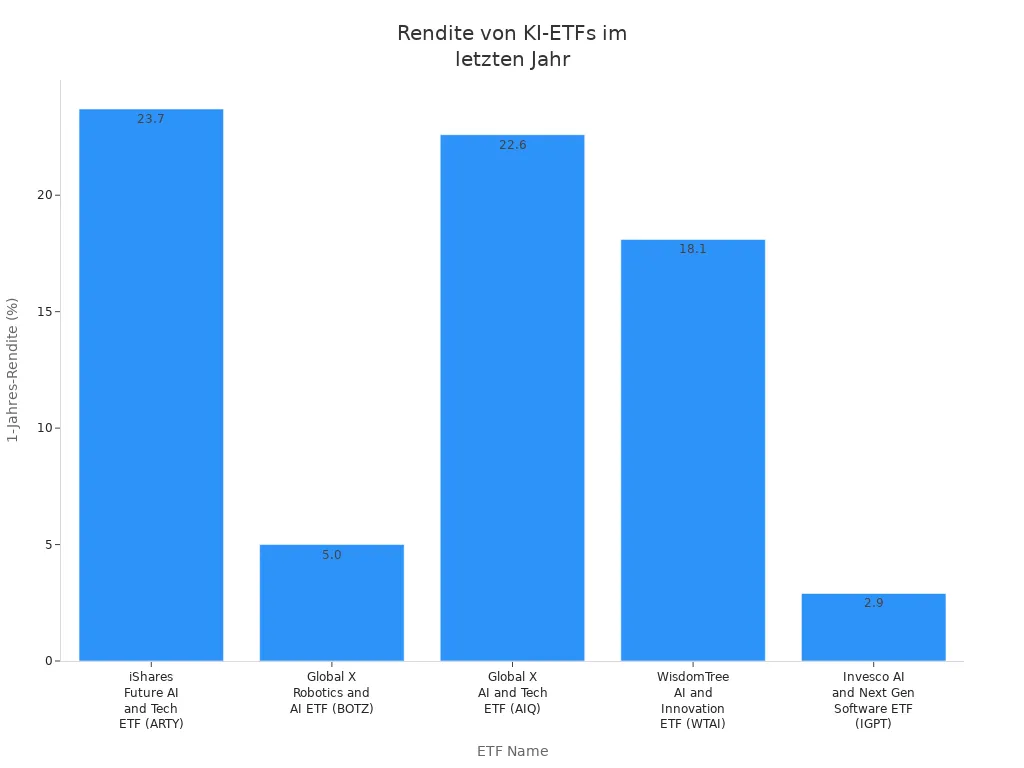
These funds make it possible to benefit from the entire AI value chain—from semiconductor manufacturers to software developers to infrastructure providers. Forecasts indicate that the global AI market could grow by 27 to 36 percent annually to up to $1.8 trillion by 2030. Anyone investing in AI today is participating in one of the most exciting innovation cycles of our time.
The future of AI stocks remains promising, but requires investors to have vision, diversification, and a willingness to actively accompany technological upheaval. Those who understand the change can spot tomorrow’s opportunities today.
The analysis of the top 5 AI stocks shows clear differences in valuation, market position, and growth prospects:
Company | Special Features | ||
|---|---|---|---|
Palantir | 574 | Strong growth, but expensive | High risk |
Nvidia | 46 | Market leader in AI processors | Strong growth |
Microsoft | 36 | Leader in cloud business, OpenAI partnership | Solid growth |
Meta | N/A | Mixed performance | |
Tesla | N/A | Fundamental challenges | Weak performance |
Long-term investors with a high risk tolerance benefit from dynamic stocks like Palantir or Nvidia, while Microsoft offers stability. Opportunities arise from innovation and global trends, risks from high valuations and market dynamics. Those who want to dive deeper can use research tools, thematic portfolios, or expert newsletters to actively track developments in the AI sector.
FAQ
What distinguishes AI stocks from classic tech stocks?
AI stocks are characterized by their focus on artificial intelligence and data-driven innovation. They invest specifically in research, infrastructure, and applications that enable machine learning and automation. Classic tech stocks often rely on established IT solutions and less on disruptive AI technologies.
What role does diversification play in investing in AI stocks?
Diversification reduces the risk associated with individual companies. Investors who combine various AI stocks or specialized ETFs benefit from different innovation cycles and market opportunities. This creates a balanced portfolio that can better absorb fluctuations in individual stocks.
How do regulatory developments affect the AI stock market?
Regulatory requirements such as data protection laws or export controls have a direct impact on business models and growth opportunities. Companies that respond flexibly to new rules gain competitive advantages. However, strict regulations can slow down innovation and change market dynamics.
Are AI stocks suitable for long-term investors?
Long-term investors benefit from the innovative power and growth potential of leading AI companies. Those with patience who can withstand market fluctuations can participate in the development of new technologies and business models. A long-term approach supports sustainable wealth creation.
What risks should investors especially consider with AI investments?
Investors should keep an eye on technological, regulatory, and market-specific risks. High valuations, rapid price movements, and uncertainties in implementing new technologies can lead to losses. Careful analysis and regular portfolio review help manage risks.
Growth with Foresight: Navigating the AI Innovation Landscape
In a world where technological innovations set the pace of change, it’s more important than ever to keep the big picture in mind when building wealth. Anyone interested in long-term wealth development currently encounters no topic more often than artificial intelligence—be it in everyday life, in business, or on financial markets. The top 5 AI stocks, including industry giants like Nvidia, Microsoft, Meta, Palantir, and Tesla, exemplify the dynamism and opportunities in the technology sector. They combine innovative strength, strong market positions, and impressive growth potential, while their stories also show how closely opportunities and challenges are linked in the future AI market. VASRO sees itself as a partner for in-depth analysis and guidance in these volatile markets—with the goal of providing clear context and carefully observing market trends. Anyone interested in sustainable wealth building today will find valuable guidance in sound information and thoughtful perspective shifts on the path to long-term financial success.
Disclaimer: The information provided on www.vasro.de is for general informational purposes only and does not constitute investment advice or a recommendation to invest in any particular asset or market. VASRO GmbH does not offer personalized investment advice, and the content on this website should not be relied upon as such. Visitors are encouraged to seek independent financial advice tailored to their specific circumstances before making any investment decisions. VASRO GmbH disclaims any liability for investment decisions made based on the information presented on this website.