

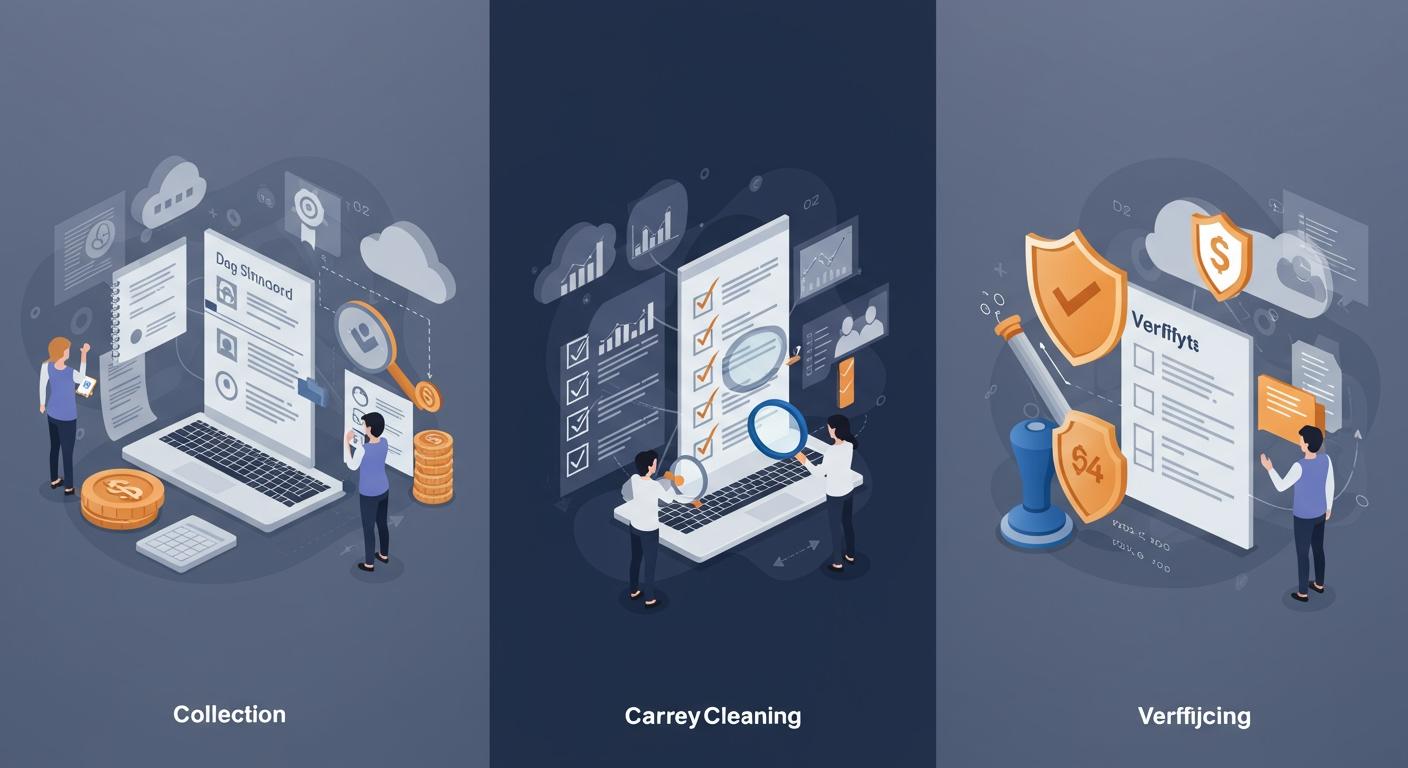
You rely on data that upholds integrity, accuracy, and trust when making financial decisions. To achieve this, you must Source Financial Data from systems that meet high standards, then clean and verify it with care. Each step ensures your financial data remains consistent and accurate, supporting your analysis and reporting. Automation and technology play a key role in maintaining integrity and accuracy. Recent industry studies highlight the importance of human oversight, audit trails, and continuous monitoring. These practices help you safeguard the accuracy of your financial records and maintain the integrity of your analysis.
Table of Contents
Key Takeaways
Start with reliable data sources to ensure accuracy in financial analysis.
Use automation tools to streamline data cleaning and reduce manual errors.
Implement quality checks to verify the integrity of your financial data.
Regularly reconcile financial records to maintain accuracy and transparency.
Document data lineage to track the origin and changes of your financial data.
Establish strong governance policies to ensure data consistency and compliance.
Utilize advanced tools like APIs and ETL solutions for efficient data management.
Conduct ongoing audits to uphold data quality and support strategic growth.
Source Financial Data

When you gather financial data, you need to start with reliable data sources. The quality of your analysis depends on the accuracy and consistency of the information you collect. You can find trustworthy data in both internal systems and external market data.
Reliable Data Sources
Internal Systems
You often gather financial data from your own organization’s systems. These include accounting systems, ERPs, databases, and cloud platforms. Each system plays a unique role in data preparation and data integration. The table below shows the most common sources you might use:
Source Type | Description |
|---|---|
Accounting Systems | Manage financial transactions and reporting. |
ERPs | Integrate core business processes for unified data. |
Databases | Store structured data for easy access and management. |
Cloud Platforms | Offer scalable resources for storage and processing. |
Spreadsheets | Organize and analyze data, often used for calculations and reporting. |
Data Warehouses | Centralize structured data for reporting and compliance. |
Data Lakes | Store raw and unstructured data for advanced analytics and real-time processing. |
External Market Data
You also gather financial data from external sources. Market reports, regulatory filings, and third-party data providers offer valuable insights. These sources help you track trends, benchmark performance, and support equity analysis or market intelligence.
Tip: Always evaluate your data sources for accuracy, consistency, transparency, timeliness, and comprehensiveness. Reliable sources align with your decision-making needs and deliver timely updates.
Data Collection Methods
APIs
Modern data collection relies on APIs. You use APIs to gather financial data securely and efficiently from multiple platforms. APIs support real-time data integration and reduce manual errors.
Automated Feeds
Automated feeds streamline the process when you gather financial data from banks, exchanges, or other institutions. These feeds update your systems automatically, ensuring your data preparation stays current and accurate.
APIs: Secure, real-time access to financial data.
Direct Connections: Establish secure links with financial institutions.
Automated Feeds: Deliver continuous updates for seamless data integration.
Screen scraping once played a role in data collection, but you now rely on more secure and regulated methods.
Data Security
Privacy Compliance
You must protect sensitive information when you source financial data. Privacy laws and regulations set strict standards for handling personal and financial data. The table below highlights key regulations:
Regulation | Description | Key Requirements |
|---|---|---|
GDPR | EU data protection law | Lawful processing, data minimization, individual rights, security, accountability |
CCPA | California privacy law | Consumer rights, data access, deletion, opt-out, non-discrimination |
PCI DSS | Payment card security standard | Compliance validation, risk assessments, security controls |
ISO/IEC 27001 | Information security management standard | Risk-based approach, security policies, continuous monitoring |
Secure Transfers
You ensure secure transfers by using encryption and secure protocols. This protects your data during transmission and storage. You also follow global and regional privacy laws, such as GDPR in Europe, CCPA in California, and PIPEDA in Canada.
Note: Strong security and compliance practices build trust and support innovation in financial data management.
By following these best practices, you create a foundation for accurate data preparation and reliable financial analysis.
Data Cleaning
You strengthen your financial analysis by cleaning data with precision and care. Data cleaning transforms raw information into a reliable foundation for reporting, forecasting, and strategic growth. You face challenges such as data complexity, volume, legacy infrastructure, and silos. Addressing these issues helps you maintain high data quality and supports innovation in your organization.
Standardization
Standardization ensures that every piece of financial data follows a consistent format and structure. You create a unified view that supports equity analysis and market intelligence.
Format Consistency
You start by aligning formats across all sources. Consistency in naming conventions, currency tags, and date formats reduces confusion and improves clarity. You use account mapping files to organize account-level information and facilitate updates. Templates and macros save time and minimize errors, while source labeling allows you to trace data back to its origin.
Description | |
|---|---|
Account Mapping File | Organize account-level data and enable efficient updates. |
Naming Conventions | Use standardized names for entities, dates, and accounts. |
Source Labeling | Tag sources for easy traceability and verification. |
Templates | Start projects with reusable templates for uniformity. |
Macros and Automation Tools | Simplify setup and reduce manual effort. |
Standardize Naming and Formatting | Align names and formats before analysis begins. |
Outline a Clear Structure | Define logical layouts for easy navigation and organization. |
Consistency in format and structure builds trust in your financial data and supports effective data validation.
Data Structures
You define clear data structures to organize information logically. A well-structured databook guides you through analysis and reporting. You outline a logical layout, grouping related fields and aligning essential names and formats. This approach improves consistency and makes it easier to navigate complex datasets.
Use account mapping files to understand business nature and facilitate updates.
Establish consistent naming conventions to enhance clarity and reduce confusion.
Implement source labeling for data traceability.
Leverage templates for efficiency and uniformity.
Utilize macros to minimize setup time and errors.
Deduplication
Deduplication removes duplicate records and corrects errors, improving the accuracy of your financial datasets. You prevent conflicting values and ensure that your analysis reflects reality.
Removing Duplicates
You identify and eliminate duplicate entries that can distort results and increase storage costs. Deduplication strategies help you maintain data integrity and support reliable decision-making. You use automated tools to scan for redundant records and resolve inconsistencies.
Deduplication enhances data accuracy by removing duplicate records, which can cause conflicting values and inaccurate analytics.
It helps maintain data integrity, which is essential for reliable decision-making in financial contexts.
Effective deduplication strategies can prevent increased storage costs and performance degradation due to redundant data.
Error Correction
You correct errors that arise from inaccurate data entry, incomplete records, or lack of governance. Automated error detection systems quickly identify and fix issues, especially those related to incorrect data types. You apply standardization processes to ensure consistency across sources, using uniform terminology and formats to improve overall data quality.
Only 17% of institutions report real-time data as clean, structured, and scalable. Less than 20% of staff feel equipped to make data-driven decisions. You can address these gaps by focusing on error correction and consistency.
Data Validation
Data validation confirms the integrity of your financial data. You use a combination of automated and manual techniques to check for errors, outliers, and inconsistencies.
Range Checks
You apply range checks to identify values that fall outside expected limits. This technique detects outliers and anomalies, helping you maintain data quality. Range checks account for 30% of error detection in financial datasets.
Validation Technique | Description | Use Case | Implementation Tip |
|---|---|---|---|
Data Entry Validation | Flags entries that don’t match set rules, preventing initial errors | Medical systems flag incorrect patient data, ensuring all records have valid IDs and DOBs | Configure fields with format restrictions |
Cross-Referencing | Compares data against trusted sources to confirm accuracy | Banking systems verify transactions by cross-referencing with account databases to prevent fraud | Automate checks against primary data sources |
Checksum Validation | Uses algorithms to detect data alterations via unique identifiers | Logistics companies apply checksum validation to detect tampered data during transfer across systems | Generate and compare checksums on data transfer |
You configure fields with format restrictions to prevent initial errors. You automate checks against primary sources to confirm accuracy and use algorithms to detect data alterations.
Outlier Detection
You use outlier detection to spot unusual patterns or values. Automated systems scan for inconsistencies and flag entries that deviate from expected norms. Consistency checks maintain data integrity across fields, identifying 15% of inconsistencies. Data type checks ensure correct formats, detecting 25% of errors.
Data type checks ensure correct format of data entries, detecting 25% of errors.
Consistency checks maintain data integrity across fields, identifying 15% of inconsistencies.
Range checks identify outliers and anomalies, detecting 30% of errors.
Automated error detection and validation systems play a vital role in maintaining data quality. You build confidence in your financial analysis by applying these techniques.
You create a robust foundation for strategic growth and adaptability by focusing on standardization, deduplication, and validation. Consistency and data quality drive innovation and support meaningful business decisions.
Automation in Cleaning
Automation transforms how you clean financial data. You gain speed, accuracy, and consistency by using advanced tools and intelligent systems. Automation frees you from repetitive tasks and lets you focus on strategic analysis and innovation.
Data Profiling Tools
Data profiling tools help you understand the structure, content, and quality of your financial data. You use these tools to scan datasets, generate summary statistics, and highlight areas that need attention. This process reveals missing values, inconsistencies, and patterns that might affect your analysis.
Impact Area | Description |
|---|---|
Time Reduction | |
Speed Improvement | Achieving 80% faster time-to-insight |
Application Context | Particularly valuable in time-sensitive domains |
You rely on data profiling tools to assess completeness and accuracy. Querio, Astera Centerprise, Experian Pandora, and Domo stand out as leading solutions. These platforms analyze large volumes of data, adapt to evolving patterns, and support your efforts to maintain high standards.
Data profiling tools analyze structure, content, and quality.
You receive summary statistics that show data completeness and accuracy.
Top tools include Querio, Astera Centerprise, Experian Pandora, and Domo.
Data profiling helps you spot issues before they impact your reporting or forecasting. You build a foundation for reliable equity analysis and market intelligence.
AI-Driven Alerts
AI-driven alerts add another layer of intelligence to your data cleaning process. You use these systems to monitor data in real time, flag anomalies, and automate validation. AI adapts to new patterns, learns from historical data, and reduces human error.
AI tools automate cleaning, validation, and standardization.
You save time and reduce manual effort.
Routine tasks are handled automatically, increasing productivity.
AI-driven alerts notify you when data falls outside expected ranges or when unusual patterns emerge. You respond quickly to potential issues, keeping your financial records accurate and trustworthy. Automation eliminates manual checks, reduces errors, and ensures consistency across systems.
The integration of AI in financial reporting has significantly enhanced accuracy. You prepare reports more efficiently, freeing up resources for strategic growth and adaptability.
Automation in cleaning supports innovation and helps you maintain a competitive edge. You create a robust environment for financial data hygiene, ready to meet the demands of equity analysis and market intelligence.
Verify Financial Data
Verifying your financial data is essential for building trust, supporting compliance, and ensuring the accuracy of your analysis. You need a robust process that combines quality checks, reconciliation, and ongoing audits. This approach helps you maintain transparency, meet regulatory requirements, and foster confidence in your organization’s reporting.
Quality Checks
Quality checks form the backbone of your verification process. You use them to confirm that your financial data is accurate, complete, and consistent before you proceed with analysis or reporting.
Manual Review
Manual review allows you to examine your data closely. You can spot subtle errors, unusual patterns, or inconsistencies that automated tools might miss. This step is especially important when you need to document compliance or investigate complex issues. You might review transaction logs, cross-check entries, or validate supporting documents. Manual review also helps you ensure that your data aligns with internal policies and regulatory standards.
Automated Scripts
Automated scripts bring speed and precision to your quality checks. These scripts scan large volumes of financial data, flag discrepancies, and enforce validation rules. You can detect errors quickly and reduce the risk of human oversight. Automated testing is especially effective for routine checks and high-frequency transactions. When you combine manual review with automated scripts, you achieve a balance between thoroughness and efficiency.
A hybrid approach that blends manual review with automation gives you optimal accuracy and compliance. You benefit from the detailed insights of human oversight and the speed of technology.
Description | Example | |
|---|---|---|
Source Data Validation | Ensures initial data accuracy and consistency to prevent erroneous data. | Checks incoming transaction data against historical patterns for consistency and accuracy. |
Accuracy in Data Transformation | Verifies that data transformations are performed correctly. | Confirms that sales data aggregated by region reflects the sum of individual transactions. |
Data Integrity Verifications | Ensures data remains intact and unaltered during storage and processing. | Ensures patient records in a healthcare database remain consistent and unaltered over time. |
Consistency Verifications | Ensures uniformity of data across different systems and datasets. | Ensures employee information is the same across HR and payroll systems. |
Completeness Verification | Ensures all required data fields are populated to avoid gaps in analysis. | Confirms that all necessary fields in a customer survey dataset are filled out for complete data. |
These procedures help you uphold high standards for data quality and compliance.
Reconciliation
Reconciliation ensures that your financial records match across different systems. You compare internal ledgers with external statements to identify and resolve discrepancies. This process is vital for maintaining accuracy and transparency.
Bank vs. Ledger
You regularly compare your bank statements with your internal ledger. This step helps you catch missing transactions, duplicate entries, or timing differences. By reconciling these records, you ensure that your reported balances reflect reality.
Description | |
|---|---|
General Ledger Reconciliation | Internal review of GL to ensure all entries and balances are correct. |
Bank Reconciliation | Comparing bank statements with internal records to identify discrepancies. |
Accounts Receivable Reconciliation | Confirming total amounts owed by customers match individual invoices and payments. |
Accounts Payable Reconciliation | Verifying amounts owed to suppliers against invoices and payment records. |
Multi-Entity Reconciliation | Ensuring consistent reporting across multiple branches or companies within a parent organization. |
You might also use:
Bank reconciliation to compare statements with internal records.
General ledger reconciliation to review entries and balances.
Accounts receivable reconciliation to match customer invoices and payments.
Accounts payable reconciliation to verify supplier invoices and payments.
Multi-entity reconciliation to ensure consistency across branches.
Exception Handling
When you find discrepancies during reconciliation, you need a clear process for exception handling. You investigate the root cause, document your findings, and take corrective action. This step helps you resolve issues quickly and maintain compliance. Exception handling also supports your efforts to improve processes and prevent future errors.
Timely reconciliation and effective exception handling protect your organization from financial misstatements and support strategic growth.
Ongoing Audits
Ongoing audits provide continuous assurance that your financial data remains accurate and compliant. You use scheduled reviews and strong data retention policies to support transparency and accountability.
Scheduled Reviews
You conduct regular audits to review your financial systems and processes. These audits help you identify weaknesses, correct errors, and strengthen internal controls. By scheduling reviews throughout the year, you maintain a proactive approach to compliance and data quality.
Review financial systems and processes periodically.
Identify and rectify data handling errors promptly.
Periodic audits help you spot anomalies, ensure regulatory compliance, and maintain transparency in your financial processes.
Data Retention Policies
Strong data retention policies are essential for compliance and risk management. You keep financial statements, audit documents, internal control reports, and supporting records for the required period. These policies help you respond to audits, investigations, or regulatory inquiries with confidence.
Recommended records to retain include:
Financial statements and supporting documents.
Audit documents, such as workpapers and risk analysis.
Internal control testing and compliance reports.
Bank statements and reconciliation reports.
Accounts payable and receivable ledgers.
Tax audit reports and filings.
Expense documentation, including reimbursements and travel.
Corporate loan and bond issuance records.
SOX Section 302 certifications and management attestations.
Whistleblower complaints and investigation records.
Adhering to data retention policies ensures you meet regulatory requirements and maintain readiness for audits or reviews.
By verifying your financial data through quality checks, reconciliation, and ongoing audits, you build a foundation of trust and compliance. This process supports innovation, adaptability, and strategic growth, empowering you to make informed decisions with confidence.
Sources of Truth
You need clear sources of truth to ensure your financial data remains accurate, reliable, and ready for analysis. These sources of truth act as the backbone for your reporting, equity analysis, and market intelligence. When you establish strong sources of truth, you create a single, trusted reference point for every financial decision. This approach supports innovation, adaptability, and strategic growth within your organization.
Data Lineage
Data lineage helps you understand where your data comes from, how it moves, and how it changes over time. By tracking data lineage, you strengthen your sources of truth and make your financial reporting more transparent.
Documentation
You document every step in your data’s journey. This documentation shows how raw data transforms into actionable insights. When you keep detailed records, you make it easier to trace errors, explain changes, and support audits. Documentation also helps you maintain consistency across your sources of truth.
Traceability
Traceability gives you the power to follow your data from its origin to its final form. You can see every transformation, adjustment, and calculation. This visibility ensures your sources of truth remain accurate and consistent. Traceability also provides a clear audit trail, which is essential for compliance in the financial sector.
Data lineage ensures data accuracy and consistency, which are critical for establishing reliable sources of truth in financial data.
It provides a clear audit trail that is essential for compliance with regulations, thereby supporting the integrity of financial reporting.
By visualizing data transformations and movements, you can better understand your data assets, which is vital for accurate financial decision-making.
Data lineage simplifies compliance audits by providing an instant audit trail, which is crucial for industries like finance that must adhere to strict regulations.
When you invest in data lineage, you build trust in your sources of truth and make your financial processes more resilient.
Governance
Strong governance keeps your sources of truth secure and reliable. You set clear rules and assign responsibility for managing your financial data. This structure supports your ability to adapt and grow in a changing market.
Policies
You create policies that define how you collect, store, and use your data. These policies ensure your sources of truth remain consistent and compliant with industry standards. Effective policies also help you respond quickly to new regulations or business needs.
Stewardship
Stewardship means assigning dedicated people to oversee your sources of truth. Data stewards monitor quality, resolve issues, and enforce policies. With strong stewardship, you maintain the integrity of your financial data and support ongoing innovation.
Framework | Key Characteristics | Advantages |
|---|---|---|
DAMA-DMBOK | Covers the whole data lifecycle in 11 areas, including data quality, metadata management, and data security. | Maintains vendor neutrality and relies on proven theory, making it widely applicable. |
COBIT | Aligns IT and data policies with business objectives; provides strong guidance on risk mitigation and control monitoring. | Popular choice for financial service institutions due to its structured domains and processes. |
DCAM | Introduces a global standard framework for managing data to drive strategic value; helps in benchmarking against industry norms. | Maps to key regulations like BCBS 239, providing a roadmap for capability development over time. |
You rely on frameworks like DAMA-DMBOK, COBIT, and DCAM to guide your data governance. These frameworks help you enforce policies, assign stewardship, and maintain your sources of truth.
Clear governance and stewardship ensure your sources of truth remain trustworthy, supporting every financial analysis and decision you make.
By focusing on data lineage, documentation, traceability, and governance, you create robust sources of truth. This foundation empowers you to deliver accurate financial insights, adapt to new challenges, and drive strategic growth.
Tools and Technology
You need the right tools and technology to manage financial data with confidence. These solutions help you source, clean, and verify information efficiently, supporting innovation and strategic growth. By choosing the right platforms, you can streamline your workflow and ensure your data remains accurate and secure.
Sourcing Tools
API Platforms
You rely on robust API platforms to aggregate financial data from multiple sources. These platforms provide real-time access and help you stay current with market changes. Widely adopted options include:
Bloomberg: Delivers real-time market intelligence.
Refinitiv: Offers comprehensive market data and analytics.
S&P Global (Compustat): Ideal for academic research and historical datasets.
Global Database: Focuses on private company financial data and compliance.
Bureau van Dijk: Specializes in private company data.
Zephira.ai: Known for registry-sourced private company data.
D&B: Provides credit and supplier risk insights.
Preqin: Targets alternative investments.
These platforms help you gather the information you need for equity analysis and market intelligence.
Secure Storage
You must protect your data at every stage. Secure storage solutions use encryption and access controls to keep your financial information safe. Cloud-based storage offers scalability and resilience, while on-premises options give you direct oversight. Always choose storage that aligns with your compliance needs and supports your organization’s adaptability.
Tip: Regularly review your storage protocols to ensure they meet evolving security standards.
Cleaning Tools
ETL Solutions
ETL (Extract, Transform, Load) solutions automate the process of cleaning and preparing financial data. These tools remove duplicates, correct errors, and standardize formats, making your datasets ready for analysis. You benefit from automation, which reduces manual effort and increases reliability.
Data Profiling
Data profiling tools help you understand the quality and structure of your data. They highlight inconsistencies, missing values, and unusual patterns. The table below shows how leading tools support your cleaning process:
Tool Name | Key Features |
|---|---|
Astera | Advanced profiling, duplicate removal, and automation for reliability. |
Data Fabric by Talend | Real-time cleaning, machine learning, and integrity scoring. |
Informatica Data Explorer | Data quality solutions and graphical scorecards for analysis. |
IBM InfoSphere Information Analyser | Built-in quality rules and resource optimization. |
These tools help you maintain high standards and support innovation in your financial operations.
Verification Tools
Reconciliation Software
Reconciliation software ensures your records match across systems. You can automate up to 90% of tasks, saving time and reducing errors. Integration with platforms like Xero and QuickBooks allows seamless syncing. Reporting and analytics features give you insights into key metrics, while compliance and audit trails track every step for accountability.
Key Feature | Description |
|---|---|
Automation | Automates up to 90% of reconciliation tasks, minimizing errors. |
Integration with Financial Systems | Syncs data with platforms like Xero and QuickBooks. |
Reporting and Analytics | Generates custom reports and visualizes key metrics. |
Compliance and Audit Trail | Tracks every step, enhancing accountability and simplifying audits. |
Audit Systems
Audit systems provide ongoing oversight of your financial data. These tools schedule reviews, enforce retention policies, and document every change. You gain transparency and can respond quickly to regulatory needs. By using audit systems, you support strategic growth and maintain trust in your reporting.
Note: Investing in the right technology strengthens your ability to adapt and innovate in a changing financial landscape.
Analyze Financial Data
You unlock the true value of your information when you analyze financial data with precision and care. This process transforms raw numbers into actionable insights, supporting innovation, equity analysis, and strategic growth. You rely on accurate reporting and robust forecasting to guide your decisions and maintain a competitive edge.
Financial Data Analysis
Reporting Accuracy
You achieve reporting accuracy by applying proven statistical methods. These techniques help you validate your results and ensure your reports reflect reality. You often use regression to predict relationships, correlation to measure connections, and hypothesis testing to confirm assumptions. The table below summarizes these methods:
Method | Description |
|---|---|
Regression | Predicts relationships between variables, such as revenue and marketing spend. |
Correlation | Measures the relationship between two financial variables, like sales and expenses. |
Hypothesis Testing | Tests assumptions about financial data, such as investment returns. |
You build trust in your reports by using these methods. Accurate reporting supports compliance and helps you communicate results with confidence.
Forecasting
You use forecasting models to predict future trends and outcomes. Cleaned and verified data forms the foundation for these models. High-quality data ensures your forecasts remain reliable and actionable. The table below highlights key aspects of effective forecasting:
Aspect | Description |
|---|---|
Data Cleanliness | Removes inconsistencies and errors for reliable predictions. |
Completeness | Ensures all necessary data points are present. |
Quality over Quantity | Focuses on high-quality data rather than just large volumes. |
You often choose time series models to analyze stable trends. Regression models help you explain or predict changes across multiple factors. The integrity of your data is crucial. Poor quality can lead to misleading forecasts, so you always prioritize accuracy and completeness.
Risk and Compliance
Fraud Detection
You protect your organization by detecting fraud early. Modern technologies, such as AI and machine learning, analyze transactions in real time and flag suspicious activities. The table below shows common technologies used for fraud detection:
Technology | Description |
|---|---|
AI and Machine Learning | Analyze transactions for fraud patterns in real time. |
Anomaly Detection | Identify unusual transactions that deviate from normal behavior. |
Rule-Based Systems | Use historical data to flag suspicious activities. |
Biometric Verification | Verify identities using unique biological traits. |
Behavioral Analysis | Detect anomalies by analyzing user behavior. |
Blockchain Technology | Provide transparency and traceability, making records hard to alter. |
Computer Vision | Verify identity documents for compliance. |
Network Analysis | Uncover fraud networks by analyzing relationships between entities. |
You also use AI programs to support Know Your Customer (KYC) and Anti-Money Laundering (AML) processes. These systems analyze identity documents and flag suspicious account behaviors, helping you stay ahead of threats.
Regulatory Needs
You meet regulatory needs by implementing strong internal controls and compliance strategies. You conduct risk assessments, use automated monitoring tools, and provide regular training for your team. Key steps include:
Implementing internal controls to prevent fraud and misstatements.
Conducting compliance risk assessments to prioritize risks.
Using automated tools to track regulatory adherence.
Training employees on compliance requirements.
Measuring compliance success through KPIs and audits.
You define lending policies, inventory your data, identify necessary sources, and develop a comprehensive plan for analysis. Management support ensures your compliance efforts succeed. By following these steps, you maintain trust and adaptability in a changing financial landscape.
You build trust in your financial reporting when you source, clean, and verify your data with care. Each step in the data reporting process protects data integrity and supports compliance. Automation and best practices help you avoid costly mistakes. For example, banks like TD Bank, Wells Fargo, and Citigroup faced major fines for weak financial reporting and poor data management. You can strengthen your financial reporting by following these steps:
Use internal monitoring and access controls for secure data reporting.
Apply AI to improve financial reporting accuracy and error checking.
Rely on real-time financial reporting for better decisions.
Automate data reporting workflows to reduce errors.
Audit your financial reporting systems to set clear goals.
You can explore more about financial reporting and data reporting in these resources:
Data Sourcing: an Integral Part of Today’s Business
Data Cleaning Made Easy with Tools, Techniques, and Best Practices
The Insider’s Guide to Clean Financial Market Data with Python and Yahoo Finance
You shape the future of financial reporting by investing in robust data reporting processes. Trusted expertise and strong data reporting practices help you adapt, innovate, and grow with confidence.
FAQ
What makes data sourcing important for financial analysis?
You need reliable data sourcing to ensure your financial insights remain accurate. Trusted sources help you track trends, benchmark performance, and support equity analysis. Strong data sourcing builds a foundation for innovation and strategic growth.
How do you clean financial data efficiently?
You use automation tools and clear standards to clean financial data. These tools remove duplicates, correct errors, and standardize formats. Automation saves time and helps you maintain high data quality for market intelligence.
Why is verifying financial data necessary?
You verify financial data to build trust and meet compliance requirements. Quality checks and reconciliation processes help you catch errors early. Verification supports transparency and strengthens your organization’s adaptability.
Which tools help with financial data management?
You rely on API platforms, ETL solutions, and reconciliation software to manage financial data. These tools streamline sourcing, cleaning, and verification. They also support reporting accuracy and strategic growth.
How do you ensure privacy and security in financial data handling?
You follow strict privacy laws and use secure storage solutions. Encryption and access controls protect sensitive information. Regular reviews help you keep your financial data safe and compliant.
What role does automation play in financial data processes?
You use automation to speed up data cleaning, validation, and reporting. Automated systems reduce manual errors and free up resources for equity analysis and innovation. Automation helps you adapt quickly to changing business needs.
How do you maintain sources of truth for financial reporting?
You document data lineage and enforce governance policies. Dedicated stewards oversee data quality and consistency. These practices ensure your financial reports remain trustworthy and ready for market intelligence.
Tip: Regular audits and clear documentation help you maintain reliable financial data for strategic decision-making.
FAQ Topic | Key Benefit |
|---|---|
Data Sourcing | Accurate insights |
Data Cleaning | High data quality |
Verification | Trust and compliance |
Automation | Efficiency and adaptability |
Governance | Reliable reporting |
Making Sense of Markets: The Role of Objective Equity Research
Markets are often described as complex, but much of that complexity becomes legible when information is gathered, structured, and examined with discipline. Objective equity research depends on meticulous data sourcing, careful cleaning, and transparent verification—each step ensuring that what analysts observe reflects reality rather than noise. Context matters as much as numbers: economic conditions, corporate disclosures, and sector dynamics only reveal their meaning when placed within a consistent analytical framework. At VASRO, this process reflects a broader philosophy of curiosity and precision, where clarity emerges not from speculation but from rigorous attention to detail and the integrity of data itself. Through this lens, equity research becomes less about prediction and more about illumination—making sense of markets by understanding how they truly move. This article is for general information only and does not constitute financial, investment, legal, or tax advice; readers should consult a licensed professional for advice tailored to their situation.
Disclaimer: The information on www.vasro.de is for general informational purposes only and does not constitute investment advice or a recommendation. VASRO GmbH does not provide personalized investment advice; visitors should seek independent financial guidance before making decisions. Some content may rely on third-party sources considered reliable, but VASRO GmbH does not guarantee accuracy, completeness, or timeliness. All information is provided “as is,” may change without notice, and VASRO GmbH has no obligation to update, correct, or continue publishing it. VASRO GmbH accepts no liability for losses arising from reliance on this information. Past performance is not a reliable indicator of future results.