


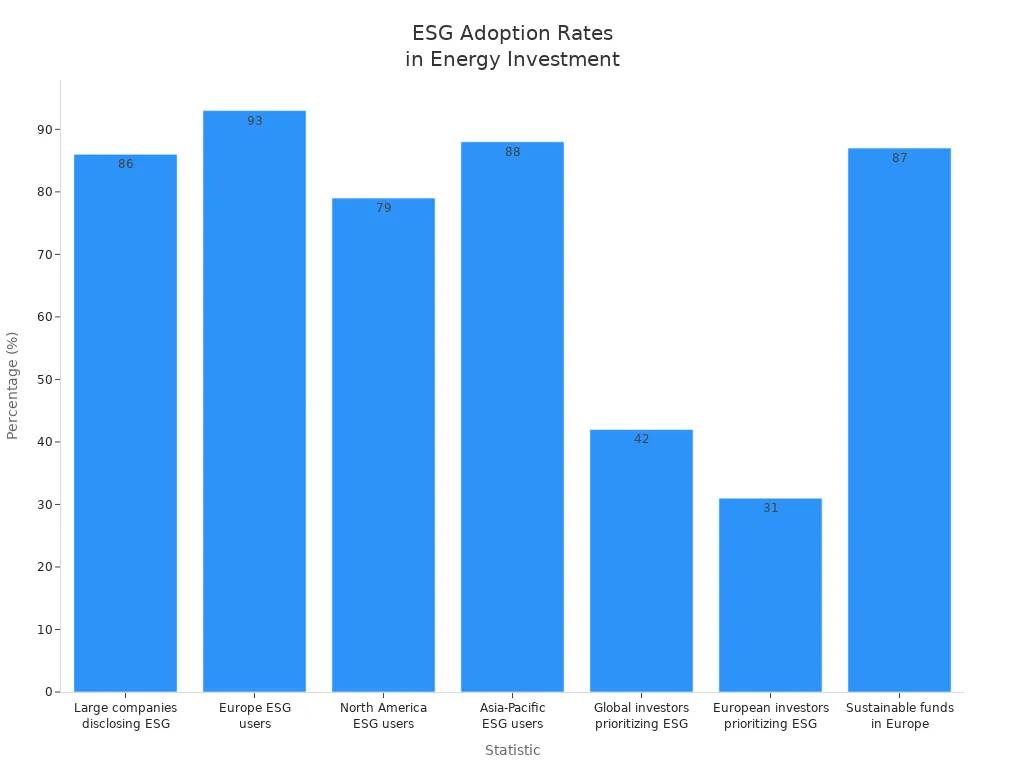
You see ESG shaping energy investment strategies across the globe. Large companies now disclose ESG information at an impressive rate—86% globally, with Europe leading at 93%.
Statistic | Value |
|---|---|
Percentage of large companies globally disclosing ESG information | 86% |
Percentage of organizations in Europe identifying as ESG users | 93% |
Percentage of organizations in North America identifying as ESG users | 79% |
Percentage of organizations in Asia-Pacific identifying as ESG users | 88% |
Global ESG Exchange-Traded Fund (ETF) assets targeting climate action | $74 billion |
Percentage of global investors prioritizing client expectations in ESG decisions | 42% |
Percentage of European investors prioritizing ESG | 31% |
Percentage of assets under management in sustainable funds in Europe | 87% |
When you integrate sustainability scores into your portfolio, you unlock key benefits. Higher ESG scores often lead to better financial performance and stronger risk management. Firms with strong ESG profiles achieve superior returns, lower volatility, and greater operational stability. An esg-driven equity report enables you to consider both strategic and operational integration, ensuring your energy investments remain resilient and adaptive.
Key Takeaways
ESG scores help you choose energy companies that prioritize sustainability, leading to better financial performance.
Integrating ESG practices can lower risks and improve your portfolio’s stability, making it more resilient to market changes.
Regularly monitor your investments using ESG metrics to ensure they align with your sustainability goals and adapt to new challenges.
Engage with stakeholders to build trust and improve ESG practices, which can enhance your portfolio’s overall performance.
Use reliable data sources and clear methodologies to evaluate ESG scores, ensuring informed investment decisions.
ESG in Energy Portfolios

ESG-Driven Equity Report Overview
You see the esg-driven equity report as a powerful tool for shaping your investment approach in the energy sector. This report helps you evaluate companies based on their environmental, social, and governance performance, giving you a clear view of how sustainability influences financial outcomes. ESG investing now acts as a catalyst for positive change, encouraging you and other stakeholders to align financial strategies with ethical and environmental values. As you use these reports, you notice several benefits:
Cultivate trust with socially responsible investors who seek transparency and accountability.
Lower the cost of capital and improve access to financing, as strong esg performance attracts better terms.
Strengthen brand equity, drawing in eco-conscious customers who value sustainability.
Proactively mitigate risks, enhancing long-term financial resilience for your portfolio.
You find that the esg-driven equity report not only guides your investment decisions but also demonstrates your commitment to responsible practices. This approach positions your portfolio for growth and stability in a rapidly evolving market.
Environmental Social Governance Trends
You witness a major shift in the energy sector as esg becomes central to business strategy. In 2025, companies that integrate esg factors into their management gain a competitive edge. Institutional investors demand greater accountability and transparency, making sustainable practices essential for survival and growth. You see firms refining their esg strategies, focusing on material risks and corporate governance due to new regulations and market pressures. The upcoming Corporate Sustainability Reporting Directive deadline pushes organizations to improve their sustainability reporting and embed esg into core business strategies.
You also observe a move away from broad esg labels toward concrete, measurable initiatives. Companies now emphasize strong governance, especially as political and environmental uncertainties grow. As consumer awareness rises, governments introduce new laws to support esg initiatives. You recognize that companies embracing esg principles gain investor confidence and reduce operational risks, proving that environmental social governance is vital for long-term success.
Key components of ESG integration in energy portfolios include:
ESG Scores Explained
ESG Metrics for Energy
You need to understand which esg metrics matter most when you evaluate energy companies. These metrics help you see how a company manages its environmental, social, and governance responsibilities. In the energy sector, certain esg metrics stand out because they directly impact sustainability and operational efficiency. You can use these metrics to compare companies and identify leaders in responsible practices.
Metric | Description |
|---|---|
Measures the company’s GHG emissions and reduction targets, emphasizing sustainability commitments. | |
Energy usage | Tracks total energy consumption, highlighting efficiency opportunities and the mix of energy sources used. |
Water usage | Evaluates water consumption and recycling efforts, particularly in water-scarce regions. |
Waste management | Assesses recycling and waste reduction initiatives, including hazardous waste levels. |
Biodiversity impact | Focuses on the company’s effects on local ecosystems and biodiversity, including financial impacts of offsets. |
You see that greenhouse gas emissions and energy usage often receive the most attention. These esg metrics reveal how well a company adapts to climate challenges and regulatory demands. Water usage and waste management also play a key role, especially in regions where resources are limited. Biodiversity impact shows you how a company protects local environments, which can influence long-term value.
Tip: When you review esg scores, always check which metrics the provider uses. Not all esg ratings weigh these factors equally.
Data Sources and Methodologies
You rely on accurate data and robust methodologies to ensure esg scores reflect real performance. Different providers use a range of approaches to calculate esg scores for energy companies. Each methodology offers unique insights and potential limitations.
Description | |
|---|---|
Equal Weighting | Simplistic approach that may overlook material issues. |
Expert-Based Weighting | Incorporates insights from sustainability analysts. |
Statistical Weighting | Utilizes PCA or regression to identify influential factors. |
Investor Preference Weighting | Customizes scores based on specific investor priorities. |
Linear Additive Model | Sums sub-scores to create a composite ESG score. |
Geometric Aggregation | Penalizes inconsistency by reducing compensation between high and low scores. |
Multi-Criteria Decision Analysis | Uses decision-maker preferences for score aggregation. |
Validation Techniques | Includes backtesting, peer benchmarking, and sensitivity analysis. |
You find that some esg scores use equal weighting, while others rely on expert judgment or statistical models. Investor preference weighting allows you to tailor esg scores to your own priorities. Linear additive models and geometric aggregation help you understand how different esg factors combine to form a single score. Validation techniques, such as backtesting and benchmarking, ensure the reliability of esg ratings.
You should always review the methodology behind esg scores before making decisions. This approach helps you select energy companies that align with your sustainability goals and risk tolerance.
Portfolio Integration Steps
Integrating ESG into your energy portfolio requires a thoughtful approach that balances financial objectives with sustainability goals. You can follow a series of practical steps to ensure your investments reflect both responsible practices and strong performance. The esg-driven equity report serves as your guide, helping you navigate the complexities of esg investing and value creation.
Screening and Selection
You begin by screening and selecting companies that align with your responsible investment philosophy. ESG screening has become essential as global assets in esg investing are projected to surpass $50 trillion by 2025. This process allows you to filter out companies that do not meet your standards for environmental, social, and governance practices. You evaluate esg factors and returns, considering both ethical values and financial outcomes.
Exclusion Category | Description |
|---|---|
High Environmental Impact Industries | Includes sectors with high GHG emissions like oil and coal, and those linked to deforestation such as palm oil production. |
Unacceptable for Human Rights | Covers industries like controversial weapons, gambling, tobacco, and alcohol. |
Excluded Countries | Involves industries in countries under international sanctions or with poor human rights records. |
You use negative screening to eliminate investments in sectors that pose environmental or social risks, such as fossil fuels or industries with poor governance. ESG screening evaluates companies based on their esg ratings, helping you identify those with higher esg scores and strong sustainability reporting. This approach supports your commitment to responsible investment and enhances your portfolio’s risk management.
ESG screening helps you align your investments with your values and financial goals. You gain confidence knowing your portfolio reflects both ethical standards and the potential for strong investment returns.
ESG Weighting in Portfolio
After screening, you move to the weighting stage, where you decide how much influence esg scores will have on your portfolio construction. You can use several strategies to incorporate esg ratings alongside traditional financial metrics. The DMV model combines market return objectives with esg-factor returns, allowing you to balance financial performance and sustainability.
The DMV model integrates financial and esg objectives, giving you flexibility in portfolio design.
You categorize investors based on their preferences for esg and their sensitivity to uncertainty in esg ratings.
You recognize that uncertainty in esg ratings can affect required returns and risk levels.
You may also use a double sorting approach, which evaluates esg exposure within a traditional asset pricing framework. This method combines factor investing with esg practices, helping you compare high esg versus low esg companies and assess their impact on investment performance. You blend esg integration with conventional strategies, ensuring your portfolio reflects both financial and sustainability priorities.
The double sorting approach allows you to measure esg exposure and financial returns together.
You employ benchmark strategies to compare esg performance across different companies.
You use these insights to optimize your portfolio for value creation and risk management.
Tip: Adjust your esg weighting based on your investment goals and risk tolerance. A higher esg weighting can enhance long-term performance and resilience.
Monitoring ESG Performance
Once you have constructed your portfolio, you need to monitor esg performance over time. Continuous monitoring ensures your investments remain aligned with your sustainability objectives and adapt to changing market conditions. Most businesses now use third-party esg management tools for ongoing analytics, with 91% relying on these solutions to track esg performance.
Evidence Type | Description |
|---|---|
Continuous Monitoring | 91% of businesses use third-party ESG management tools for ongoing monitoring and analytics. |
Benchmarking Importance | 83% of institutional investors consider ESG risks crucial in their investment decisions. |
You benchmark your portfolio against industry peers, using esg ratings and sustainability reporting to measure progress. You track key metrics such as greenhouse gas emissions, governance practices, and social impact, ensuring your portfolio maintains strong esg performance. You also review esg integration strategies regularly, adapting to new regulations and market trends.
Note: Regular monitoring helps you identify areas for improvement and respond quickly to emerging risks. You strengthen your portfolio’s resilience and support long-term investment performance.
You face operational challenges, such as political uncertainty, inconsistent regulations, and difficulty measuring esg impact. You address these issues by staying informed, investing in expertise, and using robust esg management tools. You recognize that effective esg integration requires ongoing commitment and adaptability.
By following these steps, you create an energy portfolio that reflects your values, supports responsible investment, and delivers strong returns. You position yourself as a forward-thinking investor, ready to navigate the evolving landscape of esg investing and sustainability.
ESG Factors and Returns

Financial Performance Impact
You see that esg factors and returns have become a central topic in energy sector analysis. As you explore the relationship between esg and financial performance, you notice that not all sustainability factors guarantee improved returns. Some esg elements create long-term value, while others may not directly influence investment returns. You need a rigorous, evidence-based approach to evaluate how esg-driven equity report insights affect your portfolio.
Recent research shows that environmental factors now play a larger role in shaping investment performance. Investors and regulators have increased their focus on sustainability, which means energy companies with strong environmental practices often experience better market valuations. You find that these companies attract more investor confidence, especially in sectors with strict regulations. This shift highlights the growing importance of esg investing for responsible investment strategies.
You also discover that the link between esg and returns is complex. Studies reveal that esg factors are not unique sources of systematic risk. Instead, they often reflect traditional risk factors, such as company size and market volatility. For example, esg factors tend to have positive exposure to large firms and high beta firms. This means that the performance of esg investments may be influenced by established market dynamics, not just esg characteristics.
Factor | Influence on Returns |
|---|---|
Environmental Performance | Strong environmental practices can lower the cost of capital and improve market valuations. |
Social and Governance Factors | These factors may support long-term value creation but do not always guarantee higher returns. |
Company Size and Beta | ESG factors often align with large, high beta firms, linking performance to broader market trends. |
You notice that while there is no overall esg premium for energy sector firms, an inverse relationship exists between environmental performance and the cost of capital. Companies with better environmental practices can secure lower financing costs, which is crucial for investment performance in the energy sector. As you analyze esg ratings, you see that higher esg scores often signal operational stability and value creation, even if they do not always lead to immediate investment returns.
Tip: Focus on the environmental component of esg when evaluating energy companies. Strong environmental performance can enhance both value and investor confidence, especially in a market that rewards sustainability.
Risk Management Benefits
You recognize that esg factors and returns go beyond financial performance. Effective esg integration strengthens risk management and supports the long-term resilience of your portfolio. By aligning your investments with ethical principles and robust governance, you create a foundation for stability and value creation.
Research shows that integrating esg criteria may not always deliver immediate returns, but it significantly enhances risk mitigation strategies. Companies with strong esg practices face fewer regulatory and reputational risks. You see that these organizations are less likely to encounter bribery, corruption, or fraud, which protects your investment returns and supports responsible investment.
Benefit | Description |
|---|---|
Lower Volatility | ESG practices can lead to reduced market fluctuations, enhancing portfolio stability. |
Reduced Exposure to Risks | Companies with strong ESG practices face fewer regulatory and reputational risks. |
Improved Financial Performance | Organizations addressing ESG risks often achieve better financial results and lower capital costs. |
You find that esg factors and returns are closely linked to risk management. Integrating esg criteria helps you navigate periods of market volatility and uncertainty. You also benefit from improved governance and transparency, which support value creation and long-term growth.
Integrating esg criteria helps mitigate risks during market volatility.
Companies with strong esg practices are less likely to encounter bribery, corruption, and fraud.
You see that continuous monitoring of esg performance and sustainability reporting allows you to adapt quickly to emerging risks. This approach supports value creation and helps you maintain a resilient portfolio. As you use esg ratings and governance insights, you position yourself for strategic growth and innovation in a changing market.
Note: Strong esg integration not only supports risk management but also enhances your reputation as a forward-thinking investor. You build trust with stakeholders and contribute to a more sustainable future.
Challenges in ESG Integration
Data and Consistency
You face significant challenges when you try to integrate esg into your energy portfolio. Data management stands out as a major hurdle. You must handle large volumes of information from many sources, which can quickly become overwhelming. High-quality data is essential for accurate esg reporting and informed decision-making. Poor data quality leads to operational inefficiencies, reputational damage, and even regulatory penalties. Data fragmentation and lack of standardization make esg screening and analysis more difficult.
Challenge | Description |
|---|---|
Data Management | Managing a significant volume of data from multiple sources is a key challenge. |
Reporting | ESG reporting requires efficient tools to automate data collection and analysis. |
Compliance | Ensuring compliance with various standards adds complexity to the integration process. |
You need a strong governance framework to ensure esg data accuracy and compliance. Inconsistent or unreliable esg data can result in poor sourcing decisions and harm your reputation. You see that efficient reporting tools help automate data collection and analysis, making esg practices more reliable and transparent.
High-quality data supports effective risk management and esg practices.
Data fragmentation and lack of standardization complicate esg integration.
Regulatory and Market Issues
You encounter regulatory complexity as you work to keep up with regional and global esg compliance requirements. New mandates for energy efficiency and sustainability add further layers of difficulty. Non-compliance can lead to penalties, which threaten your portfolio’s stability. Evolving regulations make it hard to stay current with changing esg reporting standards. The lack of unified standards poses significant challenges to effective esg reporting.
Challenge | Description |
|---|---|
Regulatory Complexity | Keeping up with regional and global ESG compliance requirements |
New Mandates | Adapting to new energy efficiency and sustainability mandates |
Non-compliance Penalties | Navigating penalties for non-compliance |
You notice that client preferences drive esg integration, with many investors prioritizing long-term threats such as climate change and resource scarcity. Standardized reporting enhances transparency and supports informed decision-making. Over 5,300 signatories to the PRI recognize that esg issues impact investment performance across many dimensions.
To overcome regulatory barriers, you can:
Consult legal experts and regulatory authorities to ensure compliance with reporting standards.
Establish clear esg policies and set measurable sustainability goals.
Use esg compliance software to automate data collection and reporting.
Embed esg principles in supply chain management and decision-making.
Regularly review and update esg strategies, conducting audits as needed.
Engage with stakeholders and publish sustainability reports for transparency.
Tip: Regularly review your esg practices and risk management strategies to adapt to changing regulations and market expectations. This approach helps you maintain compliance and build trust with investors.
Best Practices for ESG
Criteria and Benchmarking
You strengthen your energy portfolio by applying clear criteria and benchmarking methods for esg integration. Leading energy companies use sector-specific benchmarks, which help you compare esg performance meaningfully within the industry. You gain insight by focusing on methodological clarity and source transparency, making it easier to understand how esg scores are calculated and interpreted. Compatibility with regulatory frameworks such as CSRD and SFDR ensures your esg commitments align with reporting obligations.
You benefit from these best practices:
Implement effective data collection and reporting tools. Accurate esg data demonstrates value and supports compliance.
Prioritize the right industries and companies. Focus on sectors where esg issues have the greatest impact.
Assess readiness and ease of implementation. Evaluate existing esg practices to guide your next steps.
Align with investor and regulatory demands. Meeting expectations from investors and regulators builds trust and supports long-term growth.
Benchmarking Practice | Benefit |
|---|---|
Sector-specific benchmarks | Meaningful comparisons within the industry |
Methodological clarity | Transparent esg score calculation |
Regulatory compatibility | Alignment with CSRD and SFDR requirements |
You create a robust foundation for esg integration by using these strategies. You position your portfolio for adaptability and strategic growth in a changing market.
Stakeholder Engagement
You recognize that stakeholder engagement plays a vital role in successful esg integration. When you engage stakeholders, you include their needs and expectations in decision-making. Transparent communication builds trust and addresses concerns, making esg transformations smoother.
You can follow these steps to enhance stakeholder engagement:
Develop a stakeholder engagement plan that prioritizes esg considerations.
Communicate openly and regularly with stakeholders about esg goals and progress.
Provide guidance and support to portfolio companies, helping them improve esg practices.
Note: Active engagement with stakeholders ensures your esg strategy remains relevant and effective. You foster innovation and market intelligence by listening to diverse perspectives.
You see that strong stakeholder engagement leads to better esg outcomes and supports equity analysis. You build lasting relationships that help your portfolio adapt to new challenges and opportunities.
You can integrate esg into your energy portfolio by following clear steps that drive real impact.
Actionable Step | Description | Impact |
|---|---|---|
Use financial proxies to convert ESG outcomes into financial impacts. | Justifies investments in ESG initiatives by demonstrating cost savings. | |
Engage finance teams | Involve finance experts in ESG analysis for accurate ROI calculations. | Ensures credibility and accuracy in financial modeling. |
Utilize technology for tenant engagement | Implement real-time utility monitoring and gamification for tenants. | Increases tenant awareness and reduces energy consumption. |
You see that continuous improvement in esg practices leads to more renewable energy and supports long-term portfolio growth. Investors who focus on sustainability achieve stronger market traction and higher valuations. You can assess risks, avoid companies with high esg risks, and align your portfolio with Net Zero goals. As you adapt and innovate, you build a resilient strategy that supports both equity analysis and market intelligence. Reflect on how your choices today shape a sustainable future for your investments.
FAQ
What is an ESG score and why does it matter in energy portfolios?
An ESG score measures how well a company manages environmental, social, and governance issues. You use these scores to compare companies and make informed decisions. High ESG scores often signal strong risk management and long-term value.
Tip: ESG scores help you identify leaders in sustainability and innovation.
How do you select reliable ESG data sources?
You look for providers with transparent methodologies and sector expertise. Reliable sources use verified data, clear scoring systems, and regular updates. You gain confidence by choosing platforms that align with global standards.
Criteria | Why It Matters |
|---|---|
Transparency | Ensures accuracy |
Sector expertise | Improves relevance |
Regular updates | Reflects changes |
Can ESG integration improve portfolio performance?
You often see improved stability and resilience when you integrate ESG factors. Companies with strong ESG practices tend to manage risks better and attract investor trust. While returns may vary, ESG integration supports long-term growth.
Lower volatility
Enhanced reputation
Better risk management
What challenges do you face with ESG reporting?
You encounter issues like inconsistent data, changing regulations, and complex compliance requirements. These challenges can slow progress and create uncertainty. You address them by using automated tools and staying informed about new standards.
Note: Regular reviews and stakeholder engagement help you overcome reporting obstacles.
How do you monitor ESG performance over time?
You track key metrics using third-party tools and benchmark against industry standards. Continuous monitoring lets you adapt quickly and maintain alignment with your sustainability goals. You review ESG reports regularly to spot trends and areas for improvement.
Monitoring Method | Benefit |
|---|---|
Third-party tools | Real-time analytics |
Benchmarking | Industry comparison |
Regular reviews | Ongoing improvement |
Making Sense of Markets: The Role of Objective Equity Research
Understanding markets begins with disciplined observation—an approach rooted in evidence rather than emotion. Objective equity research draws meaning from complexity by gathering reliable data, framing it within relevant economic and sector context, and maintaining transparency about sources and assumptions. This process helps reveal how shifting fundamentals, governance structures, and behavioral patterns interact to shape market behavior. At VASRO, this commitment to curiosity, precision, and clarity defines the analytical lens through which equity insights are developed. The result is research that neither speculates nor persuades, but instead clarifies how information connects to broader market dynamics. This article is for general information only and does not constitute financial, investment, legal, or tax advice; readers should consult a licensed professional for advice tailored to their situation.
Disclaimer: The information on www.vasro.de is for general informational purposes only and does not constitute investment advice or a recommendation. VASRO GmbH does not provide personalized investment advice; visitors should seek independent financial guidance before making decisions. Some content may rely on third-party sources considered reliable, but VASRO GmbH does not guarantee accuracy, completeness, or timeliness. All information is provided “as is,” may change without notice, and VASRO GmbH has no obligation to update, correct, or continue publishing it. VASRO GmbH accepts no liability for losses arising from reliance on this information. Past performance is not a reliable indicator of future results.