


When you explore the dynamics of AI vs. Human Analysts, you discover that combining artificial intelligence with human analysts unlocks results that neither can achieve alone. The synergy between these approaches boosts both innovation and accuracy, with hybrid teams driving an 85% increase in customer satisfaction and up to 20% higher sales growth compared to solo efforts, as shown below:
Approach | Customer Satisfaction Increase | Sales Growth Increase | Source |
|---|---|---|---|
Hybrid (AI + Human) | 85% | Up to 20% | Gartner, McKinsey |
Human Only | 55% | N/A | Gartner |
You benefit from AI’s consistency and speed, while human insight adds context and creativity. To maximize these gains in the context of AI vs. Human Analysts, you need careful integration and ongoing oversight.
Table of Contents
Key Takeaways
Combining AI with human analysts boosts customer satisfaction by 85% and sales growth by up to 20%.
AI excels in speed and efficiency, processing large datasets quickly, which allows for timely decision-making.
Human analysts provide intuition and context, making decisions that require emotional intelligence and ethical considerations.
A hybrid approach reduces bias by allowing humans to review AI outputs and correct any inconsistencies.
Training and upskilling are essential for teams to effectively collaborate with AI and enhance their analytical capabilities.
Establishing clear protocols for when to rely on AI versus human judgment ensures balanced decision-making.
Creating shared knowledge maps helps align goals and improve collaboration between AI and human analysts.
Continuous evaluation and oversight of AI systems maintain ethical standards and ensure reliable outcomes.
AI Strengths
Speed & Scale
When you work with ai, you unlock a level of speed and scale that transforms how you approach data analysis. Ai-powered systems handle vast amounts of information in a fraction of the time it would take a human analyst. You might face a dataset with millions of rows, but ai can process it in minutes, not days. This rapid turnaround means you can respond to market changes, customer trends, or operational challenges almost instantly.
Ai gives you the power to analyze data at a scale that was once unimaginable, making it possible to spot opportunities and risks before they impact your business.
Ai-powered tools excel in data analytics by processing massive datasets significantly faster than human analysts.
Tasks that may take human analysts days can be completed by ai in just minutes or hours.
You gain a competitive edge when you let ai handle the heavy lifting. This efficiency supports innovation and adaptability, especially in fields like equity analysis and market intelligence, where timing can make all the difference.
Pattern Recognition
Ai stands out for its ability to recognize patterns that might escape even the most experienced human analyst. You can rely on ai to sift through complex data, identifying trends, correlations, and anomalies with remarkable precision. Ai uses advanced algorithms to detect subtle signals in financial markets, customer behavior, or operational metrics.
When you combine ai’s pattern recognition with your own business intuition, you create a powerful partnership. Ai highlights what matters, and you decide how to act. This approach leads to smarter decisions and more strategic growth.
Consistency
Ai brings a level of consistency to analysis that human analysts sometimes struggle to maintain. You never have to worry about fatigue, distraction, or bias affecting the results. Ai applies the same rules and logic every time, ensuring that your insights remain reliable and objective.
Consistent analysis helps you build trust in your data-driven decisions, especially when you need to present findings to stakeholders or make high-stakes choices.
You can depend on ai to deliver the same quality of analysis, whether you run a single report or thousands. This reliability supports your efforts to drive innovation and maintain high standards across your organization.
Human Analyst Strengths
Intuition
You bring a unique advantage to analysis through intuition. When you face complex problems, your mind often leaps to solutions that data alone cannot reveal. Research shows that intuition plays a significant role in solving analytical challenges, especially under time pressure. Many times, you find that accurate reasoning comes from an initial gut feeling rather than a slow, step-by-step process. This ability to sense patterns or spot inconsistencies, even when information is incomplete, sets you apart from automated systems.
Objective | Methodology | Significance |
|---|---|---|
Test causal role of intuition and restructuring | Systematically manipulate availability of intuitive processing and restructuring mechanisms; Measure performance changes across problem types; Compare with human performance under cognitive load conditions | Establishes necessary role of both mechanisms |
Assess human-DIBR team performance | Form human-DIBR, human-human, and DIBR-only teams; Present complex problems requiring both intuition and analysis; Measure solution quality, time, and team interaction patterns | Demonstrates complementary capabilities and practical utility |
Assess development of intuitive capabilities over time | Present increasingly challenging problems requiring intuitive leaps; Track changes in response time for intuitive judgments, accuracy of initial hypotheses, and transfer across problem domains | Demonstrates acquisition of intuitive expertise similar to human development |
You develop this intuitive expertise over time, learning from experience and adapting to new challenges. In fast-paced environments like market intelligence or equity analysis, your intuition helps you make decisions quickly and confidently.
Context & Judgment
You excel at interpreting context and exercising sound judgment. While AI can process vast amounts of data, it often struggles to understand the subtleties of human behavior or the meaning behind a CEO’s body language during an earnings call. You can read between the lines, picking up on subtext and cultural cues that machines miss. This skill proves essential in situations where decisions carry ethical implications or require a nuanced understanding of business dynamics.
You provide oversight that prevents errors and ensures ethical standards.
You recognize when data-driven recommendations do not fit the real-world context.
You apply a “trust but verify” mindset, reviewing AI-generated insights before taking action.
Human analysts bridge the gap between raw data and actionable strategy. Your judgment ensures that organizations avoid costly mistakes and maintain trust with stakeholders.
Creativity
You bring creativity to analysis, generating new ideas and approaches that drive innovation. Human analysts do not just follow established rules; you challenge assumptions and explore unconventional solutions. This creative thinking leads to breakthroughs in strategy, product development, and customer engagement.
Workers consistently prefer collaborative systems that allow for human input, rather than fully automated solutions. This preference highlights the value of creativity and adaptability that only human analysts can provide.
You help organizations adapt to changing markets and seize new opportunities. By combining your creative skills with AI’s analytical power, you unlock greater productivity and foster a culture of continuous improvement.
AI may identify trends, but you imagine new ways to respond.
You design strategies that reflect both data and human experience.
Your creative insights inspire teams and shape the future of business.
In every scenario, human analysts play a vital role in ensuring that analysis remains relevant, ethical, and innovative. Your strengths complement AI, creating a partnership that delivers smarter, more reliable results.
AI vs. Human Analysts
Comparison
When you compare ai vs. human analysts, you see that each brings unique strengths and faces distinct challenges. Ai excels in speed and efficiency, processing huge amounts of data almost instantly. You can rely on ai for precision and accuracy, especially when you need to diagnose diseases from medical images or analyze millions of customer interactions. Ai also scales easily, handling many tasks at once, such as responding to customer service inquiries across multiple channels.
Humans, on the other hand, shine in areas where creativity and emotional intelligence matter. You generate original ideas and think outside the box, which helps drive innovation in equity analysis and market intelligence. You understand emotions and context, making decisions that consider ethical implications and broader business dynamics. Ai vs. human analysts often comes down to this: ai handles the numbers, but you interpret the story behind them.
However, ai has its limits. It does not truly understand the information it processes. Ai depends on the quality of its training data, and it cannot experience emotions. You step in where ai falls short, especially in situations that require empathy or nuanced judgment.
Here is a quick overview of strengths and weaknesses:
Ai Strengths:
Speed and efficiency for time-sensitive decisions
High precision and accuracy in repetitive tasks
Scalability for large volumes of work
Human Strengths:
Creativity and original thinking
Emotional intelligence and empathy
Contextual decision-making with ethical awareness
Ai Weaknesses:
Lack of true understanding
Dependence on data quality
No emotional insight
Complementary Roles
You achieve the best results when you combine ai with human expertise. Ai vs human analysis should not be a competition; it works best as a partnership. Studies show that collaboration between ai and human analysts leads to higher accuracy and improved task performance. For example, in manufacturing, experts supported by explainable ai improved their results by 7.7 percentage points. In medical fields, the improvement reached 4.7 percentage points. When you use visual heatmaps generated by ai, you make better decisions by following accurate predictions and overruling mistakes.
Experiment Type | Improvement in Task Performance | Confidence Interval |
|---|---|---|
Manufacturing | 7.7% | 3.3% to 12.0% |
Medical | 4.7% | 1.1% to 8.3% |
You can see how ai vs. human analysts collaboration outperforms solo efforts in accuracy:
Method | Accuracy Range | Deferred Ratings |
|---|---|---|
Individual Human Rater | 89% (PRISMA) | N/A |
Individual LLMs | 63%-70% (PRISMA) | N/A |
Combined LLMs | 75%-88% (PRISMA) | 4%-74% |
Human–AI Collaboration | 89%-96% (PRISMA) | 25%-35% |
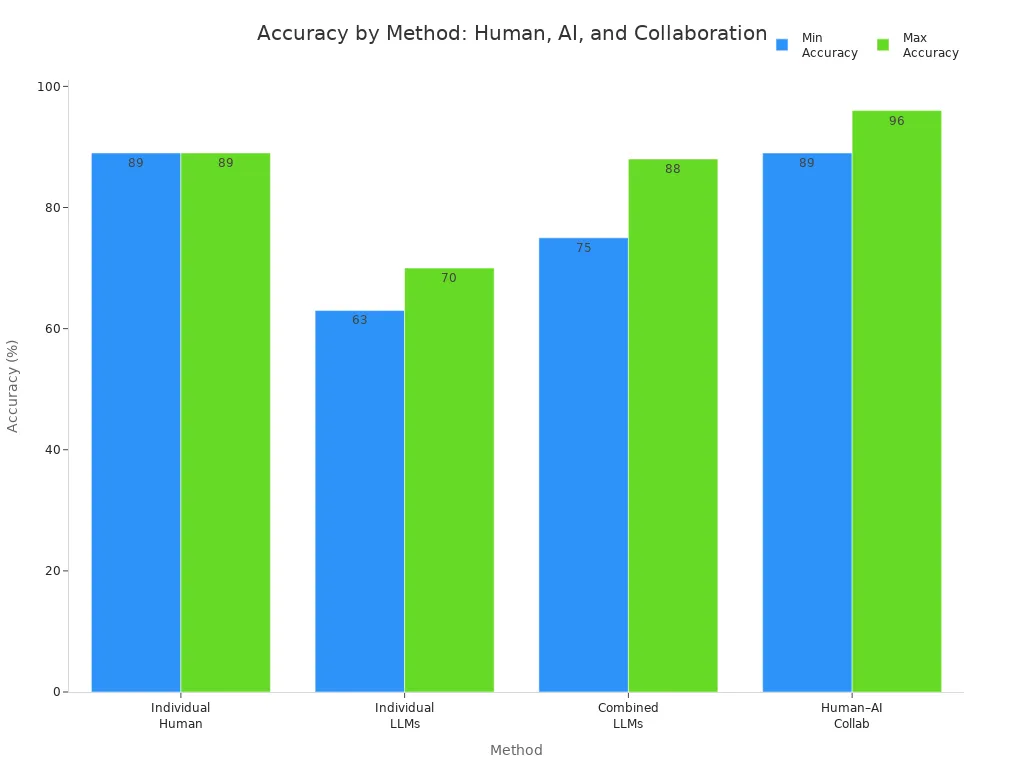
You benefit from ai’s ability to process data and your own skill in interpreting results. Ai vs human analysis becomes a cycle of innovation, where you use ai to uncover patterns and then apply your judgment to make strategic decisions. This approach supports adaptability and growth, especially in fast-moving industries.
Domain experts supported by explainable ai consistently outperform those working alone. You see this in manufacturing and healthcare, where shared knowledge and collaboration lead to smarter, more reliable outcomes. Ai vs. human analysts is not about replacing one with the other; it is about mixing minds for the best possible results.
Hybrid Collaboration

Synergy
You unlock remarkable benefits when you embrace a hybrid approach that blends ai with human analysis. This collaboration creates a synergy where the strengths of each side amplify the other, leading to outcomes that neither could achieve alone. In practice, you see this synergy in many fields. For example, in healthcare, radiologists work alongside ai imaging systems to improve cancer detection rates. The ai rapidly analyzes images, highlighting areas of concern, while you, as a human expert, interpret these findings within the broader clinical context. This partnership leads to higher accuracy and better patient outcomes.
In education, intelligent tutoring systems use ai to personalize learning, but you, as a teacher, provide the empathy and encouragement that students need. The result is significant academic improvement. Even in creative arts, artists use ai tools to explore new forms of expression, but your vision and intuition guide the creative process.
Domain | Case Study Description |
|---|---|
Healthcare | Radiologists collaborate with AI imaging systems to enhance cancer detection rates, combining AI’s data analysis with human expertise for improved accuracy. |
Education | Intelligent Tutoring Systems (ITS) provide personalized learning experiences, leading to significant academic performance gains when used alongside human teachers. |
Creative Arts | AI tools are integrated into artistic processes, enabling new forms of creative expression and collaboration with human artists. |
You measure the success of a hybrid team using a range of metrics. These include how well you assign tasks to the most capable member, how effectively you cover each other’s gaps, and whether you achieve results that neither ai nor humans could reach alone. You also look at operational performance, collaborative effectiveness, and the evolution of both human and ai skills over time.
Metric Type | Description |
|---|---|
Complementarity Utilization | Proportion of tasks assigned to the best-suited team member (human or AI) |
Capability Gap Coverage | Extent to which team members compensate for each other’s limitations |
Synergy Realization | Achievement of outcomes beyond what either human or AI could accomplish independently |
Redundancy Minimization | Reduction in duplicative effort across human and AI team members |
Psychological Metrics | Sense of control and meaningful contribution, mental effort required for collaboration with AI |
Skill Evolution | Development of new capabilities through hybrid collaboration |
Learning Effectiveness | Speed at which AI performance increases through collaboration |
Operational Performance | Productivity metrics, quality metrics, efficiency metrics |
Collaborative Effectiveness | Interface metrics, complementarity metrics, communication metrics |
Human Dimensions | Experience metrics, development metrics, engagement metrics |
AI Evolution | Learning metrics, integration metrics, adaptability metrics |
Risk and Governance | Dependency risk, security incidents, fairness metrics |
Compliance and Oversight | Regulatory adherence, audit readiness, stakeholder trust |
You see that a hybrid approach not only improves accuracy but also sparks innovation. When you combine Quality by Design and Agile Scrum methodologies in a hybrid model, you foster iterative development and collaborative work. This leads to systematic, adaptive strategies, as seen in the development of new radiopharmaceuticals for PET imaging. The hybrid approach encourages you to experiment, learn, and adapt quickly, which drives innovation in analytical processes.
Reducing Bias
You face bias in both ai and human analysis, but a hybrid approach helps you reduce its impact. Ai can inherit biases from its training data, while you may bring unconscious biases to your decisions. When you work together, you can spot and correct these issues. For example, you can review ai-generated recommendations and question any patterns that seem unfair or inconsistent. At the same time, ai can flag anomalies in your decisions, prompting you to reflect and adjust.
You also benefit from improved efficiency. Studies show that hybrid workers match the productivity of in-office peers, with no drop in performance. A Stanford study found a 33% reduction in resignations among hybrid employees, which means you keep your best talent longer. When you have control over your work environment, you experience a 32% increase in focus time. This flexibility, supported by ai tools, helps you analyze data more efficiently and make better decisions.
Hybrid workers maintain productivity levels equal to in-office peers.
Hybrid models lead to higher employee retention and increased focus.
Flexible work environments, supported by ai, enhance data analysis efficiency.
You must also address challenges that come with a hybrid approach. These include financial planning, cultural resistance, and the need for explainability. You may encounter difficulties integrating ai with existing systems or ensuring ethical practices. Training and upskilling become essential, as you need to bridge the workforce skill gap and build trust in the hybrid model.
Challenge | Description |
|---|---|
Cost, ROI, and Financial Planning | AI implementation can be more expensive than anticipated, involving costs beyond software and infrastructure, such as data preparation and maintenance. Proper financial planning is crucial to avoid budget overruns and ensure ROI. |
Cultural Resistance and Change Management | Employees may resist AI adoption due to fears of job loss or distrust in AI, which can hinder successful implementation. Effective change management is essential to build trust and demonstrate value. |
Explainability and Transparency | The complexity of AI models can lead to a lack of understanding of their decision-making processes, undermining trust and potentially causing compliance issues. Stakeholders need clarity on how AI reaches its conclusions. |
Integration with Existing Systems | Integrating AI with legacy systems can be challenging, leading to compatibility and performance issues. Proper planning is necessary to ensure smooth integration and system stability. |
Ethics & Responsible AI | Ethical concerns, such as bias and privacy violations, are critical in AI implementation. Organizations must ensure ethical practices are in place to maintain stakeholder trust and comply with regulations. |
Workforce Skill Gap | A shortage of skilled professionals in data science and AI can slow down projects and increase reliance on external vendors. Training is essential for teams to effectively utilize AI outputs in decision-making. |
Tip: You can reduce bias and improve outcomes by fostering open communication, providing training, and ensuring transparency in your hybrid approach.
Shared Knowledge Maps
You achieve the greatest value from a hybrid approach when you create shared knowledge maps. These maps help you and ai systems understand each other’s strengths, limitations, and decision-making processes. You use them to document best practices, track lessons learned, and identify areas for improvement. Shared knowledge maps also support onboarding and training, making it easier for new team members to contribute effectively.
You see that hybrid collaboration leads to faster learning and skill evolution. Ai systems improve as they interact with you, learning from your feedback and adapting to new challenges. At the same time, you develop new capabilities by working with ai, such as interpreting complex data visualizations or designing better prompts for analysis.
You use shared knowledge maps to align goals and expectations.
You track progress and celebrate achievements as a hybrid team.
You foster a culture of continuous learning and improvement.
You must integrate shared knowledge maps carefully to avoid pitfalls. Poor integration can lead to confusion, duplicated effort, or missed opportunities. You need clear communication channels and regular reviews to ensure that your hybrid approach remains effective and aligned with your strategic goals.
Note: When you invest in shared knowledge and careful integration, you unlock the full potential of hybrid collaboration. This approach supports innovation, equity analysis, market intelligence, and strategic growth, helping you stay ahead in a rapidly changing world.
Real-World Hybrid Success

Healthcare
You see the most dramatic impact of hybrid collaboration in healthcare, where ai and human expertise combine to deliver transformative results. When you work with ai-powered systems, you unlock rapid access to clinical insights, streamline workflows, and improve patient outcomes. Northwell Health, for example, introduced Clinical AI Navigators and Algorithm Stewards. This model led to a 37% reduction in time from admission to treatment plan, a 28% improvement in length-of-stay accuracy, and a 42% decrease in treatment plan revisions. Physician satisfaction increased by 31%, showing how shared insights between ai and clinicians can reshape care delivery.
Kaiser Permanente’s Cognitive Support Framework reduced diagnostic errors by 33% and improved treatment plan adherence by 29%. You notice a 41% decrease in adverse events and a 26% boost in patient-reported care coordination quality. At Mayo Clinic, Hybrid Intelligence Career Pathways encouraged clinicians to generate new ai implementation ideas, resulting in a 47% increase in clinical position applications and a 35% improvement in retention of tech-oriented staff. These examples highlight how you, as a healthcare professional, can harness ai to amplify your insights and drive innovation.
However, poor integration can undermine these gains. Over-reliance on ai may erode your decision-making skills, while automation bias can cause you to overlook errors. Compounding mistakes in automated workflows can escalate quickly, and ai often struggles with unpredictable or emotional scenarios. You must remain vigilant, verifying ai-generated insights and maintaining a human touch in patient care.
Finance
You experience the power of hybrid analysis in finance, where ai augments your ability to interpret market trends and manage risk. JPMorgan Chase uses ai to enhance predictive analytics, giving you deeper insights into market movements and helping you adapt investment strategies. Ai-driven credit risk assessment enables faster decisions and reduces default rates, protecting your investments and supporting strategic growth.
When you combine ai’s predictive capabilities with your own judgment, you gain a competitive edge. Ai delivers early identification of market trends, allowing you to capitalize on opportunities and mitigate risks. Enhanced decision-making and increased profitability stem from the fusion of ai-driven insights and your expertise. Yet, you must avoid automation bias and ensure that you do not blindly trust ai outputs. You need to verify insights and maintain oversight, especially when unpredictable market conditions arise.
If you rely too heavily on ai, you risk missing subtle signals that only human analysts can detect. Compounding errors in automated workflows can lead to significant financial losses. You must balance ai’s strengths with your own insights, ensuring that data-driven decisions remain grounded in human experience.
Customer Insights
You unlock new levels of understanding when you blend ai with human analysis to generate customer insights. A financial services firm, for instance, uses ai agents to analyze market trends and risk factors, providing real-time recommendations to portfolio managers. This collaboration shortens decision-making cycles and improves forecasting accuracy, allowing you to respond quickly to changing customer needs.
Ai handles routine tasks efficiently, freeing you to focus on building trust and emotional connections with clients. Companies that integrate ai with human elements create customer experiences that are both fast and human-centric. Ai excels at managing predictable tasks, while you engage in empathetic interactions, deepening relationships and uncovering richer insights into customer preferences.
You must remain cautious, though. Ai struggles with unpredictable or emotional scenarios, which can lead to inadequate responses in customer service. Over-reliance on ai may diminish your ability to interpret nuanced feedback or adapt to unique situations. You need to verify ai-generated insights and ensure that your approach remains flexible and responsive.
Tip: You achieve the best results when you combine ai’s analytical power with your own intuition and empathy. This hybrid approach leads to deeper customer insights, stronger relationships, and more innovative solutions.
AI vs Human Analysis: Best Practices
Workflow Integration
You can transform your business strategy by integrating AI and human analysts into your daily workflows. Begin by assessing your current processes to identify areas where AI-powered competitor research can deliver the most impact. Start with small, high-value tasks that build momentum and confidence across your team. Use prebuilt AI tools to streamline integration, making it easier for you to adapt quickly to changing business needs. Foster collaboration between departments, ensuring that every business unit benefits from shared insights and collective expertise. Design scalable automation frameworks that grow with your business, supporting both short-term goals and long-term strategy.
Tip: Leverage both passive data analysis and employee feedback to uncover inefficiencies in your business workflows. Use process mapping to align AI-powered competitor research tools with your existing business processes, ensuring seamless adoption and minimal disruption.
Analyze passive data to spot workflow bottlenecks.
Gather feedback from employees to improve buy-in.
Map processes to align AI tools with business strategy.
When you combine data-driven insights with human judgment, you create a business environment that adapts to market intelligence and supports continuous innovation.
Training & Upskilling
You unlock the full potential of hybrid analysis when you invest in ongoing training and upskilling for your team. Your business thrives when employees develop both technical literacy and human-centric capabilities, allowing them to collaborate effectively with AI-powered competitor research platforms. Leaders in your organization must embrace lifelong learning, staying ahead of AI advancements and evolving business strategy. Focus talent development on non-automatable skills such as creativity, complex problem-solving, and adaptability, which remain essential for equity analysis and strategic growth.
Evidence Point | Description |
|---|---|
Dual Competencies Required | Teams need both technical literacy and human-centric capabilities. |
Continuous Learning Imperative | Leaders must engage in lifelong learning to keep pace with AI advancements. |
Talent Development Focus | Emphasis should be on creativity and complex problem-solving. |
You see the benefits of training reflected in improved business outcomes, higher employee engagement, and greater resilience in the face of market changes. Encourage your team to experiment with new AI-powered competitor research tools, share lessons learned, and celebrate creative solutions that drive business strategy forward.
Ethical Oversight
You safeguard your business reputation and maintain stakeholder trust by establishing robust ethical oversight in your hybrid analysis environment. Train human supervisors to understand the capabilities and limitations of AI-powered competitor research, preventing over-reliance and ensuring balanced decision-making. Develop clear protocols that guide when to rely on AI and when human intervention is necessary, supporting your business strategy with transparency and accountability.
Guideline | Description |
|---|---|
Human Oversight | Train supervisors on AI capabilities and limitations. |
Protocol Development | Establish clear protocols for AI vs human intervention. |
Ethical Audits | Conduct regular audits to ensure compliance and accountability. |
Empowerment of Staff | Encourage staff to question AI decisions and use ethical judgment. |
Continuous Monitoring | Implement ongoing monitoring to ensure ethical boundaries. |
Promote transparency, fairness, and privacy protection in every business decision.
Engage stakeholders in discussions about AI-powered competitor research and its impact on business strategy.
Monitor AI systems continuously to ensure they operate within ethical boundaries.
You avoid common pitfalls such as poor data quality, over-reliance on AI, lack of transparency, and insufficient change management by validating AI recommendations with human review and refining scoring models to adapt to evolving business needs. Regular audits and open communication help you maintain a culture of accountability and ethical business strategy.
Note: Continuous evaluation and human oversight remain essential for successful hybrid analysis. Studies show that ongoing monitoring and the PDCA cycle help AI-powered competitor research adapt to new data and operational changes, ensuring your business stays agile and innovative.
You see that hybrid approaches consistently deliver better outcomes than relying on AI or human analysts alone. When you combine your expertise with AI, you amplify your ability to spot trends, adapt to new trends, and respond to emerging trends in real time. The analysis of 370 unique effect sizes from 106 experiments shows that human-AI systems generally outperform solo efforts, though true synergy remains rare. To maximize results, you should:
Design human-in-the-loop workflows that let you validate AI outputs and refine trends.
Implement continuous model retraining to keep pace with shifting trends.
Embed explainability and governance controls so you can trust the trends you uncover.
Pilot, evaluate, and scale collaborative models to ensure trends align with your goals.
Establish unified data platforms to integrate trends seamlessly.
Provide targeted training so you and your team can interpret trends confidently.
Emphasize transparency and set clear boundaries, recognizing your strengths in creativity and ethical judgment as you analyze trends.
You hold the power to shape the future by building collaborative workflows that harness both human insight and AI precision. As you explore new trends and strategies, you create smarter, more reliable results for your organization and beyond.
FAQ
What are the main limitations of ai in analysis?
You notice that ai technology often struggles with nuance, context, and strategic interpretation. Limitations include difficulty understanding emotional cues, missing subtle market signals, and relying heavily on historical data. You must always review ai-generated analysis to ensure accuracy and relevance for your decisions.
How do human stock analysts add value to analysis?
You bring human insights, creativity, and strategic interpretation to every approach. Your ability to recognize nuance, adapt to latest trends and insights, and understand complex market dynamics helps you make better decisions. You see beyond the limitations of ai, especially when analyzing stock return predictions.
Can ai technology replace human analysis in making decisions?
You should not rely solely on ai technology for decisions. Limitations of ai include missing nuance, context, and ethical considerations. You achieve the best results when you combine ai-driven analysis with your own strategic interpretation and judgment, ensuring a balanced approach to market analysis.
How does a hybrid approach reduce limitations in analysis?
You overcome limitations by blending ai technology with human insights. This approach leverages ai’s speed and data processing with your ability to interpret nuance and make strategic decisions. You create more accurate predictions and foster innovation in market intelligence and equity analysis.
Why is nuance important in market analysis?
You recognize that nuance shapes strategic interpretation and guides decisions. Ai technology often misses subtle signals, cultural context, and emotional factors. Your approach considers these elements, helping you adapt to latest trends and insights and make informed stock return predictions.
What risks do you face if you ignore limitations of ai?
You risk making poor decisions if you overlook limitations of ai. Ai may misinterpret data, miss nuance, or fail to adapt to changing market conditions. You must always validate analysis and predictions with your own expertise, ensuring your approach remains reliable and ethical.
How do you stay updated on the latest trends and insights in analysis?
You follow industry news, attend webinars, and collaborate with experts. You combine ai-driven analysis with your own strategic interpretation to adapt your approach. Staying informed helps you recognize nuance, overcome limitations, and make better decisions in market intelligence and equity analysis.
What role does strategic interpretation play in stock return predictions?
You use strategic interpretation to analyze market data, identify nuance, and make informed decisions. Ai technology provides predictions, but you add value by considering limitations, context, and human insights. Your approach ensures that stock return predictions reflect both data and real-world dynamics.
Making Sense of Markets Through Clarity and Evidence
Objective equity research is, at its core, a disciplined way of seeing: gathering clean, comparable data; situating it in historical and sector context; stating assumptions and sources plainly; and applying consistent, testable methods so patterns—and their limits—become visible rather than imagined. That means cross-checking figures, distinguishing signal from seasonal noise, and documenting how definitions, accounting choices, and macro baselines shape what the numbers can and cannot say. It also means explaining confidence levels and uncertainty with the same care given to charts and footnotes, so readers understand both the evidence and the blind spots. At VASRO, we aim to be a measured, insightful voice in equity analysis and market intelligence, pairing curiosity with precision and clarity to illuminate how businesses create, allocate, and report value without theatrics or shortcuts. This article is for general information only and does not constitute financial, investment, legal, or tax advice; readers should consult a licensed professional for advice tailored to their situation.
Disclaimer: The information on www.vasro.de is for general informational purposes only and does not constitute investment advice or a recommendation. VASRO GmbH does not provide personalized investment advice; visitors should seek independent financial guidance before making decisions. Some content may rely on third-party sources considered reliable, but VASRO GmbH does not guarantee accuracy, completeness, or timeliness. All information is provided “as is,” may change without notice, and VASRO GmbH has no obligation to update, correct, or continue publishing it. VASRO GmbH accepts no liability for losses arising from reliance on this information. Past performance is not a reliable indicator of future results.