


Equity analysis serves as a cornerstone for investors aiming to navigate the complexities of diversified sector trends. By dissecting financial data and evaluating market conditions, this methodology reveals actionable opportunities that align with broader economic movements. Understanding sector-specific dynamics enables investors to make strategic decisions that maximize returns while mitigating risks.
Recent statistics underscore the value of actionable insights in equity analysis:
For instance, the technology sector has outperformed the S&P 500 by over 25% in the past year, showcasing how precise research can uncover lucrative investment opportunities. Equity analysis empowers investors to decode these patterns, paving the way for informed and confident investing.
Table of Contents
Key Takeaways
Studying stocks helps investors find chances by checking money data and markets.
Knowing big factors like rising prices and loan rates is key to smart investing.
Spreading money across different areas and types lowers risk and boosts gains.
Picking areas with good basics, like tech and health, can grow money over time.
Watching new ideas, like electric cars and new medicines, gives cool chances for smart investors.
Macroeconomic Factors Influencing Equity Markets
Understanding the macroeconomic landscape is essential for navigating the u.s. equity market. Key factors such as inflation, interest rates, and global market outlook significantly influence equity performance. These elements shape corporate earnings, consumer behavior, and investment strategies, making them critical for market analysis.
Inflation and Its Impact on Investments
Inflation plays a pivotal role in shaping investment outcomes. Rising inflation often erodes purchasing power, prompting investors to seek assets that can outpace inflationary pressures. For instance, the Consumer Price Index (CPI) for the 12 months ending February 2025 decreased to 2.8%, reflecting improved inflation figures. Energy costs remained stable, while food prices rose by 2.6%, with notable increases in egg prices due to supply issues. Transportation services and shelter costs also saw significant hikes, impacting consumer spending patterns.
Sectors such as energy and consumer staples often perform well during inflationary periods, as they provide essential goods and services. Conversely, industries reliant on discretionary spending may face challenges. Investors must consider these dynamics when allocating resources, ensuring their portfolios remain resilient against inflationary trends.
Interest Rates and Sector Dynamics
Interest rates directly impact borrowing costs and corporate profitability, influencing sector performance within the u.s. equity market. Lower rates typically encourage borrowing and investment, boosting economic growth. Conversely, rising rates can dampen corporate earnings and consumer spending.
For example, improving bank lending conditions bolster aggregate demand and corporate profitability, positively predicting equity returns. However, sectors such as real estate and utilities, which rely heavily on debt financing, may experience pressure during periods of rising rates. Investors should monitor interest rate trends closely, adjusting their strategies to align with shifting market conditions.
Global Economic Trends Shaping Equity Performance
The global market outlook significantly affects equity performance across regions. Economic growth, geopolitical tensions, and trade policies create opportunities and risks for investors. For instance, South Asia is projected to grow by 6.2% in 2025, driven by resilient activity in India. In contrast, Europe and Central Asia face risks from geopolitical tensions despite a 2.7% growth projection.

Regions like East Asia and the Pacific, with a projected growth rate of 4.6%, benefit from strong domestic demand but face risks from trade policy shifts. Investors analyzing the u.s. equity market must consider these global trends, as they influence sector performance and investment opportunities.
Sector Trends in Equity Analysis

Understanding sector-specific trends is crucial for identifying opportunities and challenges within the equity landscape. Each sector operates under unique dynamics influenced by economic conditions, technological advancements, and consumer behavior. By examining these trends, investors can make informed decisions that align with their financial goals.
Leading Sectors in Current Markets
Certain sectors have demonstrated resilience and growth in the current market environment. Technology continues to lead, driven by advancements in artificial intelligence, cloud computing, and cybersecurity. Companies in this sector have benefited from increased demand for digital transformation across industries. For example, cloud service providers have seen significant revenue growth as businesses adopt remote work solutions.
Healthcare also remains a strong performer. The sector has experienced steady growth due to aging populations and increased healthcare spending. Pharmaceutical companies, in particular, have gained attention for their innovation in drug development and biotechnology. Additionally, renewable energy has emerged as a leading sector, supported by global initiatives to combat climate change. Investments in solar, wind, and battery technologies have positioned this sector for long-term growth.
💡 Tip for Investors: Focus on sectors with strong fundamentals and long-term growth potential. Conduct thorough research to identify companies with competitive advantages and robust financial performance.
Sectors Facing Challenges and Recovery Potential
While some sectors thrive, others face significant challenges. Real estate has encountered headwinds due to rising interest rates, which increase borrowing costs and reduce demand for property investments. Retail, particularly brick-and-mortar stores, continues to struggle as e-commerce captures a larger share of consumer spending. However, opportunities for recovery exist within these sectors.
The energy sector, specifically traditional oil and gas, has faced volatility due to fluctuating commodity prices and the global shift toward renewable energy. Despite these challenges, companies that adapt by diversifying their portfolios and investing in cleaner technologies may find opportunities for growth. Similarly, the travel and hospitality sector, heavily impacted by the pandemic, shows signs of recovery as global travel resumes. Investors should monitor these sectors closely, as they may offer value in the medium to long term.
Emerging Growth Sectors to Watch
Emerging sectors often present exciting opportunities for investors willing to embrace innovation and change. Electric vehicles (EVs) and related industries, such as battery manufacturing and charging infrastructure, are gaining momentum. Governments worldwide are implementing policies to promote EV adoption, creating a favorable environment for growth.
The biotechnology sector is another area to watch. Advances in gene editing, personalized medicine, and immunotherapy are revolutionizing healthcare. Companies at the forefront of these innovations are attracting significant investment. Additionally, the space exploration sector is gaining traction, with private companies leading efforts in satellite deployment, space tourism, and interplanetary exploration.
🚀 Emerging Trend Alert: Keep an eye on sectors driven by technological breakthroughs and regulatory support. These industries often experience rapid growth, offering substantial returns for early investors.
By analyzing sector-specific trends, investors can identify opportunities across leading, challenged, and emerging sectors. This approach enables a balanced portfolio that captures growth while managing risks effectively.
Strategic Portfolio Diversification

Strategic portfolio diversification remains a cornerstone of effective investment strategies, enabling investors to mitigate equity market risk while optimizing portfolio performance. By allocating investments across sectors, asset classes, and geographic regions, investors can reduce volatility and enhance long-term returns.
Risk Management Through Sector Allocation
Sector allocation plays a pivotal role in managing equity market risk. Diversifying investments across sectors ensures that gains in one area can offset losses in another, reducing overall portfolio volatility. For instance, counter-cyclical sectors such as utilities and consumer staples often perform well during economic downturns, balancing risks associated with growth-oriented sectors like technology and discretionary spending.
Investors can adopt various strategies to tailor their sector allocation to financial goals and risk tolerance. The table below highlights key approaches:
Strategy | Description |
|---|---|
Diversification | Ensures that gains in some investments can offset losses in others, reducing overall volatility. |
Strategic Asset Allocation | Adjusts the mix of assets to tailor risk exposure to financial goals and risk tolerance. |
Conservative Allocation | Higher allocation to bonds and cash reduces volatility and risk. |
Aggressive Allocation | Higher allocation to stocks provides greater growth potential but increases risk. |
Diversifying investments across asset types and sectors enhances portfolio resilience. For example, stocks and bonds often exhibit counter-cyclical performance, providing a natural hedge against market fluctuations. This diversified strategy empowers investors to navigate equity market risk with confidence.
Balancing Defensive and Growth Investments
Balancing defensive and growth investments is essential for achieving a well-rounded portfolio. Defensive assets, such as bonds and dividend-paying stocks, offer stability and lower risk, making them ideal for preserving capital during market volatility. Growth assets, including equities in emerging sectors, provide higher potential returns but come with increased risk.
The chart below illustrates the percentage allocation across diversification types, emphasizing the importance of balancing defensive and growth investments:
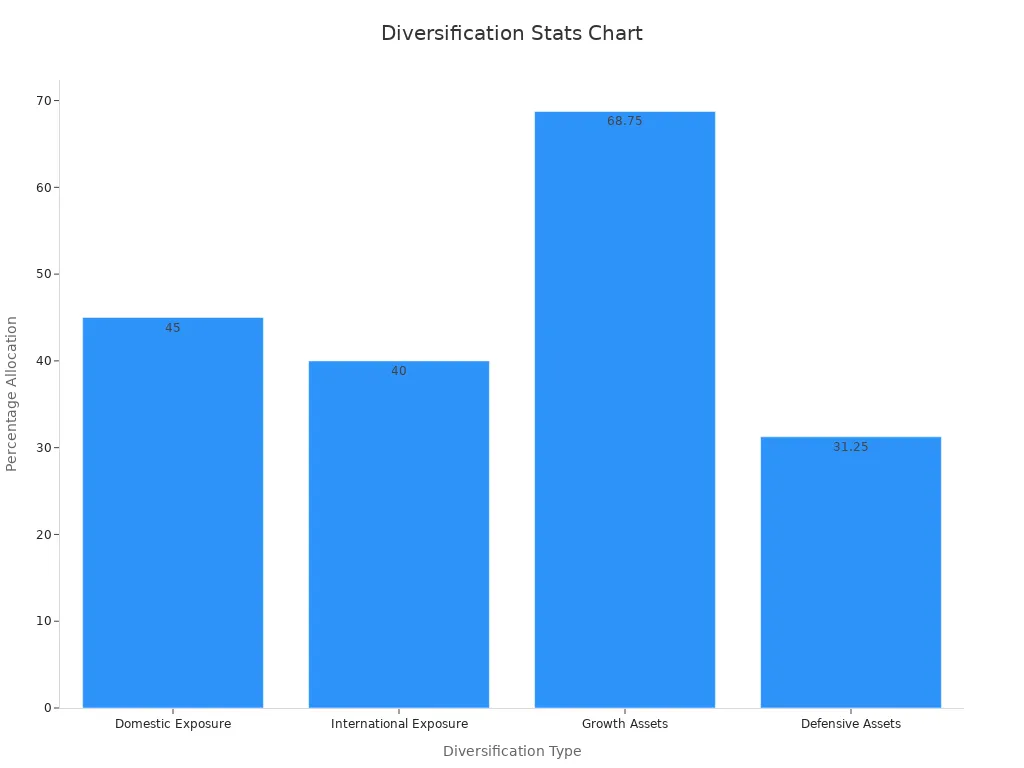
A strategic approach to equity market risk involves maintaining a mix of defensive and growth investments. For example, allocating 31.25% to defensive assets and 68.75% to growth assets ensures stability while capturing opportunities for higher investment returns. This balance allows investors to adapt to changing market conditions without compromising long-term goals.
Tactical Adjustments Based on Market Trends
Tactical adjustments enable investors to respond proactively to evolving market trends. By analyzing historical data and current projections, investors can identify opportunities for portfolio optimization. For instance, significant performance gaps between asset classes, such as stocks and bonds, often signal the need for reallocation.
In early 2025, technology stocks underperformed despite substantial spending, highlighting the importance of careful sector analysis. Similarly, solid economic growth suggests that equities may outperform bonds, justifying a tactical shift toward growth-oriented investments. The table below outlines key insights that support tactical adjustments:
Evidence Description | Key Insight |
|---|---|
Tactical asset allocation in a changing market | Investors may regret investing just before a market pullback, suggesting the need for tactical adjustments. |
Performance gaps between asset classes | A significant stock-bond performance gap and disconnect between domestic and international equities create opportunities for portfolio adjustments. |
Sector performance insights | In early 2025, technology stocks were underperforming despite significant spending, indicating a need for careful sector allocation. |
Economic growth implications | Continued solid economic growth suggests that stocks may outperform bonds, justifying a tactical shift towards equities. |
Investors employing tactical adjustments can capitalize on emerging trends while mitigating risks. For example, reallocating investments toward sectors with strong fundamentals or shifting exposure between domestic and international equities can enhance portfolio performance. This strategic approach ensures that portfolios remain aligned with market dynamics and investor strategies.
Equity Market Forecasts and Insights
Short-Term Sector Projections
Short-term projections for equity sectors rely on a blend of quantitative models and qualitative assessments. The Schwab Center for Financial Research evaluates all 11 equity sectors using five critical factors: growth, quality, sentiment, stability, and value. These factors include data points such as estimated dividend growth, cash flow, and price momentum. This comprehensive approach helps forecast sector performance relative to the S&P 500 index over the next six to twelve months.
Technology and healthcare sectors are expected to maintain their momentum due to strong fundamentals and innovation-driven demand. Meanwhile, consumer staples may see steady performance as inflationary pressures ease, supporting consistent consumer spending. However, sectors like real estate and utilities could face headwinds from rising interest rates, which increase borrowing costs and impact profitability. Investors should monitor these trends closely to identify short-term opportunities and risks.
Long-Term Market Trends
Long-term equity market trends often reflect sustained economic and corporate performance. U.S. companies have demonstrated resilience, with corporate earnings growing over 18% year-over-year in Q4, significantly outpacing Europe’s 7%-8% growth. The U.S. equity market, valued at $63 trillion, represents more than half of the global market capitalization, underscoring its dominance.
Evidence Type | Details |
|---|---|
Corporate Earnings Growth | U.S. companies posted earnings growth of more than 18% year-over-year in Q4, compared to 7%-8% in Europe. |
Market Capitalization | The total market cap of public companies in the U.S. is $63 trillion, representing more than half of global market value. |
Innovation | The U.S. leads in R&D spending and patent applications, with more than half of the world’s unicorn companies. |
Innovation remains a key driver of long-term growth. The U.S. leads in research and development spending, patent applications, and the creation of unicorn companies. However, elevated forward price-to-earnings ratios suggest potential headwinds for growth stocks, with value stocks offering more stability and an annualized return of approximately 4.9%. Investors should focus on sectors with strong fundamentals and adaptability to sustain long-term growth.
Anticipating Risks and Opportunities
Equity markets present both risks and opportunities, shaped by economic conditions and valuation trends. Historical data reveals that markets often outperform in the 12 months following periods of elevated economic policy uncertainty. However, current elevated valuations in U.S. equity markets raise concerns about sustainability, particularly for growth stocks.
Investors must remain vigilant in identifying opportunities across sectors. Emerging industries like electric vehicles and biotechnology offer significant growth potential, driven by technological advancements and regulatory support. At the same time, traditional sectors such as energy and real estate may provide value as they adapt to changing market dynamics. A balanced approach, combining growth-oriented investments with defensive assets, can help mitigate risks while capturing opportunities in evolving markets.
💡 Key Insight: Staying informed through thorough research and analysis enables investors to navigate risks effectively and capitalize on emerging opportunities.
Investors navigating equity markets must prioritize understanding macroeconomic influences and sector-specific trends. Indicators such as GDP, inflation, and employment trends provide valuable insights into economic health and sector performance.
Indicator | Description |
|---|---|
GDP | Reflects the overall economic output and health of the economy. |
Unemployment Rate | Indicates job availability and economic distress; a high rate suggests economic challenges. |
Labor Force Participation Rate | Measures the active engagement of the working-age population in the labor market. |
Inflation (CPI, PPI, Core) | Tracks price changes over time, indicating economic stability or inflationary pressures. |
Employment Trends | Provides insights into sector-specific growth or decline, guiding investment strategies. |
Diversification remains a cornerstone of effective investing. Spreading investments across asset classes, sectors, and regions mitigates risks and enhances portfolio resilience. For example:
Asset Class Diversification: Stabilizes against market fluctuations.
Geographical Diversification: Reduces risks tied to local economic downturns.
Sector Diversification: Protects against industry-specific challenges.
Strategic recommendations for future market conditions include focusing on sectors with strong fundamentals, leveraging reliable forecasts for informed decisions, and maintaining a balanced portfolio to adapt to evolving dynamics.
Benefit | Description |
|---|---|
Revenue Maximization | Helps in identifying potential sales volume and market opportunities. |
Fact Base Decision | Provides a solid foundation for making informed investment choices. |
Reliable Predictions | Utilizes robust forecasting methods to predict market developments accurately. |
By combining macroeconomic insights with diversification strategies, investors can position themselves to capitalize on opportunities while mitigating risks in an ever-changing market landscape.
FAQ
What is equity analysis, and why is it important?
Equity analysis evaluates financial data to assess the value and performance of stocks. It helps investors identify opportunities, manage risks, and make informed decisions based on market trends and sector dynamics.
How do macroeconomic factors influence equity markets?
Macroeconomic factors like inflation, interest rates, and global economic trends shape corporate earnings and consumer behavior. These elements directly impact sector performance and investment strategies.
Which sectors are currently leading in equity markets?
Technology, healthcare, and renewable energy sectors are leading due to innovation, demographic shifts, and global sustainability initiatives. These sectors offer strong fundamentals and long-term growth potential.
How can investors manage risks through portfolio diversification?
Investors can reduce risks by allocating assets across sectors, asset classes, and regions. Diversification balances defensive and growth investments, ensuring portfolio stability during market fluctuations.
What are the emerging trends in equity markets?
Emerging trends include growth in electric vehicles, biotechnology, and space exploration. These sectors benefit from technological advancements and regulatory support, offering substantial opportunities for early investors.
Finding Clarity in Complexity: A Smarter Path to Long-Term Wealth
Navigating wealth creation is as much about clarity as it is about courage, understanding where the opportunities lie, and having the foresight to act on them with discipline and intent. At VASRO, we see equity analysis not just as a technical tool, but as a compass for investors seeking direction in a complex, ever-evolving landscape. By interpreting macroeconomic indicators, sector trends, and company fundamentals with precision, we help investors look beyond the noise to uncover long-term value. Whether it’s spotting resilience in healthcare, innovation in tech, or emerging potential in renewable energy, our market intelligence is rooted in thoughtful insight, not speculation. In a world where markets are increasingly shaped by global forces and shifting consumer behavior, smart investing means aligning decisions with reliable data and a long-term vision. With a balanced portfolio, a keen eye on sector dynamics, and a commitment to continuous learning, wealth creation becomes not just possible, but sustainable.
Disclaimer: The information provided on www.vasro.de is for general informational purposes only and does not constitute investment advice or a recommendation to invest in any particular asset or market. VASRO GmbH does not offer personalized investment advice, and the content on this website should not be relied upon as such. Visitors are encouraged to seek independent financial advice tailored to their specific circumstances before making any investment decisions. VASRO GmbH disclaims any liability for investment decisions made based on the information presented on this website.