


Artificial intelligence continues to redefine industries, and its impact on equity trends for 2025 is nothing short of revolutionary. You’re witnessing a shift where AI innovations drive efficiency and unlock unprecedented opportunities across pharma, biotech, and tech sectors. For instance, AI could generate up to $410 billion annually for pharmaceuticals through advancements in drug development and clinical trials. Spending on AI in healthcare is projected to grow at 37% annually, reaching $188 billion by 2030. These numbers highlight why understanding AI-driven equity report essentials is crucial for making informed decisions in a rapidly evolving landscape.
Table of Contents
Key Takeaways
AI is changing how drugs are made, cutting time from years to months. This helps people get new treatments faster.
Putting money into AI healthcare and biotech companies can bring more growth and new ideas.
AI makes supply chains better by guessing what’s needed, saving money, and giving better service.
It’s important to think about ethics in AI. Companies should protect data and avoid unfairness to gain trust.
Learning about AI trends in different areas can help you find good investments and handle market changes.
AI’s Role in Pharma

Drug Discovery Innovations
AI is revolutionizing drug discovery by accelerating processes that once took years. You’re now witnessing breakthroughs where AI-driven drug discovery models analyze vast datasets to identify potential compounds in record time. For example, DSP-1181, the first AI-designed drug, entered clinical phases in just 12 months—a stark contrast to the traditional 4-5 years. Similarly, Insilico Medicine identified new drug targets and generated candidate molecules in only 18 months. These advancements highlight how AI-powered drug discovery is reshaping the pharma landscape.
Case Study | Description |
|---|---|
Cancer Treatment | AI identified novel compounds for cancer treatment using deep learning. |
MEK Inhibitors | Machine learning discovered inhibitors for the MEK protein, aiding cancer therapy. |
Alzheimer’s Disease | AI pinpointed inhibitors of beta-secretase (BACE1), linked to Alzheimer’s. |
Antibiotics | AI identified new antibiotics from over 100 million molecules. |
COVID-19 | AI analyzed datasets to find promising drug candidates, reducing discovery time. |
AI and machine learning are also enabling cutting-edge drug delivery systems. By analyzing molecular interactions, AI-driven research models optimize drug formulations for better efficacy. This innovation ensures that treatments are not only effective but also tailored to individual patient needs. As a result, artificial intelligence in pharmaceuticals is paving the way for a future where drug development is faster, more precise, and cost-effective.
Predictive Analytics in Clinical Trials
Clinical trials are often plagued by delays and inefficiencies, but AI is changing that narrative. Predictive analytics, powered by AI and machine learning, is transforming clinical trial optimization by improving recruitment strategies and predicting treatment responses. For instance, gradient boosting models analyze site enrollment diversity, ensuring trials recruit the right participants. AI models trained on genomic and clinical data enhance the prediction of treatment outcomes, particularly in oncology.
Predictive Model Type | Application in Clinical Trials | Impact on Success Rates |
|---|---|---|
AI and ML Algorithms | Analyzing vast healthcare data | |
Gradient Boosting ML | Predicting site enrollment diversity | Enhanced recruitment strategies |
You’ll also find that AI-driven insights reduce trial costs and timelines. By leveraging real-time data, researchers can adapt protocols dynamically, ensuring trials remain on track. This adaptability is crucial for meeting the growing demand for personalized medicine. As 2025 pharma predictions suggest, AI will continue to play a pivotal role in clinical trial optimization, driving better outcomes for both patients and stakeholders.
Pharmacovigilance and Safety Monitoring
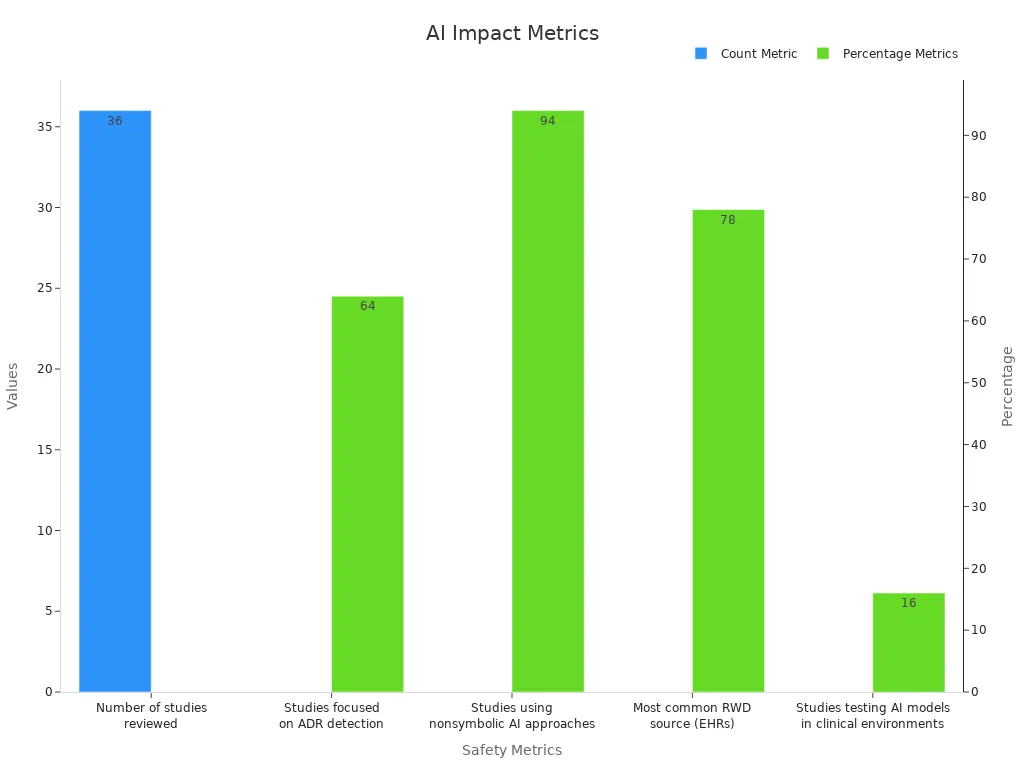
Patient safety remains a top priority in pharma, and AI is proving to be a game-changer in pharmacovigilance. By automating data collection and analysis, AI enhances the detection of adverse drug reactions (ADRs). This capability allows you to identify safety signals in real time, significantly reducing the time needed compared to traditional methods. A recent review revealed that 64% of studies focused on ADR detection, with 94% employing nonsymbolic AI approaches.
Metric | Value |
|---|---|
Number of studies reviewed | 36 |
Studies focused on ADR detection | 64% |
Studies using nonsymbolic AI | 94% |
Most common RWD source (EHRs) | 78% |
Studies testing AI models | 16% |
AI-driven pharmacovigilance systems also improve data transparency and collaboration with contract research organizations (CROs). This transparency ensures that safety data is clean and organized, enabling better compliance with regulations. Companies investing in scalable systems are better positioned to leverage AI insights effectively. As the volume of safety data grows, AI’s role in ensuring patient safety will only become more critical.
AI’s integration into pharmacovigilance not only addresses the challenge of managing large data volumes but also sets a new standard for safety monitoring. By 2025, you can expect AI to be at the forefront of ensuring that drugs are both effective and safe for patients worldwide.
AI-Driven Manufacturing Processes
AI is transforming pharmaceutical manufacturing by streamlining processes and enhancing efficiency. You can now see how AI-driven systems analyze complex datasets to optimize production workflows. Predictive maintenance, for example, minimizes machine downtime by identifying potential issues before they occur. This proactive approach ensures that equipment operates at peak performance, reducing delays and increasing productivity.
Metric | Before AI Implementation | After AI Implementation |
|---|---|---|
Machine Downtime | 15% | 5% |
Productivity | 85% | 95% |
Cost Savings | N/A | 20% |
AI also plays a critical role in quality assurance. By monitoring production in real time, AI systems detect anomalies and ensure that products meet stringent quality standards. This reduces the number of defective products and minimizes waste. For instance, AI has helped reduce defective product rates from 5% to just 1%, while improving overall product quality from 90% to 98%.
Metric | Before AI Implementation | After AI Implementation |
|---|---|---|
Defective Products | 5% | 1% |
Product Quality | 90% | 98% |
Waste and Rework Costs | N/A | 25% reduction |
AI-driven manufacturing processes also enhance supply chain management. By analyzing market trends and demand patterns, AI helps you predict inventory needs and avoid shortages or overstocking. This level of precision not only saves costs but also ensures that essential medications reach patients without delay. As you look toward 2025, the integration of AI in pharma manufacturing will continue to set new benchmarks for efficiency, quality, and reliability.
Tip: Companies that invest in AI-driven manufacturing systems gain a competitive edge by reducing costs and improving operational efficiency. Staying ahead in this rapidly evolving landscape requires embracing these innovations.
Regulatory and Ethical Impacts
The integration of AI in pharma brings significant regulatory and ethical considerations. Regulatory bodies like the FDA emphasize the importance of addressing algorithmic bias and ensuring data representativeness in AI applications. You’ll find that companies like Pfizer and Merck have already demonstrated how AI can improve compliance and manufacturing quality. These advancements lead to time savings, reduced manual workloads, and enhanced accuracy, strengthening their regulatory positions.
AI enhances compliance and efficiency in the pharmaceutical sector.
Companies like Pfizer and Merck demonstrate improved pharmacovigilance and manufacturing quality through AI.
Outcomes include significant time savings, reduced manual workload, and improved accuracy, which strengthen regulatory positions.
The FDA emphasizes the need to address algorithmic bias and data representativeness in AI applications.
Ethical considerations are equally important. AI systems must prioritize human autonomy, ensuring that decision-making remains under human control. This involves designing AI tools that respect privacy, confidentiality, and informed consent. For example, AI-driven systems in healthcare must align with established ethical principles and human rights, ensuring that patient data is handled responsibly.
As AI continues to evolve, you must remain vigilant about its ethical implications. Balancing innovation with ethical responsibility will be crucial for maintaining public trust and ensuring that AI serves the greater good. By 2025, the pharma industry will likely see more robust frameworks to guide the ethical and regulatory use of AI, setting a precedent for other sectors to follow.
Note: Ethical AI integration is not just a regulatory requirement; it’s a moral obligation. Companies that prioritize transparency and fairness will lead the way in building trust and credibility.
AI’s Role in Biotech
Gene Therapy and Genomics Advancements
AI in biotechnology is driving remarkable progress in gene therapy and genomics. By analyzing vast genomic datasets, AI identifies genetic mutations linked to diseases, enabling the development of targeted therapies. For example, hybrid AI systems reduce clinical trial failure rates and accelerate drug discovery, ensuring ethical and safety standards are met. These advancements make emerging therapies like cell and gene therapies more accessible and effective.
You’ll notice that biotech companies are leveraging AI to enhance precision in gene editing techniques like CRISPR. AI algorithms predict off-target effects, ensuring edits are accurate and safe. This precision minimizes risks and improves the success rates of treatments for genetic disorders. The biotech industry is also witnessing a surge in investments, as AI healthcare investments are growing twice as fast as general tech investments. This trend underscores the transformative potential of AI in biotechnology.
AI will cut inefficiencies, align trials with real-world needs, and make precision medicine more than just a lofty goal. By 2025, clinical teams will integrate AI-driven RBQM solutions to unearth hidden risks, safeguard patient safety, and elevate data quality.
Precision Medicine Breakthroughs
Precision medicine is no longer a distant dream, thanks to AI. By analyzing patient data, AI predicts drug responses and minimizes side effects, tailoring treatments to individual needs. In oncology, machine learning algorithms predict patient responses to immunotherapies based on tumor characteristics. This approach improves treatment outcomes and reduces trial-and-error prescribing.
Application Area | Evidence |
|---|---|
Oncology | Machine learning algorithms predict patient responses to immunotherapies based on tumor characteristics. |
Cardiovascular Diseases | Genetic risk scores derived from statistical analysis help assess individual heart disease risk. |
Neurological Disorders | Statistical analysis identifies early biomarkers for Alzheimer’s disease, aiding timely intervention. |
AI also screens compound libraries to predict therapeutic effects, accelerating drug discovery. Biotech companies are using these insights to develop innovative treatments for complex diseases. As the biotech industry continues to evolve, AI will play a pivotal role in advancing cell and gene therapy advances, ensuring that treatments are both effective and personalized.
AI in Immunology and Vaccines
AI is revolutionizing immunology and vaccine development. During the COVID-19 pandemic, AI reduced vaccine development timelines from years to months. By analyzing large datasets, AI identified the spike protein of SARS-CoV-2 as an optimal vaccine target. This breakthrough highlights how AI-driven predictive modeling accelerates target identification and improves vaccine efficacy.
Biotech companies like AstraZeneca have utilized AI to optimize clinical trial designs. Real-time adjustments based on participant data ensure trials are efficient and safe. AI-assisted systems also enhance participant monitoring, improving safety and efficacy. Multi-omic datasets analyzed by AI accelerate the discovery of immunogenic epitopes, increasing the likelihood of successful vaccine development.
AI reduced the conventional vaccine development timeline from years to months during the COVID-19 pandemic.
AI-assisted systems improved the precision of participant monitoring in clinical trials, enhancing safety and efficacy.
Multi-omic datasets analyzed by AI accelerated target identification for vaccines, improving the likelihood of finding effective immunogenic epitopes.
The biotech industry is poised for significant growth as artificial intelligence continues to drive innovation in immunology and vaccines. By 2025, AI in biotechnology will set new standards for efficiency, safety, and effectiveness in vaccine development.
Biotech Investment Trends
Biotech investment is undergoing a transformation, driven by the increasing influence of AI and the demand for innovative solutions. Venture capital plays a pivotal role in funding groundbreaking advancements in this field. However, recent trends reveal a shift in investment patterns. You’ll notice fewer but larger deals as investors adapt to macroeconomic pressures. This approach reflects a focus on late-stage assets, which offer clearer paths to profitability and reduced risk.
The biotech sector is also experiencing rapid growth in AI applications. The AI in biotechnology market is projected to expand from $2.73 billion in 2023 to $7.75 billion by 2029, with a compound annual growth rate (CAGR) of 19.1%. This surge highlights the increasing reliance on AI for advanced data analysis and faster drug development. As a result, biotech companies are attracting significant attention from investors seeking to capitalize on these advancements.
For you, this means that understanding these trends is essential. Investors are prioritizing companies that leverage AI to streamline processes and deliver measurable outcomes. Late-stage biotech firms with proven technologies and clear regulatory pathways are particularly appealing. By focusing on these areas, you can identify opportunities that align with the evolving landscape of biotech investment.
Tip: Keep an eye on biotech firms integrating AI into their operations. These companies are likely to drive the next wave of innovation and profitability in the sector.
Challenges and Opportunities in Biotech AI
The integration of AI into biotech presents both challenges and opportunities. One of the most pressing concerns is patient confidentiality. Large datasets, while invaluable for AI models, can compromise anonymity if not managed properly. Implementing robust data governance and security measures is critical to addressing this issue.
Another challenge lies in data quality and bias. AI models trained on biased datasets can lead to unintended consequences, particularly in patient care. Companies must prioritize effective dataset design and adopt best practices to mitigate these risks. Regulatory compliance also poses a significant hurdle. Stricter requirements mean organizations must invest in compliance programs and regular audits to avoid penalties.
Challenge/Opportunity | Description |
|---|---|
Patient confidentiality | Ensuring the security of sensitive patient data is critical, as large datasets can lead to loss of anonymity. Organizations must implement data governance and security measures to protect patient information. |
Data quality and bias | AI models trained on real-world data can contain biases, leading to significant consequences for patients. Companies need to ensure effective dataset design and mitigate bias through best practices. |
Regulatory compliance | Stricter regulatory requirements increase risks for organizations that fail to comply, leading to legal and financial penalties. A robust compliance program and regular audits are essential to minimize these risks. |
Skills gaps and workforce | A significant barrier to AI initiatives is the lack of skilled talent, with over half of organizations lacking the right mix of AI expertise. Partnerships and collaborations are being used to address this skills gap. |
Despite these challenges, the opportunities are immense. AI enhances risk management by providing tools for monitoring and analysis, transforming how organizations handle compliance and operational risks. Additionally, partnerships and collaborations are helping to bridge the skills gap, enabling companies to harness AI’s full potential. For you, this means that the biotech sector remains a fertile ground for innovation and growth, provided these challenges are addressed effectively.
Note: Companies that proactively tackle these challenges will position themselves as leaders in the biotech AI space, paving the way for sustainable growth and innovation.
AI’s Role in Tech

Intelligent Automation Trends
Intelligent automation is reshaping the tech landscape by streamlining operations and enhancing productivity. You’ll notice that businesses increasingly rely on AI to automate repetitive tasks, allowing employees to focus on higher-value activities. This shift not only improves efficiency but also boosts employee satisfaction. For instance, automation success metrics reveal significant improvements in quality output, productivity, and reliability.
Metric | Description |
|---|---|
Quality Output | Measures if the output meets expected quality levels, enhancing reliability and growth. |
Better Productivity | Assessed through cycle time, resource utilization, and task completion rates, indicating efficiency. |
Motivated Staff | Employee satisfaction and motivation can be gauged through surveys and retention rates. |
ROI / Cost Reduction | Financial impact assessed through ROI analysis, considering savings from reduced working hours. |
Reliability | Evaluated by comparing error rates and downtimes before and after automation. |
Customer Satisfaction | Key indicator of automation’s impact on customer experience, measured through satisfaction surveys. |
AI-driven solutions in automation also enable predictive analytics, helping you anticipate potential issues before they arise. This proactive approach minimizes downtime and ensures seamless operations. By 2025, intelligent automation will become a cornerstone of tech innovation, driving both operational excellence and strategic growth.
AI in Supply Chain Optimization
AI is revolutionizing supply chain management by improving efficiency and reducing costs. You’ll see companies adopting AI to optimize inventory levels, enhance logistics, and improve service delivery. For example, AI reduces forecast errors by 20%-50%, leading to fewer lost sales and better customer satisfaction.
Metric | Value |
|---|---|
Forecast Error Reduction | 20%-50% |
Lost Sales Reduction | 65% |
Predictive Maintenance Reduction | 75% |
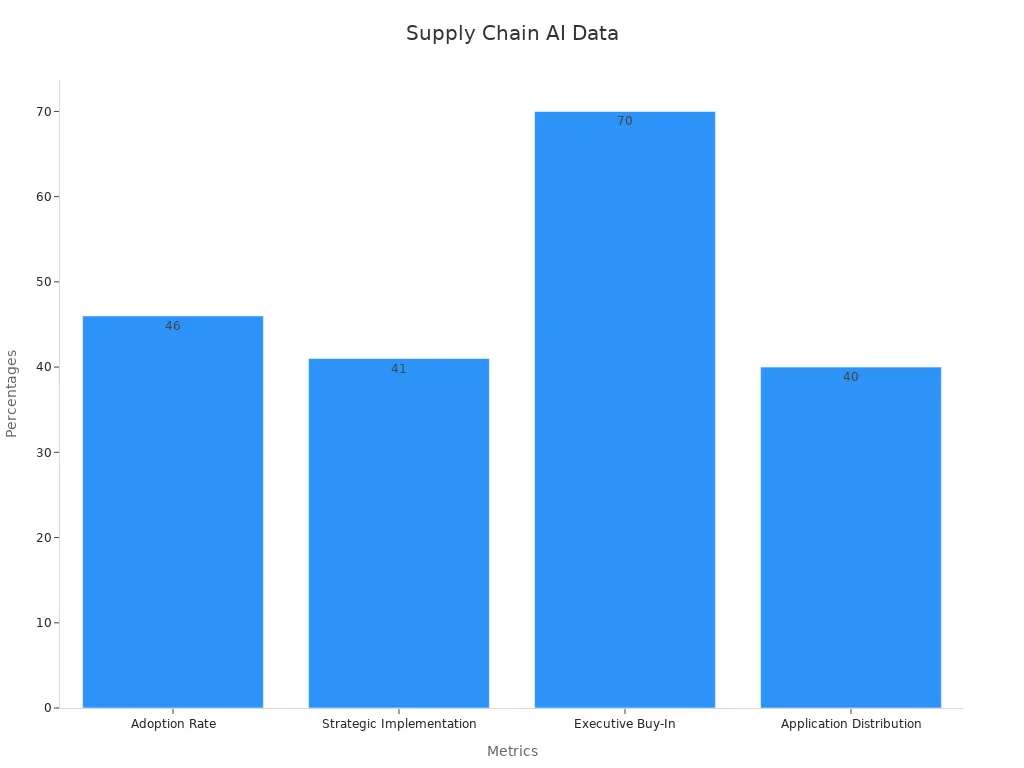
AI also enables real-time tracking and predictive maintenance, ensuring that supply chains remain resilient even during disruptions. The adoption rate of AI in supply chain optimization has reached 46%, with 70% of executives supporting its implementation. These advancements highlight how AI empowers businesses to make data-driven decisions, aligning strategies with market demands.
By leveraging AI, you can achieve higher returns on investment and improve overall supply chain performance. As the market for AI in supply chain management grows, its transformative impact will continue to shape the tech industry.
Generative AI Applications
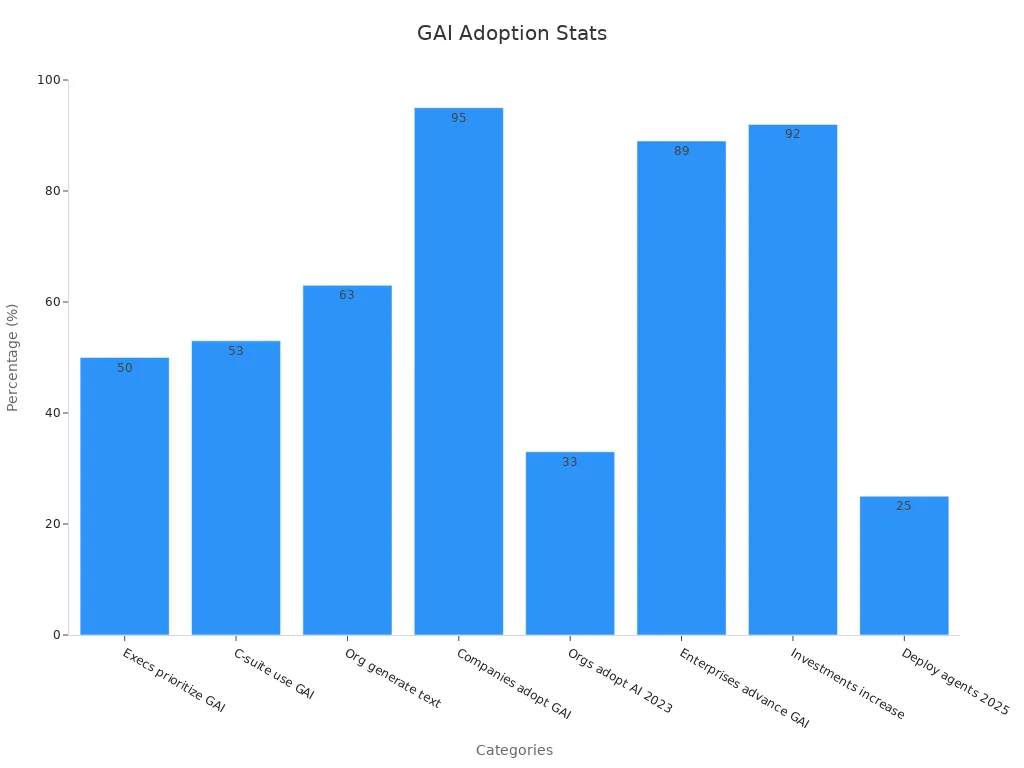
Generative AI is unlocking new possibilities in creativity and innovation. You’ll find that businesses are using generative AI to create content, design products, and even develop software. Nearly 95% of companies have adopted generative AI, with many focusing on text generation and intelligent agents. This technology is projected to contribute $2.6 to $4.4 trillion to the global economy.
Statistic | Value | Description |
|---|---|---|
Executives prioritizing GAI | 50% | Nearly half of executives see GAI as a top 3 priority due to its disruptive potential. |
Organizations generating text | 63% | The majority of organizations focus on text generation with generative AI. |
Projected economic contribution | $2.6 to $4.4 trillion | GAI could significantly boost the economy across various use cases. |
Generative AI also enhances innovation by enabling rapid prototyping and personalized customer experiences. As adoption rates rise, you’ll see more businesses integrating generative AI into their workflows to stay competitive. By 2025, this technology will redefine how organizations approach creativity and problem-solving.
Takeaway: Embracing AI-driven solutions in automation, supply chain management, and generative applications will position you at the forefront of tech innovation. These advancements not only optimize operations but also unlock new opportunities for growth and creativity.
Emerging AI-Driven Tech Startups
AI-driven startups are reshaping the technology landscape, offering innovative solutions across diverse industries. These startups are thriving in niches like generative AI, automation, healthcare diagnostics, and computer vision. You’ll notice that their influence is growing rapidly, fueled by advancements in AI and increasing venture capital interest. Despite a high failure rate, these startups continue to attract significant funding due to their transformative potential.
Metric | Value |
|---|---|
AI Market Size (2022) | |
AI Market Size (2027 projected) | $407 billion |
Corporate Productivity Belief | 64% believe AI increases productivity |
Global Cloud AI Market Size | $44.97 billion |
The AI market is projected to grow at a compound annual growth rate (CAGR) of 37.3% from 2023 to 2030. This growth reflects the increasing reliance on AI to solve complex problems and improve efficiency. Startups are leveraging this momentum to develop groundbreaking technologies. For instance, generative AI startups are creating tools that enhance creativity, while automation-focused companies streamline business operations.
Tip: Keep an eye on emerging startups in healthcare diagnostics and computer vision. These areas are poised for significant breakthroughs, offering opportunities for early adopters to gain a competitive edge.
By 2025, you can expect AI-driven startups to play a pivotal role in shaping the future of technology. Their ability to innovate and adapt will continue to drive growth, making them key players in the evolving tech ecosystem.
Ethical and Privacy Challenges in Tech
The rapid adoption of AI and other technologies brings ethical and privacy challenges that demand your attention. Data privacy remains a critical concern, as companies collect and use personal information without adequate consent. Balancing cybersecurity needs with individual privacy rights presents a significant ethical dilemma.
Ethical Dilemmas in Emerging Technologies | Description |
|---|---|
Data Privacy | Concerns regarding the collection and use of personal data without consent. |
Risks Associated with AI | Ethical implications of AI decision-making and potential biases. |
Developing Sustainable Environments | Balancing technological advancement with environmental sustainability. |
Health Implications due to Technology | Ethical concerns related to health data and technology use. |
Infodemic and Data Weaponization Issues | Challenges in managing misinformation and data misuse. |
High-profile data breaches have highlighted the importance of protecting sensitive information. As technology evolves, you’ll find that ethical decision-making becomes more complex. Professionals must navigate the fine line between innovation and responsibility, ensuring that AI systems respect privacy and minimize biases.
Note: Privacy is not just a legal requirement; it’s a fundamental human right. Companies that prioritize ethical practices will build trust and foster long-term success.
By addressing these challenges head-on, you can help create a tech landscape that balances innovation with ethical responsibility. This approach will ensure that technology serves humanity while safeguarding individual rights.
Investment and Equity Trends
AI-Driven Equity Market Shifts
Artificial intelligence is reshaping equity markets, offering you tools to navigate complexities with greater precision. AI-driven systems enhance portfolio oversight by providing real-time monitoring and automated rebalancing. These capabilities allow you to respond swiftly to changing risk-reward dynamics, ensuring your investments remain aligned with market conditions. Research from the University of Hamburg reveals that AI-enhanced models can boost portfolio performance by up to 1.5% annually. This improvement underscores the transformative potential of AI in optimizing financial strategies.
Firms leveraging AI tools consistently outperform market consensus over 60% of the time. This track record demonstrates how innovation in AI empowers you to achieve alpha-rich returns. By integrating predictive analytics, you can anticipate market shifts and make informed decisions. These advancements not only improve risk assessment but also enhance your ability to seize emerging opportunities. As AI continues to evolve, its role in equity markets will grow, offering you a competitive edge in an increasingly dynamic landscape.
Takeaway: Embracing AI-driven tools in equity management can help you stay ahead of market trends, ensuring your portfolio remains resilient and adaptive.
IPO Trends in AI-Enhanced Sectors
The IPO landscape in AI-enhanced sectors is experiencing notable growth, reflecting the increasing demand for innovation-driven companies. In the first half of 2024, there were 14 technology IPOs, up from 9 during the same period in 2023. While the total number of technology IPOs in 2023 reached 22, the average deal size decreased from approximately $304 million in 2023 to $234 million in 2024. This shift suggests a focus on smaller, more agile companies that prioritize scalability and technological breakthroughs.
For you, this trend highlights the importance of identifying companies with strong AI integration. These firms often demonstrate higher growth potential, driven by their ability to leverage AI for operational efficiency and market differentiation. As the IPO market evolves, you’ll notice a growing emphasis on sectors like healthcare, biotech, and tech, where AI plays a pivotal role in driving innovation. By staying informed about these trends, you can better position yourself to capitalize on emerging opportunities in AI-enhanced industries.
Tip: Keep an eye on IPOs in sectors where AI adoption is accelerating. These companies often lead the way in innovation, offering you a chance to invest in the future of technology.
Mergers and Acquisitions in AI
Mergers and acquisitions (M&A) in AI are reshaping industries, creating opportunities for you to benefit from corporate consolidations. A recent survey shows that 48% of M&A professionals now use AI in due diligence, a significant increase from 20% in 2018. AI tools automate data collection and analysis, enabling quicker and more comprehensive assessments. These capabilities allow you to evaluate market conditions and competitive landscapes with greater accuracy.
Generative AI is also gaining traction in M&A. A Bain report predicts that its use will rise from 16% to 80% within three years, particularly among larger companies in tech, healthcare, and finance. This growth reflects the increasing reliance on AI to streamline processes and uncover synergies. For example, AI-driven analytics provide real-time insights into market trends, helping you identify strategic opportunities.
As M&A activity intensifies, you’ll see AI playing a central role in shaping corporate strategies. Companies that adopt AI-driven approaches gain a competitive advantage, enabling them to navigate complexities and achieve sustainable growth. By understanding these dynamics, you can better assess the impact of M&A on your investments and identify opportunities that align with your goals.
Note: The rise of AI in M&A underscores the importance of staying informed about technological advancements. By leveraging AI-driven insights, you can make more strategic decisions in an evolving market.
Sector-Specific Investment Opportunities
AI is unlocking investment opportunities across a wide range of industries, each with its own unique potential for growth. By focusing on sector-specific trends, you can identify areas where AI is driving innovation and creating value.
Healthcare and Biotech
In healthcare, AI is revolutionizing diagnostics, drug discovery, and personalized medicine. Companies leveraging AI to analyze patient data and predict treatment outcomes are attracting significant investor interest. For example, biotech firms using AI to accelerate clinical trials and develop gene therapies are seeing increased funding. These advancements not only improve patient care but also reduce costs, making healthcare a prime sector for AI-driven investments.
Technology and Semiconductors
The tech sector continues to lead in AI adoption, with semiconductors playing a critical role in powering AI applications. Companies like Nvidia are at the forefront, developing GPUs that enhance computational efficiency. These innovations are essential for training larger AI models, which are expected to dominate the market by 2025. Investing in semiconductor firms and AI-native startups offers you a chance to capitalize on this growth.
Finance and Retail
AI is transforming finance through predictive analytics and automated trading systems. Banks and investment firms are using AI to optimize portfolios and manage risks, creating opportunities for you to invest in companies offering these solutions. In retail, AI-driven personalization and supply chain optimization are helping businesses improve customer experiences and reduce operational costs. This makes retail tech another promising area for AI-focused investments.
Energy and Sustainability
AI is also making waves in the energy sector by optimizing resource allocation and improving grid management. Companies using AI to develop renewable energy solutions or enhance energy efficiency are gaining traction among investors. These innovations align with global sustainability goals, offering you a chance to invest in businesses that combine profitability with environmental responsibility.
Tip: Diversify your portfolio by exploring AI-driven opportunities across multiple sectors. This approach helps you balance risk while maximizing potential returns.
Long-Term 2025 Forecasts for AI Growth
The future of AI looks incredibly promising, with 2025 poised to be a pivotal year for its expansion. Several key trends and projections highlight the transformative potential of AI across industries.
AI-native applications are expected to attract over $45 billion in funding in 2024, marking a 70% increase from the previous year. This momentum reflects strong investor appetite and the growing capital needs of AI-driven businesses.
Major firms like Blackrock and Vanguard are focusing on sectors such as semiconductors and data centers, underscoring AI’s role as a game changer for efficiency and productivity.
Advances in computational power will further accelerate AI adoption. Nvidia’s upcoming GPUs, set to launch in 2025, promise to be 25 times more power-efficient and 30 times faster than current models.
Scaling laws in AI indicate that larger models and datasets lead to better performance. This trend suggests that future AI systems may require up to 10,000 times more computational power, driving demand for cutting-edge hardware.
AI’s impact is often compared to the internet’s transformative effect, with continued investment opportunities anticipated across various sectors.
These projections align with broader 2025 predictions, emphasizing AI’s role in shaping the future of industries. By staying informed about these trends, you can position yourself to benefit from AI’s long-term growth.
Takeaway: The 2025 forecast for AI highlights its potential to redefine industries and create new investment opportunities. Staying ahead of these trends will help you navigate the evolving landscape with confidence.
AI is reshaping equity trends by addressing systemic biases and fostering inclusivity across industries. Its ability to leverage data-driven insights enables evidence-based policies that reduce discrimination and improve outcomes for marginalized groups. For investors and policymakers, actionable strategies include using historical context to refine forecasts, aligning investments with predictive insights, and employing macroeconomic analysis for risk management. By embracing these tools, you can anticipate market shifts and make informed decisions. As 2025 approaches, AI’s transformative potential offers you a unique opportunity to drive equity and innovation across sectors.
FAQ
What is the role of AI in shaping equity trends?
AI analyzes vast datasets to identify patterns and predict market shifts. It helps you make informed decisions by offering insights into emerging opportunities, risks, and sector-specific growth. This data-driven approach enhances precision and reduces uncertainty in equity markets.
How does AI improve drug discovery in pharma?
AI accelerates drug discovery by analyzing molecular data to identify potential compounds. It reduces development timelines from years to months, saving costs and improving efficiency. This innovation enables you to bring life-saving treatments to market faster.
Why is AI important for biotech investments?
AI drives advancements in genomics, precision medicine, and vaccine development. It reduces inefficiencies and enhances success rates in clinical trials. For investors, this means biotech companies leveraging AI often demonstrate higher growth potential and innovation.
What are the ethical challenges of AI in tech?
AI raises concerns about data privacy, algorithmic bias, and decision-making transparency. You must ensure that AI systems respect individual rights, minimize biases, and prioritize ethical practices to build trust and foster long-term success.
How can you identify AI-driven investment opportunities?
Focus on sectors like healthcare, tech, and energy where AI adoption is accelerating. Look for companies using AI to innovate, streamline operations, or enhance customer experiences. Diversifying your portfolio across these areas can maximize returns while managing risks.
AI, Markets, and the Path Forward
Navigating the journey of wealth creation is more art than science, especially in a world where technology and markets shift almost overnight. At VASRO, we understand that true financial success comes from looking beyond the noise—embracing both long-term vision and daily discipline. With artificial intelligence now at the forefront of equity analysis, investors have access to sharper insights and deeper foresight than ever before, particularly in dynamic sectors like pharma, biotech, and tech. But while AI-driven tools can illuminate trends and forecast shifts, smart investing still rests on timeless principles: careful research, a clear understanding of risk, and the patience to let your strategy unfold. At VASRO, we value precision and clarity in every report, empowering you to make informed choices that stand the test of time. As you chart your own path to financial growth, remember that real wealth isn’t built on hype—it’s built on insight, adaptability, and a steady hand through every market cycle.
Disclaimer: The information provided on www.vasro.de is for general informational purposes only and does not constitute investment advice or a recommendation to invest in any particular asset or market. VASRO GmbH does not offer personalized investment advice, and the content on this website should not be relied upon as such. Visitors are encouraged to seek independent financial advice tailored to their specific circumstances before making any investment decisions. VASRO GmbH disclaims any liability for investment decisions made based on the information presented on this website.