


You see technology trends transform the way small- and mid-cap companies operate each day. These technology trends push you to rethink your approach, especially as mid-cap companies step forward with bold investments in AI infrastructure and innovative product development. The numbers tell a clear story.
Segment | Growth Rate | Context |
|---|---|---|
Small and Mid-sized Enterprises | Projected growth in AI adoption for cybersecurity solutions |
You recognize the drive for automation, improved decision-making, and enhanced customer experiences as core reasons for this surge. Technology trends do not just shape your operations—they redefine your strategic direction. As you witness this rapid evolution, you gain an edge by staying alert to the opportunities and risks these technology trends present.
Table of Contents
Key Takeaways
Mid-cap companies lead in AI adoption, using agility to implement automation and analytics for efficiency.
Enhancing customer experience through AI personalization builds loyalty and attracts new clients.
Investing in robust AI infrastructure, like data centers, supports growth and scalability in technology.
Navigating investment risks requires careful management of debt and market volatility to ensure sustainable growth.
Small-cap companies excel by focusing on niche AI solutions, allowing them to capture early market opportunities.
Cybersecurity threats, such as ransomware and phishing, demand proactive strategies to protect data and reputation.
Adopting cloud and hybrid models enables flexibility and cost management, essential for modern business operations.
Building strategic partnerships enhances capabilities and market reach, driving innovation and growth.
AI Revolution in Mid-Cap Companies

AI Adoption Trends
Automation and Analytics
You see mid-cap companies at the forefront of the ai revolution, using their agility to implement ai-powered solutions that drive efficiency and innovation. Unlike large-cap firms, you can move quickly, adopting automation tools and advanced analytics without the burden of bureaucracy. This nimbleness allows you to extract insights from unstructured data—like customer service handbooks and call transcripts—using generative ai. You do not need a massive data science team to unlock value from these resources. Instead, you use ai applications to streamline operations, reduce costs, and improve decision-making.
You often choose ai-powered growth strategies that focus on automating repetitive tasks.
You leverage ai-driven diagnostics to identify trends and anomalies in your business data.
You use analytics to forecast demand, optimize supply chains, and enhance productivity.
This approach gives you a competitive edge, especially as you respond to market changes faster than larger organizations.
Customer Experience
You recognize that customer experience sets you apart in a crowded market. With ai-powered solutions, you personalize interactions, resolve issues faster, and anticipate customer needs. You use ai applications to analyze feedback, monitor sentiment, and tailor your services. This focus on customer experience not only builds loyalty but also drives growth by attracting new clients who value responsive, tech-savvy partners.
Tip: You can use ai to analyze call transcripts and support tickets, uncovering hidden pain points and opportunities for improvement.
AI Infrastructure Growth
Data Centers
You understand that robust ai infrastructure forms the backbone of your digital transformation. Many mid-cap companies invest in new data centers to support ai workloads, especially in regions experiencing rapid expansion. The Asia Pacific region leads this growth, with India, Indonesia, Brazil, Mexico, and the UAE emerging as important markets for data center development.
Region | Significance in AI Data Center Market |
|---|---|
Asia Pacific | Fastest growing market |
India | Emerging player |
Indonesia | Emerging player |
Brazil | Emerging player |
Mexico | Emerging player |
UAE | Emerging player |
You see this trend as a signal to scale your operations and support high-growth ai technologies. By building or partnering for advanced data centers, you ensure your ai-driven products have the computing resources they need.
Computing Power
You know that ai infrastructure requires significant computing power. You invest in hardware and cloud solutions that can handle complex ai workloads. This investment supports not only your current needs but also positions you for future expansion as ai adoption accelerates. The momentum in ai infrastructure spending among mid-cap companies shows no sign of slowing, reflecting strong demand for scalable, reliable platforms.
Investment Opportunities and Risks
Growth Potential
You find that the ai revolution creates compelling opportunities for investors and business leaders. Mid-cap companies often trade at attractive valuations, offering a chance to participate in ai-powered growth at a discount compared to large-cap firms. Your willingness to take calculated risks and your focus on innovation make you a magnet for private equity and strategic partners. As you expand your ai capabilities, you unlock new revenue streams and strengthen your market position.
Debt Financing Risks
You must also navigate risks that come with rapid investment in ai. Market volatility can shift sentiment quickly, moving from optimism to caution. Some companies rely on debt financing to fund their ai initiatives, which can create financial strain if market conditions change. You may see elevated valuations in the ai sector, sometimes resembling past market bubbles. Circular financing arrangements can mask underlying economic issues, making it important to assess the sustainability of your growth strategies.
You face market volatility as expectations for ai shift.
You must manage debt financing carefully to avoid overextension.
You need to evaluate whether current valuations reflect true business fundamentals.
Note: You can mitigate these risks by focusing on sustainable growth, transparent financial practices, and ongoing market analysis.
By understanding both the opportunities and the risks, you position yourself to lead in the ai revolution, driving innovation and value creation in the mid-cap segment.
Artificial Intelligence in Small-Cap Companies
Niche AI Innovation
Specialized Solutions
You see small-cap ai companies making their mark by focusing on specialized solutions that larger firms often overlook. Their agility allows you to respond quickly to emerging needs in sectors like health care, agriculture, and logistics. In the field of ai in healthcare, you find small-cap ai firms advancing early disease detection with ai-powered imaging, personalizing medicine by analyzing genetic data, and driving drug discovery with machine learning. These targeted innovations help you carve out a unique space in the artificial intelligence landscape.
Early disease detection with ai imaging
Personalized medicine through genetic data analysis
Drug discovery powered by ai
Market Differentiation
You understand that small-cap ai companies often gain early-mover advantages by developing unique applications. Your ability to adapt quickly lets you capture growth opportunities before larger competitors react. Investors see small-cap ai stocks as appealing due to their potential for rapid growth and their focus on niche markets. You often develop proprietary solutions that set you apart, giving you a competitive edge in a crowded field.
Supporting AI Ecosystems
Data Center Operations
You play a vital role in supporting the broader ai ecosystem. Many small-cap ai companies provide specialized technologies that enhance ai infrastructure, hardware, and software. For example, Fabrinet manufactures optical components essential for ai data centers, boosting performance for machine learning applications. Your contributions help power the next generation of ai solutions.
Partnerships with Large Tech
You often collaborate with industry leaders to expand your reach and capabilities. Partnerships with companies like NVIDIA allow you to integrate advanced technologies and scale your offerings. These alliances show how small-cap ai firms can support and enhance the work of larger players, strengthening the entire ai ecosystem.
Challenges for Small-Cap AI Firms
Funding and Talent
You face significant challenges in securing funding and attracting top talent. The demand for ai specialists far exceeds the supply, driving salaries higher than those offered by established tech companies. You must compete fiercely for skilled engineers and researchers, often reshaping your recruitment strategies and compensation packages.
Challenge | Description |
|---|---|
High Development Costs | ai development requires major investment in computing power and talent. |
Discerning Investors | Venture capitalists demand a clear path to profitability and solid planning. |
Market Visibility
You know that limited market visibility can affect your growth prospects. Many small-cap ai companies experience high volatility, with sharp price swings due to low trading volumes and shifting investor sentiment. You often lack analyst coverage, making it harder for investors to evaluate your business. Weaker balance sheets and evolving regulations add to the uncertainty, while the outcomes of ai models can be difficult to validate, sometimes damaging trust.
Challenge | Description |
|---|---|
High Volatility | Small-cap ai stocks often experience sharp price swings due to low trading volumes and investor sentiment shifts. |
Limited Analyst Coverage | Many small-cap ai companies lack professional insights, making due diligence harder for investors. |
Weaker Balance Sheets | These companies often operate with limited cash reserves, making them vulnerable to economic downturns. |
Regulatory Risks | Evolving ai regulations can impose compliance costs or restrictions, delaying product launches. |
AI Model Uncertainty | Outcomes from ai models can be hard to validate, leading to unreliable results and damaging trust. |
You see that successful small-cap companies overcome these hurdles by focusing on innovation, building strong partnerships, and maintaining financial discipline. Your adaptability and strategic vision position you to thrive in the evolving ai landscape.
Technology Trends in Cybersecurity
Threat Landscape
Ransomware and Phishing
You face a rapidly changing threat landscape where attackers use advanced tools to target your business. Ransomware has evolved into double-extortion schemes, threatening both your data and your reputation. Payment demands often exceed $1 million, and you may experience downtime that lasts over 20 days. Attackers also use artificial intelligence to create personalized phishing emails. These messages look convincing and can trick your team, with click-through rates now exceeding 30%. You must stay alert, as these threats can disrupt your operations and damage trust with your clients.
Cyber Threat Type | Description | Impact |
|---|---|---|
AI-Driven Phishing | Cybercriminals use AI to create personalized phishing emails. | Click-through rates exceed 30%, significantly higher than traditional phishing attempts. |
Ransomware | Evolved to double-extortion schemes, threatening data availability and confidentiality. | Payment demands often exceed $1 million, with average downtime over 20 days. |
Supply Chain Attacks | Exploit trusted relationships to compromise third-party systems. | Can remain undetected for months, leading to significant data breaches. |
Cloud Misconfigurations | Human error leads to data breaches due to misconfigured cloud settings. | Over 65% of cloud security incidents are due to human error, exposing sensitive data. |
Insider Threats | Threats from employees or contractors with authorized access. | Can lead to significant data theft or security incidents due to negligence or malice. |
Supply Chain Risks
You know that supply chain attacks can remain hidden for months, making them especially dangerous. Attackers exploit trusted relationships with your vendors or partners to access your systems. You must map out your supply chain to identify critical vendors. You should establish security standards in your contracts and monitor updates for mission-critical software. Regular reviews of your cybersecurity protocols and vendor assessments help you reduce these risks. By adopting the NIST Cybersecurity Framework 2.0, you align your efforts with industry best practices and strengthen your defenses.
Cybersecurity Strategies
Managed Services
You may not have a large internal security team, so you turn to managed security services for support. These providers monitor your systems, respond to incidents, and help you stay ahead of threats. Managed services give you access to advanced tools and expertise that might otherwise be out of reach. This approach allows you to focus on your core business while maintaining strong protection.
Zero Trust
You see more small- and mid-cap companies adopting zero trust models. In North America, businesses like yours lead this trend, driven by the need for reliable security in a complex environment. Zero trust means you verify every user and device, no matter where they connect from. This model reduces the risk of insider threats and limits the damage if an attacker gains access. Large enterprises drive the market, but you benefit as these practices become more accessible and affordable.
Tip: You can combine zero trust with ai-powered cybersecurity to enhance your defenses and detect threats faster.
Compliance and Trust
Regulatory Demands
You must keep up with new regulations that set higher standards for cybersecurity. The Cyber Resilience Act establishes binding requirements for products with digital elements, aiming for uniform security standards across the EU. Key obligations begin in autumn 2026, with full provisions by December 2027. The Digital Omnibus simplifies EU data laws, combining the Data Act and GDPR, and proposes changes to improve data access while protecting citizens’ rights.
Regulation | Key Features |
|---|---|
Cyber Resilience Act (CRA) | Establishes binding minimum cybersecurity requirements for products with digital elements. |
Aims to create uniform security standards across the EU to protect against digital threats. | |
Key obligations start in autumn 2026, with full provisions applying from December 2027. | |
Digital Omnibus | Simplifies EU data laws into two major laws: the Data Act and GDPR. |
Proposes amendments to enhance data access while maintaining high protection for citizens’ rights. |
Customer Confidence
You build trust with your customers by showing that you take security seriously. When you comply with regulations and adopt best practices, you reassure clients that their data is safe. You also protect your reputation and create a foundation for long-term growth. In today’s market, strong cybersecurity is not just a technical requirement—it is a key part of your business strategy.
Note: You can use ai-enhanced threat detection and robust data center infrastructure to support your compliance efforts and strengthen customer confidence.
Digital Infrastructure Transformation

Cloud and Hybrid Models
Migration Strategies
You see that moving to the cloud is no longer just an option—it is a necessity for growth and resilience. You often start with a hybrid approach, blending on-premises systems with cloud services to minimize risk and disruption. This strategy lets you test workloads in the cloud before a full migration. You can prioritize mission-critical applications and move them in phases. You also work with trusted partners to ensure a smooth transition. By taking these steps, you reduce downtime and keep your business running smoothly.
Cost and Scale
You know that cloud and hybrid models help you manage costs and scale operations. You pay only for the resources you use, which means you can adjust spending as your needs change. This flexibility supports your growth, especially when you need to respond quickly to market shifts. You can add storage or computing power without investing in expensive hardware. This approach also helps you support remote teams and new digital services.
Networking Upgrades
SD-WAN
You recognize that networking upgrades drive efficiency and agility. SD-WAN gives you better control over your network traffic. You can route data through the best available path, which improves performance and reliability. SD-WAN also helps you manage bandwidth more effectively, so you avoid bottlenecks and keep your teams productive.
5G and Edge
You see 5G and edge computing as game changers for your operations. These technologies deliver faster connectivity and lower latency. You can support remote workforces and connect devices across multiple locations. You also reduce your reliance on outdated systems. Here is how SD-WAN and 5G adoption improve your operational efficiency:
Enhanced connectivity for all your sites and teams
Optimized bandwidth usage for critical applications
Support for remote workforces, increasing flexibility
Cost reduction through seamless integration
Security integration that protects sensitive data
You use these upgrades to build a strong foundation for your ai and cybersecurity initiatives.
Infrastructure Challenges
Legacy Integration
You face real challenges when you integrate legacy systems with new infrastructure. Data silos and fragmentation make it hard to share information across departments. Compatibility issues slow down your progress. You may need to invest in specialized tools and expertise, which increases costs. System downtime and disruption can occur if you do not plan carefully. Employees may resist change because they feel comfortable with old systems.
Compatibility issues with outdated technologies
Security risks from legacy systems
High integration costs for tools and expertise
System downtime and disruption during upgrades
Resistance to change among staff
Security Concerns
You understand that security remains a top priority as you upgrade your infrastructure. Legacy systems often lack modern security features, making them vulnerable to cyber threats. You address these risks by adopting new security protocols and monitoring tools. Companies like Qualys use cloud-based cybersecurity solutions and ai-powered tools to manage application risks and detect threats. Fastly’s infrastructure software supports secure cloud computing and optimizes ai applications. These examples show how digital infrastructure upgrades help you protect your business and support innovation.
Tip: You can strengthen your defenses by combining network optimization with advanced security features.
Investment Implications for Technology Trends
Growth Sectors
AI and Infrastructure
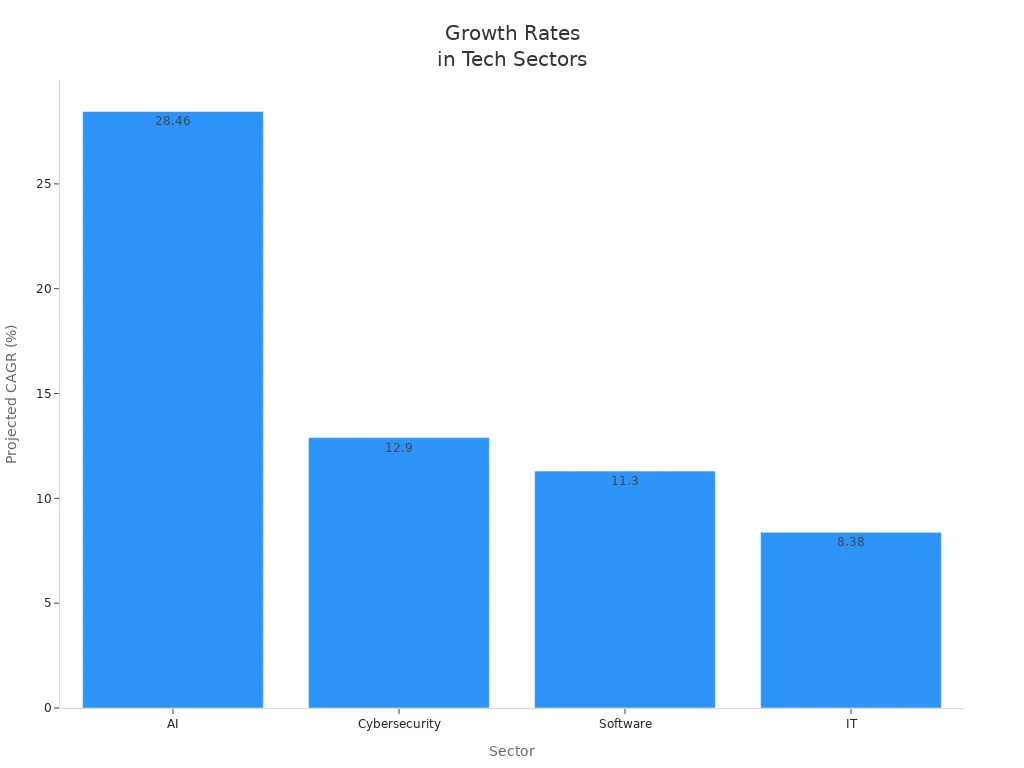
You see the landscape for investing in mid-cap companies shifting rapidly as technology trends accelerate. Sectors like ai and digital infrastructure stand out for their remarkable growth. The projected compound annual growth rate for ai reaches 28.46%, making it the fastest-growing industry among small- and mid-cap firms. Infrastructure upgrades, including cloud migration and data center expansion, fuel new revenue streams and support scalable business models. You notice that software and IT also show strong momentum, with growth rates of 11.3% and 8.38% respectively. These sectors offer you opportunities to capture value as digital solutions become essential for business operations.
Sector | Projected CAGR | Notes |
|---|---|---|
AI | 28.46% | Fastest-growing industry, significant impact on digital solutions. |
Cybersecurity | 12.9% | Increased demand for security as more activities move online. |
Software | 11.3% | Continued reliance on digital solutions drives growth. |
IT | 8.38% | Broad industry with high growth potential, projected market size growth. |
Cybersecurity
You recognize cybersecurity as a critical area for investing. The sector’s projected growth rate of 12.9% reflects rising demand for protection as more business activities move online. Mid-cap companies that prioritize security build trust and unlock new revenue opportunities. You see that robust cybersecurity strategies not only safeguard assets but also position your business for sustainable growth.
Risk Management
Adoption Risks
You face several risks when investing in technology-driven mid-cap companies. Expensive, speculative stocks often drive index returns, creating volatility. Quality companies show mid-teens earnings growth, but you must evaluate whether these gains are sustainable. Ai adoption and reshoring create tailwinds, yet margin pressures may arise if companies pass costs to consumers. You may encounter stagflation risks if workforce reductions occur to maintain margins.
Expensive, speculative stocks drive index returns.
Quality companies show mid-teens earnings growth.
Ai adoption and reshoring create tailwinds for smaller companies.
Risk Description | Implication |
|---|---|
Margin pressures due to cost passing | Potential stagflation if companies cut workforces to maintain margins |
Concentration of capital spending in megacap tech | Risks of overcapacity similar to past market behaviors |
Stagflation risks if costs are passed to consumers.
Potential workforce reductions to maintain margins.
Overcapacity risks from concentrated capital spending.
Regulatory Risks
You must stay alert to evolving regulations that impact technology adoption. New laws can impose compliance costs or restrict product launches, affecting revenue and growth. You see that regulatory uncertainty may delay innovation, so you need to monitor changes and adjust your investing strategy accordingly.
Strategic Approaches
Partnerships
You benefit from engaging in joint ventures and strategic partnerships. These approaches help you leverage strengths in ai and infrastructure, as seen in collaborations like Dell and NVIDIA. Partnerships allow you to access new markets, share expertise, and accelerate growth. You see that mid-cap companies thrive when they build alliances that support innovation and revenue expansion.
Joint ventures and strategic partnerships drive technology adoption.
Collaborations help you scale ai and infrastructure solutions.
Internal Capabilities
You strengthen your position by developing internal capabilities. Nontraditional hiring methods, such as reverse acqui-hiring, enable you to acquire specialized talent quickly. You focus on building teams that adapt to rapid technology change. Investing in internal skills and resources ensures you remain competitive and resilient as the market evolves.
Tip: You can combine partnerships with internal capability development to maximize growth and minimize risk in your investing strategy.
You see that thoughtful investing in mid-cap technology companies requires balancing opportunity with risk. By focusing on high-growth sectors, managing adoption and regulatory risks, and pursuing strategic approaches, you position yourself to capture revenue and drive innovation in a dynamic market.
Future Outlook for Small- and Mid-Cap Technology
Next-Gen AI
You stand at the edge of a new era in artificial intelligence. Small- and mid-cap companies now drive innovation in ways that reshape entire industries. You see leaders like Sensata, UiPath, and Five9 setting the pace for next-generation AI adoption. Sensata’s focus on self-driving technology signals a shift in automotive sensors, with revenue growth projected to reach 8% by 2026. UiPath continues to automate routine tasks, and improvements in AI allow you to tackle more complex processes. This progress points toward potential profitability by the end of the decade. Five9’s AI-powered customer service tools promise revenue growth of 21% in 2025, accelerating to 32% in 2026.
Company | AI Trend Impact | Expected Growth |
|---|---|---|
Sensata | Self-driving technology | Revenue growth from 0% to 8% by 2026 |
UiPath | AI-powered automation | Potential GAAP profitability by 2030 |
Five9 | AI in customer service | Revenue growth of 21% in 2025, 32% in 2026 |
You notice that these trends do not just boost financial performance. They also create new opportunities for you to differentiate your business, improve customer experiences, and adapt to changing market demands. You can expect AI to become more accessible, with tools that help you automate, analyze, and innovate at scale.
Evolving Cybersecurity
You face a cybersecurity landscape that grows more complex each year. Attackers use sophisticated methods, and you must respond with smarter strategies. You see that low awareness and inadequate implementation remain key barriers to adopting best practices. Many business leaders report recent cyberattacks, and most security leaders worry about the increasing sophistication of threats. You recognize the importance of comprehensive employee education. Training helps your team spot and prevent cyber threats before they cause harm.
You plan to increase cybersecurity spending, with 80% of small- and mid-cap businesses focusing on protecting financial assets and client data. You allocate more resources to data protection, responding to the rise in AI-driven threats. You consider hiring Managed Service Providers to manage IT services and implement tailored security solutions. Regular security training and phishing simulations strengthen your organization’s security posture.
Employee education improves threat recognition.
Managed Service Providers enhance security.
Increased spending protects assets and data.
Tip: You can build a resilient business by making cybersecurity a core part of your strategy.
Infrastructure Advances
You see digital infrastructure evolving rapidly. Cloud migration and hybrid models give you flexibility and scalability. Networking upgrades, such as SD-WAN and 5G, improve connectivity and support remote workforces. You use these advances to optimize bandwidth, reduce costs, and secure sensitive data. Legacy integration remains a challenge, but you address it by investing in specialized tools and expertise.
You recognize that infrastructure upgrades support your AI and cybersecurity initiatives. You build a foundation for innovation, agility, and growth. You prepare for the next wave of technology by staying informed and adapting your strategies.
Cloud and hybrid models enable scalable operations.
Networking upgrades drive efficiency.
Infrastructure investments support security and innovation.
Note: You can position your company for long-term success by embracing infrastructure advances and integrating them with your strategic goals.
Strategic Recommendations
You stand at a crossroads where technology shapes your future. You must choose strategies that help you adapt, innovate, and thrive in a changing market. You see that small- and mid-cap companies succeed when they combine vision with practical steps. You can use these recommendations to guide your next moves.
Embrace Continuous Learning
You need to stay curious and open to new ideas. You can encourage your team to learn about emerging technologies. You might host workshops or invite experts to share insights. You build a culture where everyone feels responsible for growth.Invest in Scalable Infrastructure
You should review your digital infrastructure regularly. You can upgrade systems to support new workloads and remote teams. You may choose cloud solutions or hybrid models that grow with your business. This flexibility helps you respond quickly to market changes.Prioritize Cybersecurity
You must protect your data and reputation. You can adopt best practices like zero trust and regular security training. You may work with managed service providers to strengthen your defenses. You show your clients that you value their trust.Foster Strategic Partnerships
You can look for partners who share your vision. You might collaborate with technology leaders or join industry groups. These alliances help you access new markets and share expertise. You build relationships that support long-term success.Focus on Responsible AI Adoption
You need to use ai in ways that benefit your business and society. You can start with small projects that solve real problems. You should monitor outcomes and adjust your approach as needed. You show leadership by using technology ethically.Monitor Regulatory Changes
You must keep up with new laws and standards. You can assign someone to track updates and assess their impact. You prepare for changes by reviewing contracts and compliance plans. You reduce risk and avoid surprises.
Tip: You can create a roadmap that aligns your technology investments with your business goals. Review this plan often and adjust as the market evolves.
Recommendation | Action Step | Benefit |
|---|---|---|
Continuous Learning | Host workshops, encourage curiosity | Drives innovation |
Scalable Infrastructure | Upgrade systems, adopt cloud/hybrid models | Enables growth and flexibility |
Cybersecurity | Train staff, use managed services | Builds trust and resilience |
Strategic Partnerships | Collaborate with leaders, join groups | Expands market reach |
Responsible AI Adoption | Start small, monitor outcomes | Ensures ethical growth |
Regulatory Monitoring | Track laws, update compliance plans | Reduces risk |
You shape your future by making thoughtful choices. You build a business that adapts, grows, and leads in a world of constant change.
You now hold practical insights to guide your next steps.
You can harness ai, strengthen cybersecurity, and upgrade digital infrastructure to drive growth.
You must stay alert to both risks and opportunities as you shape your strategy.
You benefit from ongoing learning and strong partnerships that help you adapt in a changing market.
Reflect on your current approach. Consider how you can turn these technology trends into lasting advantages for your business.
FAQ
What makes small- and mid-cap companies important in technology trends?
You often see these companies drive innovation. Their agility lets you adopt new technologies quickly. You can spot opportunities early and respond to market shifts faster than larger firms.
How can you start adopting AI in your business?
You can begin with small projects. Try automating simple tasks or using AI-powered analytics. This approach helps you learn and build confidence before scaling up.
Why should you prioritize cybersecurity as a small- or mid-cap company?
You face growing threats like ransomware and phishing. Strong cybersecurity protects your data, builds trust with clients, and supports your long-term growth.
What are the main challenges in upgrading digital infrastructure?
You may encounter issues with legacy systems, integration costs, and employee resistance. Careful planning and clear communication help you overcome these obstacles.
How do partnerships benefit your technology strategy?
You gain access to new expertise and resources. Strategic alliances help you scale faster, enter new markets, and strengthen your innovation pipeline.
What risks should you watch for when investing in technology trends?
You need to monitor market volatility, regulatory changes, and overreliance on debt. Staying informed and focusing on sustainable growth helps you manage these risks.
How can you keep up with rapid changes in technology?
You can foster a culture of continuous learning. Encourage your team to attend workshops, follow industry news, and share insights. This mindset keeps your business adaptable.
Does digital infrastructure support both AI and cybersecurity?
Yes. Upgraded infrastructure gives you the speed and reliability needed for AI applications. It also strengthens your cybersecurity defenses, making your business more resilient.
Objective Insights on Technology-Driven Market Dynamics
Understanding technology-driven small- and mid-cap markets hinges on objective equity research grounded in disciplined data gathering, contextual analysis, and transparent methods that clarify how AI adoption, cybersecurity demands, and digital infrastructure buildout influence corporate fundamentals without relying on hype or short-term sentiment. By tracing how operational metrics, regulatory developments, and technological capabilities interact—and by making underlying assumptions explicit—rigorous analysis cuts through noise and reveals how structural trends shape business dynamics. VASRO contributes a measured, insightful perspective to this work, applying curiosity, precision, and clarity to illuminate complex market signals and articulate them in a way that is both accessible and analytically sound. This article is for general information only and does not constitute financial, investment, legal, or tax advice; readers should consult a licensed professional for advice tailored to their situation.
Disclaimer: The information on www.vasro.de is for general informational purposes only and does not constitute investment advice or a recommendation. VASRO GmbH does not provide personalized investment advice; visitors should seek independent financial guidance before making decisions. Some content may rely on third-party sources considered reliable, but VASRO GmbH does not guarantee accuracy, completeness, or timeliness. All information is provided “as is,” may change without notice, and VASRO GmbH has no obligation to update, correct, or continue publishing it. VASRO GmbH accepts no liability for losses arising from reliance on this information. Past performance is not a reliable indicator of future results.