


Tech equity forecasts reveal that 5G IoT is set to experience the most dynamic market expansion by 2025, with a projected compound annual growth rate (CAGR) exceeding 50%. Recent investment surges in AI, 5G, and IoT highlight a transformative shift, as global IoT market revenue is expected to surpass $1.8 trillion within five years. Investors see these trends reflected in robust adoption rates, especially in Asia-Pacific and North America.
Understanding sector-specific and regional forecasts empowers strategic decisions, ensuring tech equity forecasts offer actionable insights for those seeking long-term growth.
Table of Contents
Key Takeaways
AI, 5G, and IoT markets are growing rapidly, with IoT expected to lead in investment and device adoption by 2025.
Asia-Pacific, North America, and Europe are the top regions driving tech adoption, supported by strong infrastructure and government initiatives.
Industries like manufacturing, healthcare, and smart cities offer the best opportunities for growth through AI, 5G, and IoT integration.
The combination of AI, 5G, and IoT (AIoT) enables real-time data analysis and automation, boosting efficiency and innovation across sectors.
Investors should prepare for challenges like high costs and security concerns by staying adaptable and focusing on strategic, data-driven decisions.
Tech Equity Forecasts 2025
AI Growth Forecasts
Tech equity forecasts for 2025 reveal that artificial intelligence stands at the center of digital transformation, driving innovation across industries and reshaping the landscape for investors. The projected compound annual growth rate for AI investments in Asia Pacific reaches 24.0% from 2023 to 2028, reflecting robust momentum in institutional investment and large-scale generative AI deployments. Data from leading market intelligence firms highlights that AI sub-sectors such as healthcare, logistics, precision agriculture, cybersecurity, and cloud services attract the most investor capital. Private equity channels funds into mature, revenue-generating segments like healthcare IT and cloud infrastructure, while venture capital targets practical AI applications in logistics and agriculture.
Infrastructure investments in foundational AI technologies, including data centers, connectivity, and edge computing, continue to accelerate. The intersection of AI with IoT, robotics, and machine learning emerges as a key trend, amplifying the value of real-time analytics and operational efficiency. Recent tech equity forecasts underscore the strategic importance of AI-driven transformation, with telecom operators leveraging AI for network optimization, predictive maintenance, and customer service automation. These advances enable real-time analytics for IoT and edge computing, supporting the broader market’s adaptability and resilience.
SoftBank’s $2 billion equity investment in Intel exemplifies the high returns possible in AI, 5G, and cloud computing technologies. Microsoft and NVIDIA maintain strong business growth, with double-digit revenues and expanding market share, while AMD accelerates its presence in cloud and AI software. The AIoT market forecast projects rapid expansion, growing from $18.37 billion in 2024 to $79.13 billion by 2030, with a CAGR of 27.6%. This upward revision reflects increasing demand for automation and operational efficiency in healthcare, manufacturing, and agriculture. Investors recognize that AI’s transformative potential lies not only in standalone applications but also in its synergy with IoT and 5G, driving strategic growth and market intelligence.
5G Market Outlook
The 5G market outlook for 2025 signals a period of accelerated adoption and infrastructure expansion, with global market size projected to reach approximately $32.74 billion. Tech equity forecasts indicate a compound annual growth rate of 16.8% from 2025 to 2030, supported by widespread deployment across North America, Asia-Pacific, Europe, and emerging regions. Data from Mordor Intelligence and Ericsson Mobility Report shows that global 5G connections will approach 2.4 billion by Q1 2025, with North America contributing 314 million connections. The current global 5G penetration stands at 30%, reflecting rapid device adoption and network rollout.
Metric | Value |
|---|---|
Global 5G connections (Q1 2025) | 2.4 billion |
Projected global 5G connections (2029) | 8 billion |
North America 5G connections (Q1 2025) | 314 million |
Projected North America 5G connections (2029) | 772 million |
Global IoT connections (Q1 2025) | 3.7 billion |
Projected global IoT connections (2029) | 4.9 billion |
Current global 5G penetration | 30% |
Revised forecasts suggest that 5G adoption rates in 2025 surpass previous expectations, driven by major telecom providers expanding coverage and investing in private 5G networks. The expansion of low Earth orbit satellite networks, such as Starlink, enhances global connectivity, bridging the digital divide and supporting disaster response. 5G acts as a critical enabler for IoT growth, providing ultra-low latency and massive connectivity for smart cities, manufacturing, healthcare, and logistics. AST SpaceMobile’s rapid growth in near-Earth 5G satellite networks and Verizon’s strong device business growth exemplify the sector’s dynamism.
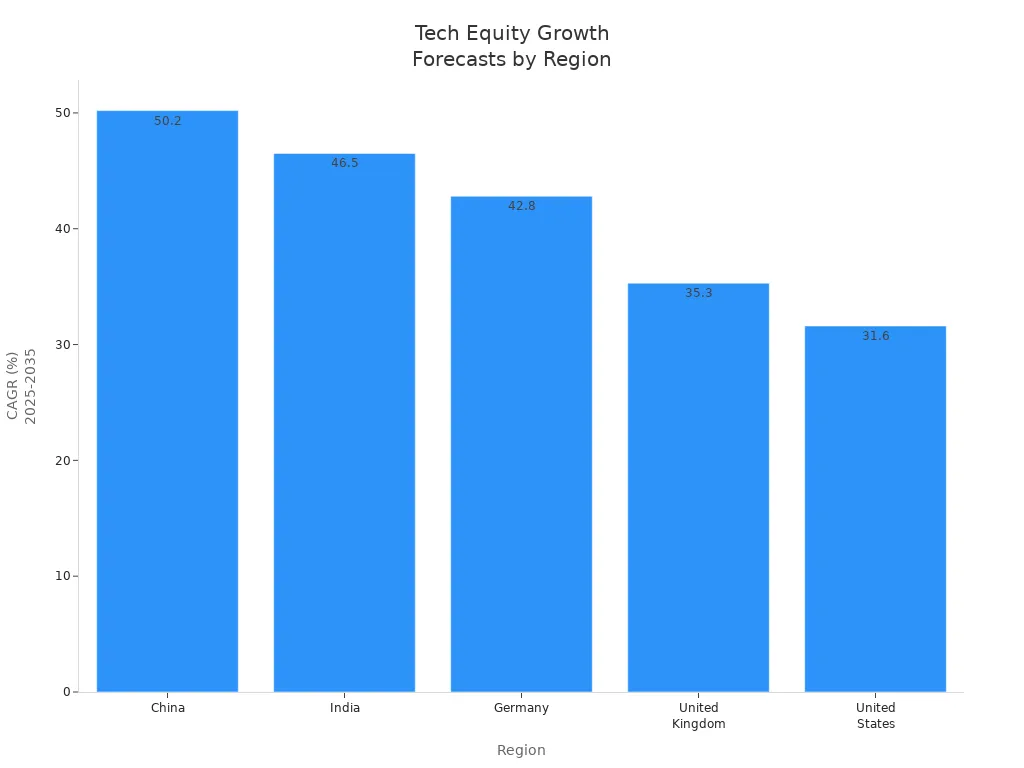
Regional differences in tech equity forecasts highlight China and India as leaders, with CAGRs of 50.2% and 46.5% respectively, fueled by government-backed 5G build-outs, industrial automation, and smart city initiatives. Germany, the United Kingdom, and the United States also demonstrate significant growth, though the US faces fragmented infrastructure that slows expansion. The following chart illustrates the comparative CAGR forecasts for AI, 5G, and IoT across key regions:
Tech equity forecasts emphasize that 5G’s role as an enabler within the IoT ecosystem will continue to drive investment, innovation, and market expansion, supporting the convergence of AI, IoT, and edge computing.
IoT Market Expansion
The IoT market expansion stands out as the leading sector in tech equity forecasts for 2025, with IoT expected to generate the highest equity investment growth. McKinsey and Gartner attribute this leadership to several factors: the widespread rollout of 5G networks, falling costs of sensors and hardware, and the convergence of cloud computing, edge computing, and AI. These trends democratize IoT adoption, making it economically viable for a broad range of applications and industries.
The forecasted number of connected IoT devices globally by 2025 approaches 19.8 billion, with a total IoT market value nearing $1 trillion in annual spending. The following table summarizes the projected IoT connections:
IoT Connection Type | Approximate Number in 2024 (billion) | Forecasted CAGR (2024-2030) | Estimated Number in 2025 (billion) |
|---|---|---|---|
Wide-area IoT | 4.4 | 11% | ~4.9 |
Cellular IoT | 3.9 | 11% | ~4.3 |
Short-range IoT | 14.4 | 16% | ~16.7 |
Total IoT | 18.8 | 15% | ~19.8 |
Industry demand drives robust investment in sectors such as manufacturing (Industry 4.0), healthcare, smart cities, consumer electronics, energy, agriculture, and logistics. Manufacturing leads with smart factory initiatives, predictive maintenance, and real-time monitoring, exemplified by Siemens’ factory achieving 99.99% quality and a 75% productivity increase. Agriculture benefits from precision farming platforms, optimizing resource use and supply chain efficiency, with the agricultural IoT market projected to reach $13 billion by 2025. Energy sector investments in IoT-enabled smart grids support sustainability and cost savings, while transportation and logistics leverage 5G connectivity for telematics and real-time navigation.
Note: The convergence of AI, 5G, and IoT—often referred to as AIoT—amplifies the value of real-time analytics, operational efficiency, and market intelligence. This synergy drives the transformative potential of the IoT market, positioning it as the primary engine of tech equity growth for 2025.
Tech equity forecasts from authoritative sources such as TechInsights, McKinsey, and Gartner consistently project the IoT market to nearly double from $546 billion in 2022 to $991 billion by 2028, with a CAGR of about 10.3%. McKinsey estimates IoT could generate up to $12.6 trillion in global economic value by 2030, underscoring its strategic importance for investors seeking long-term growth and adaptability.
AI Adoption Trends

Leading Industries
AI adoption continues to accelerate across multiple sectors, with certain industries establishing themselves as clear leaders. Finance and banking, manufacturing, IT and telecom, retail, and healthcare stand at the forefront of this transformation. These industries leverage vast amounts of data, enabling advanced AI model training and rapid scaling. Their leadership in AI adoption is expected to persist through 2025, driven by both necessity and opportunity for innovation.
Industry | Current AI Adoption / Implementation Rate | Projected Leadership Through 2025 | Supporting Statistic / Projection |
|---|---|---|---|
Finance & Banking | High adoption | Maintain leadership | Potential $1.2 trillion GVA increase by 2035 |
Manufacturing | 77% AI implementation rate | Maintain leadership | High implementation rate supports continued growth |
IT & Telecom | High adoption | Maintain leadership | Projected $4.7 trillion gross value addition by 2035 |
Retail | Extensive AI use cases | Maintain leadership | Ongoing expansion and strong use cases |
Healthcare | Extensive AI use cases | Maintain leadership | Significant current adoption and growth projections |
These sectors excel in AI adoption because they generate and digitize large volumes of data, which supports continuous improvement and innovation. The ability to harness data for real-time insights and operational efficiency sets these industries apart, ensuring sustained growth and leadership in AI-driven transformation.
Investment Highlights
AI investment trends reveal remarkable momentum in 2025. The global AI market is projected to reach $294 billion by year-end. AI startups raised $107 billion worldwide, marking a 28% increase over the previous year. Every industry now participates in AI adoption, reflecting a universal commitment to digital transformation and innovation.
AI startups secured $107 billion in funding in 2025, a 28% year-over-year increase.
The global AI market is expected to reach $294 billion by the end of 2025.
All industries report active AI adoption, highlighting widespread investment and growth.
A closer look at sector-specific data shows that information technology dominates AI equity investments, capturing 74% of Q1 2025 investment share and leading seven of the top ten deals. Healthcare and industrial goods also report positive growth, with healthcare investments rising 15% quarter-over-quarter. Business services and financial services saw fewer large deals, indicating more selective investment behavior.
Industry Sector | Q1 2025 Investment Share | Top Deals Count (Top 10) | Quarter-over-Quarter Growth | Year-over-Year Change |
|---|---|---|---|---|
Information Technology (IT) | 74% | 7 | N/A | Dominant sector, nearly 50% without $40B deal |
Health Care | N/A | N/A | +15% | Growth noted |
Industrial Goods & Materials | N/A | N/A | +3% | Growth noted |
Business Services | N/A | 8 deals ≥ $100M | Decline vs previous quarter | Weakness observed |
Financial Services | N/A | Fewer large deals | Decline vs previous quarter | Weakness observed |
Data-driven decision-making, robust AI adoption, and strategic investment continue to shape the future of these industries. The trends point to ongoing growth, increased selectivity in funding, and a focus on sectors with the strongest data assets and operational needs.
5G Adoption and Impact

Infrastructure Growth
5G infrastructure continues to reshape the global technology landscape, driving innovation and strategic growth across industries. Companies invest heavily in network expansion, with annual growth rates for the overall 5G industry reaching 20.38%. Standalone 5G infrastructure demonstrates remarkable momentum, posting a compound annual growth rate of 55.6% from 2025 to 2035. The United States and China lead in technology market growth, with respective rates of 18.5% and 21.5%. These figures highlight the rapid pace of adoption and the increasing demand for advanced connectivity solutions.
Segment | Growth Rate Type | Growth Rate (%) | Period |
|---|---|---|---|
Overall 5G Industry | Annual Growth Rate | 20.38 | Current |
5G Technology Market (USA) | Compound Annual Growth Rate | 18.5 | 2025 – 2035 |
5G Technology Market (China) | Compound Annual Growth Rate | 21.5 | 2025 – 2035 |
Standalone 5G Infrastructure | Compound Annual Growth Rate | 55.6 | 2025 – 2035 |

Private 5G spending accelerates as enterprises seek secure, high-performance networks for mission-critical operations. Private 5G installations support push-to-talk solutions in manufacturing, logistics, and energy, enhancing operational efficiency and safety. The adoption of 5G connectivity enables real-time data exchange, low latency, and robust support for emerging applications. Companies prioritize infrastructure upgrades to remain competitive and adaptable in a rapidly evolving market.
Regional Leaders
Asia-Pacific holds the largest share of the 5G infrastructure market at 42.1%, followed by North America at 35.4% and Europe at 18.2%. North America leads in 5G adoption, with 289 million connections by the end of 2024 and coverage reaching 77% of the population. The region achieves parity between 5G and 4G LTE network deployments, with 18 networks of each type. Latin America doubles its 5G connections to 76 million, driven by deployments in Mexico, Brazil, and Chile, though 4G LTE remains dominant.
Europe focuses on industrial and private 5G installations, reaching 72% of LTE network levels. The Caribbean shows fragmented deployment, with Puerto Rico and the U.S. Virgin Islands leading in availability, comparable to the U.S. at over 63%. Competitive dynamics and return on investment drive deployment decisions in these regions.
Push-to-talk technology gains traction in North America and Europe, supporting critical communications in public safety and enterprise environments. Industry leaders invest in expanding network infrastructure and exploring advanced 5G technologies to meet growing demand.
The global push for 5G adoption reflects a commitment to innovation, adaptability, and market intelligence. Strategic investments in infrastructure and regional leadership position companies to capture new opportunities and drive long-term growth.
IoT Market Opportunities
Sectoral Adoption
The IoT market continues to demonstrate rapid growth and integration across industrial, consumer, and enterprise verticals. Industry analysts observe that manufacturing, energy and utilities, healthcare, automotive, transportation, and agriculture drive the largest share of IIoT adoption. The BCC Research report estimates the global industrial IoT market will reach $391.8 billion by 2028, up from $124.7 billion in 2022, reflecting a CAGR of 21.6%. This expansion highlights the transformation underway in sectors that rely on real-time data and automation.
Manufacturing leads IIoT adoption, leveraging connected sensors and devices to optimize production, monitor equipment, and improve supply chain dynamics. Healthcare organizations use IoT solutions for patient monitoring and asset tracking, while energy and utilities deploy smart grids and predictive maintenance. Automotive and transportation sectors integrate IoT for fleet management and autonomous systems. Agriculture benefits from precision farming, using IoT data to enhance yields and resource efficiency. The Precedence Research report projects the global IoT market will reach $76.97 billion in 2025, with North America as the leading region due to strong AI and smart device adoption.
Industrial IoT Vertical | Market Size Estimate / Forecast for 2025 (USD Billion) |
|---|---|
Manufacturing | |
Automotive and Transportation | Forecast data available through 2029 |
Energy and Utilities | Forecast data available through 2029 |
Healthcare | Forecast data available through 2029 |
Others | Included in segmentation |
Note: The IoT market forecast shows that IIoT adoption will continue to accelerate, driven by innovation, operational efficiency, and the need for real-time data.
Integration with AI and 5G
The convergence of IoT, AI, and 5G is reshaping Industry 4.0 sales and driving new IoT trends. By 2025, experts predict that 75% of enterprise data will be processed at the edge, enabling real-time decision-making and reducing latency. 5G’s ultra-reliable low latency communications support mission-critical applications, such as factory automation and autonomous driving, while AI and machine learning analyze production data to predict failures and optimize processes.
AI and machine learning enable predictive maintenance and process optimization.
5G networks deliver high-speed, low-latency communication for real-time control.
Edge computing processes data locally, enhancing privacy and security.
IIoT connects devices and sensors, providing insights into machine performance and supply chain management.
Advanced robotics and digital twins improve efficiency and innovation.
Edge AI and 5G integration allow sensors to detect failure-prone assets and notify operators before breakdowns occur. This synergy decreases downtime, automates production lines, and saves costs. 5G supports massive device connectivity, essential for real-time industrial communication. However, organizations face challenges such as high implementation costs, model optimization for edge devices, and interoperability.
The internet of things continues to evolve, with IoT growth driven by the need for transformation, adaptability, and strategic market intelligence. Businesses that embrace these IoT trends position themselves for long-term success in a rapidly changing landscape.
Drivers and Challenges
Growth Drivers
Recent industry analyses highlight several powerful forces fueling the rapid growth and adoption of AI, 5G, and IoT technologies. The exponential increase in data traffic from connected devices and cloud applications has created a pressing need for intelligent network management. Companies respond to rising cyber threats by investing in AI-enhanced security solutions, which protect sensitive data and maintain operational integrity. The push towards 5G enables ultra-reliable, low latency communications, supporting critical applications such as autonomous vehicles and remote surgeries. Strategic initiatives, including Huawei’s RAN Intelligent Agent ecosystem, integrate AI into networks, optimizing bandwidth and prioritizing essential applications. Edge computing emerges as a key trend, reducing latency and bandwidth usage while supporting real-time analytics and AI decision-making.
The demand for smart devices across consumer and industrial sectors drives robust IoT infrastructure investment. Advancements in network technologies, especially 5G, enable scalable connectivity for IoT solutions. The integration of AI and machine learning into IoT systems facilitates predictive analytics, enhancing operational capabilities and supporting digital transformation across sectors. Regulatory compliance frameworks, such as the NIST AI Risk Management Framework, accelerate secure AI-IoT deployment. Cost optimization in semiconductor manufacturing improves scalability and affordability, while technological advancements like neuromorphic computing and hybrid cloud-edge infrastructures enhance real-time data processing. Regional digitalization initiatives, particularly in Asia-Pacific and North America, further fuel market growth and transformation.
Quantitative impacts include a 25% improvement in 5G network speed and latency, a 30% reduction in operational costs, a 40% reduction in network downtime, and a 30% decrease in fraud-related losses. These trends underscore the strategic value of ongoing investment and innovation.
Key Challenges
Despite strong growth and adoption trends, significant challenges remain. The massive capital investment required for 5G network infrastructure development slows global rollout and widespread use. Spectrum access delays, regulatory issues, and hardware upgrade complexity present additional barriers. Many organizations struggle with existing infrastructure limitations and difficulty proving return on investment to stakeholders. Operational risks from unreliable connectivity can increase costs and damage reputations.
Skepticism and trust issues persist due to fears of errors, misinformation, and security risks. Building trust demands transparency, explainability, and responsible AI implementation. High financial costs related to AI computation, cloud processing, and data storage challenge scalability. Organizations must adopt gradual, structured frameworks for transformation, moving from proof-of-concept to production. Collaboration between domain experts and data scientists ensures AI models remain interpretable and effective. Data security and privacy concerns, interoperability issues, and deficiencies in education and awareness further hinder adoption.
Addressing these challenges requires strategic investment, market intelligence, and adaptability. Companies that prioritize innovation and transformation position themselves to lead in the evolving tech landscape.
Regional and Industry Opportunities
Fastest-Growing Regions
Tech equity investments in AI, 5G, and the IoT market are accelerating across several global regions. Asia-Pacific leads with the highest growth rate, driven by robust government support and advanced telecom infrastructure in China, South Korea, and Japan. North America maintains a dominant market share, with the United States investing heavily in 5G infrastructure and IoT market expansion. Europe, including Germany, the UK, and France, shows strong adoption of private 5G networks, especially in manufacturing and urban sectors. The Middle East and Africa, while in early stages, are advancing through strategic partnerships in countries such as UAE and Saudi Arabia.
Asia-Pacific: Largest and fastest-growing 5G and IoT market, supported by Industry 4.0 applications and ultra-low latency requirements.
North America: Significant investments in 5G and IoT market infrastructure, with major telecom operators and federal initiatives.
Europe: Notable growth in private 5G and IoT market deployments, driven by EU digital strategies and national programs.
Middle East & Africa: Emerging IoT market investments, with government and private sector collaboration.
Region | Forecasted Growth (CAGR) | Key Drivers and Highlights |
|---|---|---|
Asia-Pacific | Largest and fastest-growing 5G and IoT market; Industry 4.0, advanced telecom, strong government support. | |
North America | ~15% (indoor 5G growth) | Dominant market share, substantial investments in 5G and IoT market infrastructure, federal funding. |
Europe | ~15% (indoor 5G growth) | Growth in private 5G and IoT market deployments, EU digital strategies, national programs. |
Middle East & Africa | Early stage growth | Emerging IoT market, government and private partnerships, focus on UAE, Saudi Arabia, South Africa. |
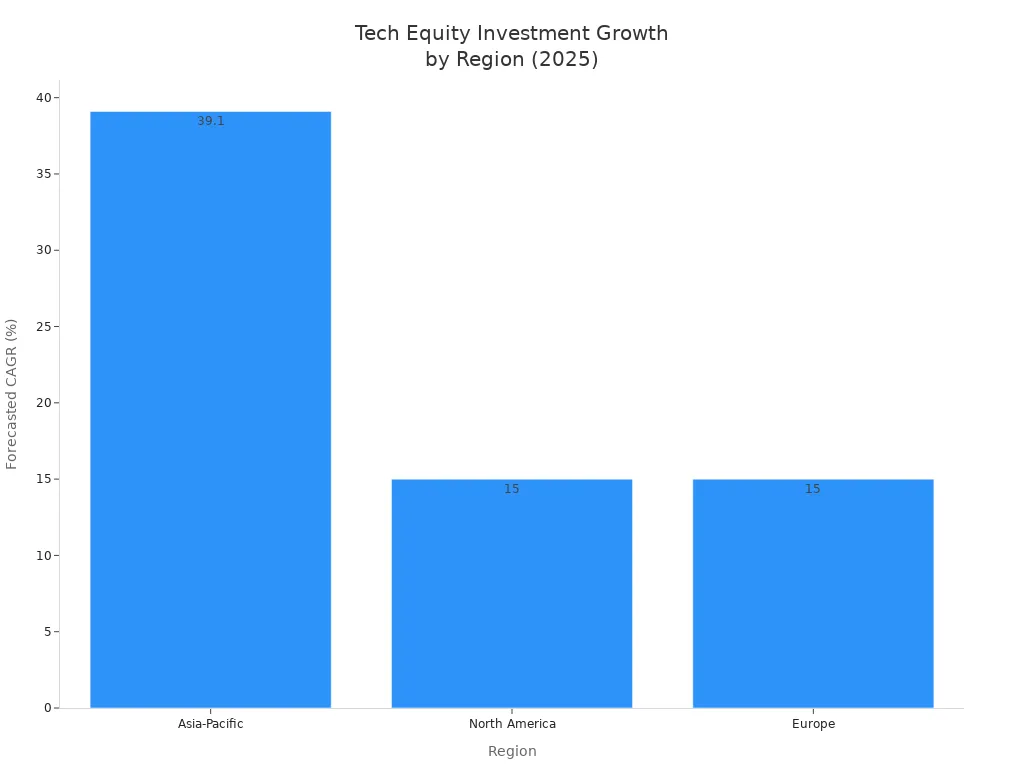
These regions demonstrate remarkable adaptability and innovation, setting the pace for global IoT market adoption and strategic growth.
High-ROI Sectors
Investors continue to target sectors within the IoT market that promise high returns and sustained growth. Data centers, fiber networks, and mobile towers have attracted over $600 billion in investments from 2019 to 2023. The data center market is projected to reach $624 billion by 2029, fueled by AI and cloud services. Cloud and edge computing form the backbone of AI deployment, supporting next-generation applications in autonomous vehicles and smart factories. Mobile network operators focus on enterprise markets and IoT adoption to monetize 5G infrastructure, with 40% of industry players identifying IoT as the top area for increased 5G monetization.
AI stands as the top priority for mobile network operators, with advanced AI solutions driving new business opportunities.
IoT market adoption in enterprise environments enables predictive analytics, operational efficiency, and real-time data insights.
Cloud and edge computing support scalable AI deployment and IoT market integration, offering both immediate and long-term returns.
Digital infrastructure investments in fiber networks, mobile towers, and data centers continue to expand, driven by the rise of AI and IoT market trends.
Recent market research highlights AI, software development, and cloud and edge computing as the most promising areas for tech equity. These sectors combine innovation, market intelligence, and adaptability, positioning them as strategic engines for long-term growth in the IoT market. Companies that prioritize these themes demonstrate resilience and vision, reflecting the expertise and perspective of trusted advisors in the field.
Investors see the iot market poised for robust expansion, with AI-driven wireless use cases and 5G infrastructure fueling innovation. The following table highlights the most important growth forecasts for 2025:
Technology | Key Growth Forecasts for 2025 |
|---|---|
AI | AIoT convergence, predictive analytics, generative AI in 5G ecosystems |
5G | Rural expansion, private networks, hybrid connectivity, network slicing |
IoT | $629.5B market size, 18B+ devices, enterprise spending, AIoT for smart cities |
North America, China, and Europe lead in iot adoption, while manufacturing, healthcare, and logistics drive sectoral growth. Investors should diversify across iot, ai, and 5G, leverage edge computing, and monitor regulatory trends. Hedging strategies and comprehensive research help balance market opportunity with risk. Staying agile and informed ensures long-term success in the evolving iot landscape.
FAQ
What sectors offer the most promising tech equity opportunities for 2025?
Manufacturing, healthcare, and smart infrastructure lead in tech equity growth. These sectors benefit from rapid AI, 5G, and IoT adoption. Investors see strong innovation, operational efficiency, and adaptability in these industries, making them attractive for strategic growth.
How do AI, 5G, and IoT work together to drive innovation?
AI analyzes data from IoT devices, while 5G enables fast, reliable connections. This synergy supports real-time analytics, automation, and smarter decision-making. Companies leverage these technologies to improve efficiency, reduce costs, and create new business models.
Which regions are expected to lead in tech adoption by 2025?
Asia-Pacific, North America, and Europe stand out as leaders. Asia-Pacific drives growth with advanced infrastructure and government support. North America excels in 5G and IoT investments. Europe focuses on private networks and digital transformation.
What challenges do companies face when adopting these technologies?
Companies encounter high infrastructure costs, regulatory hurdles, and data security concerns. They must also address interoperability issues and build trust in AI systems. Strategic planning and adaptability help organizations overcome these barriers.
Why is adaptability important for investors in emerging tech markets?
Adaptability allows investors to respond to rapid market changes and evolving technologies. By staying informed and flexible, they can identify new opportunities, manage risks, and support sustainable growth in dynamic sectors.
Steady Growth, Clear Signals
Building lasting wealth is less about chasing the moment and more about stacking good decisions over time—patiently, consistently, and with an eye for what truly drives durable business performance. At VASRO, we bring a calm, research-first lens to equity analysis and market intelligence, translating fast-moving data into clear context so readers can see the difference between noise and signal: quality of earnings over headlines, cash-flow resilience over hype, and sensible position sizing over swings in sentiment. We value insight and precision because compounding rewards steady habits—regular check-ins with your plan, attention to costs and risks, and a willingness to let strong fundamentals work through cycles. Markets will zig and zag; that’s their job. Ours is to illuminate where discipline, diversification across time horizons, and evidence-based judgment have historically aligned with long-term growth—so you can navigate with confidence and keep the destination in view.
Disclaimer: The information provided on www.vasro.de is for general informational purposes only and does not constitute investment advice or a recommendation to invest in any particular asset or market. VASRO GmbH does not offer personalized investment advice, and the content on this website should not be relied upon as such. Visitors are encouraged to seek independent financial advice tailored to their specific circumstances before making any investment decisions. VASRO GmbH disclaims any liability for investment decisions made based on the information presented on this website. For the data from external sources; VASRO is not liable for accuracy.