


You see the Asia-Pacific region transforming rapidly, drawing attention from investors worldwide. The region’s investment landscape reflects both challenges and opportunities. Recent figures show the total investment value in the Asia-Pacific fell to USD 21 billion in Q2 2025, representing a 44% year-over-year decline and the lowest in ten years. Despite this, hotel investment volumes are set to rise, reaching USD 13.3 billion in 2026. Regional cross-border investment has surged, hitting an 18% share, the highest in six years. Family offices increasingly favour the Asia-Pacific, with 35% planning to boost investments. Technological progress, corporate reforms, and a shift from dollar assets enhance the region’s appeal. For effective investor targeting, you must understand investor profiles, market shifts, and evolving regulations in the pacific.
Table of Contents
Key Takeaways
Understand the unique profiles of investors in the Asia-Pacific, including institutional investors and family offices, to tailor your approach effectively.
Stay informed about local regulations and compliance requirements, as these can vary significantly across countries in the region.
Build strong local partnerships to navigate cultural nuances and gain access to valuable market intelligence and off-market deals.
Leverage digital platforms to enhance communication with investors, providing real-time updates and showcasing investment opportunities.
Focus on sectors with strong growth potential, such as logistics, healthcare, and data centres, to align with emerging market trends.
Emphasise sustainability and ESG factors in your investment strategies, as these are increasingly important to investors in the region.
Adapt your targeting strategies to the specific needs and preferences of different investor types, ensuring a personalised approach.
Monitor market volatility and external factors closely to remain agile and responsive to changes in the investment landscape.
Investor Targeting Strategies in Asia-Pacific
You operate in a region where investor targeting requires a clear understanding of both the market and the people behind the capital. The Asia-Pacific landscape continues to evolve, shaped by new investment trends, regulatory shifts, and the growing influence of real estate private equity. You must adapt your approach to match the unique profiles and expectations of each investor group.
Understanding Investor Profiles
Institutional Investors
Institutional investors play a central role in the Asia-Pacific market. You see them favouring manager selection and active management, with 40% prioritising this strategy. They also show interest in hedge funds and high-quality short duration fixed income. These investors often seek stability, transparency, and robust governance. You need to present clear value propositions and demonstrate strong compliance frameworks to attract their attention.
Private Equity & Family Offices
Private equity and family offices in Asia-Pacific differ from their Western counterparts. Many family offices are younger, often led by first- or second-generation wealth holders. They may lack established governance structures, which means you must address compliance concerns directly. Asian families value control, so you should respect their culture and integrate external advisors carefully. Many family offices operate across multiple markets, seeking global opportunities through real estate private equity and private equity investments. You must tailor your investor targeting to these preferences, offering flexible solutions and cross-border access.
Key characteristics of Asia-Pacific family offices:
Less formal governance
Strong emphasis on control and family culture
Global investment outlook
Market Entry Factors
Regulation
You face a complex regulatory environment across Asia-Pacific. Each country sets its own rules, with a strong focus on risk management and investor protection. For example, the Monetary Authority of Singapore has introduced environmental risk management guidelines for asset managers, banks, and insurers. These guidelines cover governance, portfolio risk, and stewardship, aiming to reduce greenwashing and improve understanding of ESG funds. You must stay informed about local regulations and adapt your investor targeting to meet these standards, especially when engaging real estate private equity and private equity investors.
Region | Regulatory Focus | Impact on Investor Strategies |
|---|---|---|
Europe | Promoting sustainable investment | Focus on disclosures and adverse impacts of investments |
Asia | Risk management and investor protection | Emphasis on reducing greenwashing and understanding ESG funds |
Local Partnerships
You gain a competitive edge by building strong local partnerships. Local partners help you navigate cultural nuances, regulatory requirements, and market dynamics. They also provide valuable market intelligence and access to off-market deals, which is essential for real estate private equity and private equity transactions. You should invest time in relationship-building and choose partners who share your values and long-term vision.
Engagement Tactics
Digital Platforms
You see technology transforming investor targeting in Asia-Pacific. Real estate private equity and private equity firms now use digital platforms to reach investors, streamline communication, and showcase opportunities. You can leverage these tools to provide real-time updates, host virtual roadshows, and share data-driven insights. This approach increases transparency and builds trust with investors.
Relationship Building
You cannot overlook the importance of personal relationships in Asia-Pacific. Investors value trust, reliability, and long-term commitment. You should engage through regular meetings, transparent reporting, and consistent follow-up. By understanding each investor’s goals and adapting your approach, you strengthen your position in the competitive real estate private equity and private equity landscape.
Tip: Combine digital engagement with face-to-face interactions to maximise your impact.
Most Effective Investor Targeting Strategies
You benefit from knowing which strategies deliver results in the current market. The table below highlights the most effective investor targeting approaches in Asia-Pacific, based on recent data:
Strategy | Percentage (%) |
|---|---|
Manager selection or active management | 40 |
Hedge funds | 31 |
Increasing holdings in illiquid assets | 27 |
High-quality short duration fixed income | 26 |
Investing in precious metals | 19 |
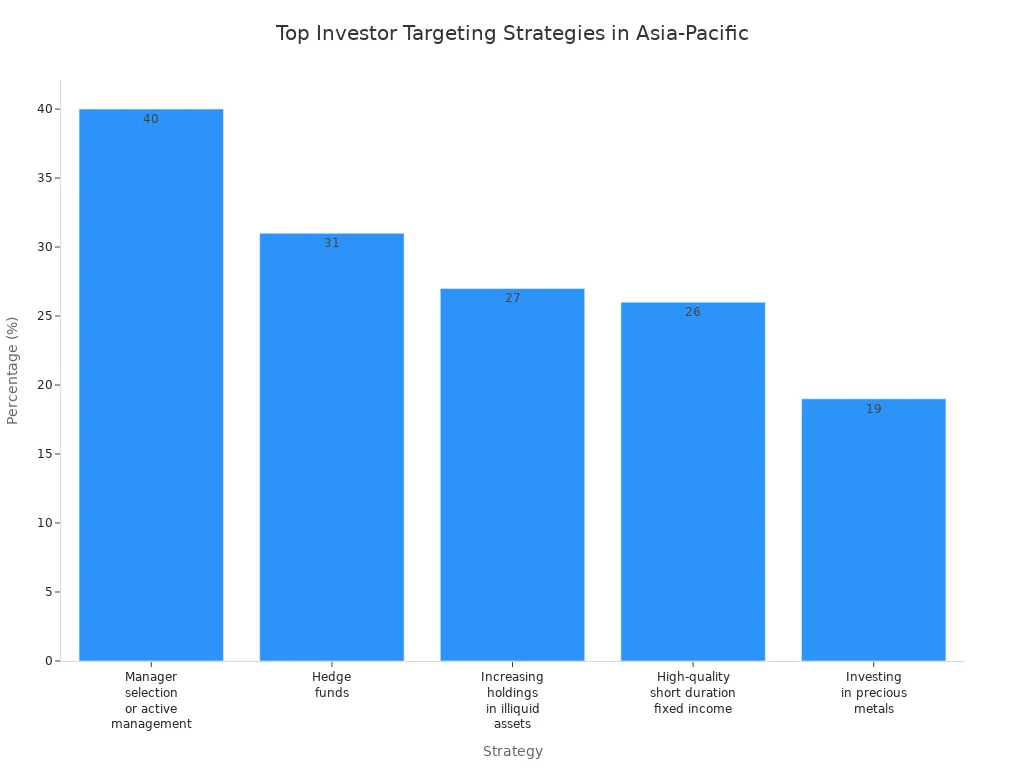
You notice a clear trend towards alternative assets, including data centres, build-to-rent, logistics, and life sciences. Real estate private equity and private equity investors also place greater emphasis on ESG criteria, requiring you to formalise your approach to sustainability. Technology adoption continues to rise, with real estate companies integrating digital solutions to improve efficiency and transparency.
Tailoring Approaches to Investor Type and Market Conditions
You must customise your investor targeting for each investor type and market condition. Market volatility and diverse investor needs make a one-size-fits-all approach ineffective. In Asia-Pacific, you succeed by understanding the unique characteristics of institutional investors, private equity, and family offices. You adapt your strategies to local regulations, cultural expectations, and emerging trends. This targeted approach helps you seize opportunities and manage risks in a dynamic investment environment.
Asia-Pacific Investment Landscape

Economic Growth Trends
You see the Asia-Pacific region at the forefront of economic transformation. The shift towards green and digital transitions is shaping inclusive growth across many countries. Employment in green sectors now surpasses that in traditional fossil fuel industries, which signals a significant change in the economic landscape. This transition not only supports environmental goals but also improves health and food security for millions.
The region is moving quickly towards green and digital economies.
Green sector jobs are increasing faster than those in fossil fuels.
The green transition could help Asia-Pacific set new global standards.
Southeast Asia stands out with a young and expanding labour force. You notice a demographic dividend, as the region’s workforce is projected to peak at 510 million by 2050. Indonesia alone expects its labour force to reach 205 million, while countries like the Philippines, Malaysia, Laos, and Vietnam also see rising numbers of young workers. This demographic trend supports long-term growth and creates new opportunities for investors.
Cross-Border Capital Flows
You observe a strong increase in cross-border capital flows within the Asia-Pacific. In 2023, China’s engagement in the region reached USD 530 billion, split between construction contracts and non-financial investments. The number of deals rose by 25% compared to the previous year, with the average deal size more than doubling since 2021. Investments now make up over half of China’s regional activity, showing a return to pre-pandemic levels. Southeast Asia received 40% of this engagement, highlighting its role as a key destination for capital.
China’s regional investments and construction contracts have grown sharply.
The average investment deal size has more than doubled since 2021.
Southeast Asia attracts a large share of cross-border capital.
Key Challenges & Opportunities
You face a dynamic investment environment in Asia-Pacific. Southeast Asia’s growing middle class, expected to exceed 300 million by 2030, and a median age of just 30, offer a strong demographic advantage. Investors increasingly focus on sustainability, aligning financial goals with positive social and environmental outcomes.
The region’s middle class is expanding rapidly.
A youthful population supports long-term market potential.
Sustainability is now a central theme for investment strategies.
However, you must also navigate challenges. Climate change, economic shifts, and geopolitical tensions create uncertainty. Some experts warn of risks similar to those seen in the 1930s, urging careful analysis and adaptability.
When you look for stable and attractive markets, Australia, Japan, Singapore, and New Zealand stand out. The Asia-Pacific bond market remains stable, with Japan showing resilience against rising rates. India also offers solid growth and attractive yields, appealing to those with a higher risk appetite. Growth credit is emerging as a key strategy, especially for technology companies seeking non-dilutive funding. This approach addresses a critical funding gap and offers attractive risk-adjusted returns.
Note: You can unlock new opportunities by focusing on stable markets and innovative investment strategies, while staying alert to evolving risks.
Opportunities by Sector
Offices
Market Hotspots: Tokyo, Sydney, Singapore
You find the office sector in Asia-Pacific offers a range of opportunities due to its political stability and robust economic fundamentals. Several cities stand out as leading destinations for investment, each presenting unique value for investors seeking growth and resilience.
Australia’s political stability and economic framework enhance its appeal to investors.
Sydney’s CBD experiences strong rental growth and capital appreciation, making it a prime investment location.
Brisbane’s affordable rents and business-friendly environment contribute to its attractiveness.
Sydney is a leading city for cross-border real estate investment, particularly in premium office assets.
Brisbane gains traction due to population growth and infrastructure investment.
Sydney is noted as a top destination for international capital, especially from Asian investors.
Brisbane is highlighted as a major player in the recovery narrative of the Australian office market.
Tokyo and Singapore also remain at the forefront of the commercial real estate market, offering stable environments and strong infrastructure. These cities attract global capital and provide a foundation for long-term value creation.
Investor Preferences
You notice a clear trend among investors towards quality office assets, especially in prime CBD locations. The market demonstrates a ‘flight to quality’, where tenants and investors prefer premium office spaces with modern amenities and flexible layouts.
Investors increasingly focus on quality office assets, particularly in prime CBD locations.
There is a notable trend of ‘flight to quality’, where tenants prefer premium office spaces.
Despite high vacancy rates, well-located buildings see strong leasing demand.
Older or less flexible office spaces face challenges in attracting tenants.
This shift creates opportunity for you to target projects that offer modern infrastructure and strong rental growth prospects. You can add value by repositioning or upgrading existing assets to meet evolving tenant expectations.
Targeting Tactics
You succeed in targeting office investors by highlighting the value of stable markets and the potential for capital appreciation. You should emphasise infrastructure improvements, such as new transport links or business district upgrades, which enhance the appeal of office assets. You can also leverage data-driven insights to demonstrate rental growth prospects and long-term opportunity.
Focus on premium locations with strong infrastructure and connectivity.
Showcase projects that offer flexible layouts and sustainability features.
Provide market intelligence on rental growth prospects and capital appreciation.
Build relationships with local partners to access off-market opportunities.
Tip: You can maximise your impact by combining local knowledge with global market intelligence, ensuring your investment opportunities align with investor preferences.
Industrial & Logistics
Growth Drivers
According to a Colliers report, recovering consumer spending is expected to support economic momentum for the industrial and logistics sector over the next 12 to 18 months across major Asia Pacific markets. The report also highlights that rising e-commerce activity and third-party logistics providers will continue to fuel demand as occupiers seek high-quality, efficient warehouse solutions.
Vijay Ganesh, Managing Director, Industrial & Logistics Services, Colliers India, stated, ‘Rising consumer demand in the region has driven the increase of leasing activity by third-party logistics providers and e-commerce sector.’
You see that logistics and industrial assets benefit from strong demand, driven by e-commerce growth and supply chain diversification. The sector offers significant opportunities for value creation, especially in markets with robust infrastructure and rising consumer activity.
Key Markets: Greater China, India, Southeast Asia
Market | Investment Interest |
|---|---|
Southeast Asia | High |
India | High |
Mexico | Moderate |
United States | Moderate |
Southeast Asia demonstrates significant growth, becoming a key player in global manufacturing. Companies diversify their supply chains in this region to enhance resilience against disruptions. India and Greater China also attract high levels of investment, supported by infrastructure development and government initiatives.
You find that southeast asian markets offer unique opportunities for logistics projects, as infrastructure investment continues to rise and consumer demand expands.
Targeting Tactics
You can target logistics investors by focusing on markets with strong infrastructure and high demand for modern warehouse solutions. Highlight the value of projects that offer efficient layouts, proximity to transport hubs, and sustainability features.
Identify regions with ongoing infrastructure upgrades and government support.
Emphasise the value of logistics assets in supply chain resilience.
Present data on consumer demand and e-commerce growth.
Collaborate with local partners to access new opportunities and navigate regulatory requirements.
Note: You can unlock value by aligning your logistics investment strategies with the evolving needs of occupiers and the broader supply chain ecosystem.
Retail
Market Dynamics
You observe that the retail sector in Asia-Pacific is undergoing rapid transformation, driven by demographic shifts and digital innovation.
The proportion of middle-class households in APAC increased from 18% in 2013 to 28% in 2023, indicating a growing consumer base with disposable income.
Retail e-commerce sales in APAC grew by 630% from 2013 to 2023, reaching USD 1.8 trillion, which shows the rapid expansion of online shopping.
63% of consumers in the region prefer shopping online, highlighting the shift towards e-commerce.
This growth creates opportunity for you to invest in retail projects that blend physical and digital experiences, catering to changing consumer preferences.
Key Markets: Hong Kong, Seoul, Bangkok
You find several cities stand out as hotspots for retail investment due to their strong consumer sentiment and infrastructure.
China: High consumer sentiment and significant retail market expansion.
Vietnam: Rising middle class and increased interest from retailers, particularly in Ho Chi Minh City and Hanoi.
Malaysia: New retail space and lower rental levels attract international retailers.
Singapore: Economic stability and growth in international tourism boost retail spending.
Indonesia: Increased retailer appetite following the entry of major international brands and expected retail sales growth.
Hong Kong, Seoul, and Bangkok also offer opportunities for value creation, supported by infrastructure investment and a vibrant retail environment.
Targeting Tactics
You can target retail investors by showcasing projects in cities with strong infrastructure, rising consumer demand, and a growing middle class. Emphasise the value of integrating digital platforms and omnichannel strategies to capture new opportunities.
Highlight retail projects in markets with robust infrastructure and tourism growth.
Present data on consumer demand and e-commerce trends.
Offer insights into rental growth prospects and value creation through redevelopment.
Build partnerships with local stakeholders to access new opportunities and navigate regulatory changes.
Tip: You can enhance your retail investment opportunities by focusing on cities with strong infrastructure, a dynamic consumer base, and a willingness to embrace innovation.
Living Sector
Key Markets: Australia, Japan, Singapore
You see the living sector in Asia-Pacific gaining momentum as a core part of real estate investment strategies. Major cities such as Sydney, Melbourne, Tokyo, and Singapore stand out as key markets. These cities face growing challenges with housing affordability, which drives a surge in rental demand. In Sydney and Melbourne, the ratio of median house price to household income has reached about nine times, making home ownership less accessible for many. As a result, you notice rental markets in Mainland China and Australia are expected to double in size over the next decade. This shift creates significant opportunities for investors who focus on the living sector.
Deteriorating housing affordability increases rental demand.
House prices in major Asian cities are becoming less affordable.
Rental markets in Mainland China and Australia are set to expand rapidly.
Investor Preferences
You observe that investor preferences in the living sector differ across Australia, Japan, and Singapore. The table below summarises these differences and highlights the unique characteristics of each market.
Country | Investor Preference | Key Insights |
|---|---|---|
Australia | Growing offshore investment, particularly from Japanese capital | Japanese investors are looking to partner with local developers in the living sector. |
Japan | Strong interest in the living sector due to familiarity with the asset class | Japanese investors are particularly engaged in the living sector, reflecting their domestic experience. |
Singapore | Less highlighted investment activity in the living sector | Singapore’s role appears more traditional, with less emphasis on the living sector compared to Australia and Japan. |
You see Japanese investors actively seeking partnerships with local developers in Australia. Their familiarity with the living sector gives them confidence to expand abroad. In Japan, domestic experience drives strong engagement in this asset class. Singapore, however, plays a more traditional role, with less focus on living sector investments.
Targeting Tactics
You can target investors in the living sector by focusing on markets with strong rental growth and clear affordability challenges. Highlight the potential for long-term value creation as rental demand rises. You should present data on demographic trends, affordability ratios, and projected rental market growth. Building relationships with local developers and understanding cultural preferences will help you unlock new opportunities.
Tip: You can enhance your approach by offering flexible investment structures and cross-border access, which appeal to both domestic and offshore investors.
Data Centres
Key Markets: Singapore, India, Indonesia
You see data centres emerging as a dynamic segment within real estate across Asia-Pacific. Australia, especially Melbourne, is becoming a leading hub. Melbourne is projected to double its data centre capacity by 2030. Global players such as Equinex and Digital Realty have made significant investments, which highlights the city’s growing importance. In 2024, Australia attracted USD 6.7 billion in data centre investments, second only to the United States. The demand for data centre capacity is fuelled by digital transformation, cloud adoption, and the integration of AI and IoT technologies.
Melbourne is set to double its data centre capacity by 2030.
Major global investors are increasing their presence in Australia.
Digital transformation and AI drive demand for data centre infrastructure.
Singapore, India, and Indonesia also stand out as key markets. You notice that these countries benefit from rapid digitalisation, strong economic growth, and supportive government policies. The need for reliable and scalable data infrastructure continues to rise, making these markets attractive for real estate investors.
Targeting Tactics
You can target data centre investors by focusing on three main strategies:
Prioritise energy reliability. Investors seek markets where data centres can access stable and sufficient power to support AI and digital services.
Leverage political stability and regulatory advantages. Australia’s stable climate and clear regulations make it a preferred destination for global capital.
Ensure infrastructure planning meets the growing demand for data services. You should highlight projects with robust connectivity, power access, and expansion potential.
Note: Unlocking access to reliable power is essential for maximising investment opportunities in the data centre sector.
You can also build trust by providing transparent information on regulatory frameworks and long-term market trends. Collaborating with local partners and technology providers will help you stay ahead in this fast-evolving segment of real estate.
Country-Specific Investment Strategies
Japan
You find Japan offers a unique landscape for investors. The market stands out for its stability, deep liquidity, and transparent regulations. You notice that Japanese investors value long-term relationships and trust. You should focus on building credibility and demonstrating commitment to the market. Regulatory frameworks in Japan support foreign investment, but you must pay attention to local business customs and decision-making processes, which often involve consensus and patience.
You can access opportunities in Japan through Emerging Global Asian Equity Funds. These funds help you manage risks related to currency and market volatility. They also provide exposure to both established and emerging sectors. You see that Japan’s ageing population drives demand for healthcare and living sector investments. You should highlight projects that address these demographic shifts and offer sustainable growth.
Australia
You see Australia as a gateway to the Asia-Pacific region. The country attracts investors with its strong legal system, transparent markets, and political stability. You benefit from a clear regulatory environment that supports foreign investment. Australian investors often seek diversification, with 29% of outbound investment going to the United States and 23% to the United Kingdom. Only a small share, about 3%, flows to Southeast Asia, which shows a preference for mature markets.
You should tailor your approach by emphasising Australia’s stable returns and robust governance. Local investors value innovation and sustainability. You can stand out by presenting projects that integrate ESG principles and offer long-term value. You also need to understand that cultural factors, such as a preference for direct communication and straightforward negotiations, shape investor behaviour in Australia.
Tip: You can unlock new opportunities by focusing on sectors like logistics, living, and data centres, which align with Australia’s economic strengths.
Singapore
You recognise Singapore as a leading financial hub in Asia. The city-state offers a business-friendly environment, strong rule of law, and efficient regulatory processes. You find that Singaporean investors are open to regional and global opportunities. They often use Asian Equity Funds to gain exposure to both developed and emerging markets, including China, India, and ASEAN countries.
Singapore’s government encourages innovation and digital transformation. You should highlight projects that leverage technology and support sustainable growth. Investors in Singapore value transparency, speed, and adaptability. You can build trust by providing clear information and demonstrating a strong track record.
Unique Investor Targeting Approaches | Key Insights |
|---|---|
Use of Asian Equity Funds | Provides access to diverse markets and manages risks. |
Focus on innovation and technology | Aligns with Singapore’s national priorities. |
Emphasis on transparency | Builds trust with local investors. |
You see that asia pacific investment strategies must adapt to each country’s regulatory, economic, and cultural context. By understanding these differences, you can position yourself for long-term success in the region.
China
You encounter a market in China that stands as both a powerhouse and a puzzle for investors. The country’s sheer scale and rapid transformation create vast opportunities, yet you must navigate a landscape shaped by evolving regulations, shifting economic priorities, and unique cultural dynamics.
China’s government plays a central role in shaping investment flows. You see policies that favour sectors such as advanced manufacturing, green technology, and digital infrastructure. The government’s focus on self-reliance and innovation means you should target investors who align with these national priorities. For example, you can highlight projects in renewable energy, electric vehicles, or smart cities, as these areas attract both domestic and international capital.
You must pay close attention to regulatory changes. China’s authorities frequently update rules to manage risk and encourage sustainable growth. In recent years, you have seen tighter controls on capital outflows and increased scrutiny of foreign investment, especially in sensitive sectors. You should stay informed about the latest guidelines from agencies such as the National Development and Reform Commission (NDRC) and the State Administration of Foreign Exchange (SAFE). This knowledge helps you build trust and demonstrate compliance.
Cultural understanding is essential when you engage with Chinese investors. You notice that relationships, or “personal connections,” play a vital role in business. You build credibility by showing respect, patience, and a long-term commitment. Face-to-face meetings and regular communication help you establish trust. You should also recognise the importance of hierarchy and decision-making processes, which often involve several stakeholders.
Tip: You can strengthen your position by partnering with local firms that understand the regulatory environment and have established networks.
You see that China’s economic landscape is shifting. The country is moving from export-led growth to a model driven by domestic consumption and technological advancement. This transition creates new opportunities in sectors such as healthcare, logistics, and consumer services. You can target investors by presenting data on urbanisation trends, rising middle-class incomes, and government incentives for innovation.
Key Factor | Impact on Investor Targeting |
|---|---|
Policy Priorities | Focus on innovation and sustainability |
Regulatory Environment | Frequent updates and sector-specific rules |
Cultural Dynamics | Emphasis on relationships and trust |
You succeed in China by combining market intelligence with adaptability. You must tailor your strategies to local conditions, stay alert to policy shifts, and invest in building strong relationships. This approach helps you unlock the full potential of one of the world’s most dynamic investment markets.
Emerging Opportunities & Alternative Assets

You see the Asia-Pacific region opening new doors for investors who seek diversification and innovation. The market is not just about traditional assets anymore. You can now explore a range of alternative investments that offer growth and resilience in a changing world.
Healthcare Real Estate
Healthcare real estate stands out as a promising area. You notice strong demand for hospitals, clinics, and senior living facilities. Ageing populations in Japan, Australia, and Singapore drive this trend. You can also find opportunities in biotechnology hubs and medical research centres. Investors value stable returns and long-term leases in this sector. You should focus on cities with advanced healthcare systems and growing elderly populations.
Key drivers for healthcare real estate:
Ageing demographics in developed markets
Rising demand for private healthcare services
Growth in biotechnology and medical research
Australia leads with diverse opportunities in healthcare and biotechnology. You can target investors by highlighting stable income streams and the essential nature of healthcare assets.
Hospitality & Leisure
You see hospitality and leisure rebounding across Asia-Pacific. Tourism is returning, and domestic travel is growing. Cities like Bangkok, Bali, and Sydney attract both regional and international visitors. You can invest in hotels, resorts, and serviced apartments. Investors look for assets in prime locations with strong tourism infrastructure. You should also consider leisure assets such as theme parks and wellness retreats, which appeal to changing consumer preferences.
Why hospitality and leisure attract investors:
Recovery in tourism and business travel
Expansion of middle-class consumers
Demand for unique leisure experiences
You can target investors by presenting data on tourism growth and showcasing projects that blend hospitality with lifestyle and wellness trends.
ESG & Impact Investing
ESG and climate reporting is changing the game in Asia Pacific. There is urgency with the simultaneous adoption of standards across Asia Pacific. There is collective acknowledgment of the climate crisis and economic risks of inaction. ESG is no longer a peripheral concern, but a central business imperative. Companies must view climate and ESG concerns as integral to their growth strategies.
You see ESG and impact investing moving to the centre of investment strategies. Investors want assets that deliver both financial returns and positive social or environmental outcomes. You can focus on renewable energy, green buildings, and sustainable agriculture. Australia offers strong opportunities in renewable energy and agribusiness. Emerging markets like India are also gaining attention as they become more autonomous and financially independent.
Sectors with strong ESG potential:
Renewable energy projects
Green real estate developments
Sustainable agriculture and agribusiness
You can target ESG-focused investors by demonstrating measurable impact, transparent reporting, and alignment with global sustainability standards.
Note: You unlock new opportunities by staying ahead of innovation and responding to the region’s evolving needs.
Common Pitfalls for Investors
When you target investors in the Asia-Pacific region, you encounter a landscape full of promise and complexity. Many investors make similar mistakes when entering these markets. You can avoid these pitfalls by building local knowledge and practising thorough due diligence.
Cultural Misunderstandings
You may underestimate the importance of culture in business. Each country in Asia-Pacific has its own customs, values, and ways of building trust. For example, in Japan, you see decision-making that values consensus and patience. In China, relationships or “personal connections” shape business success. If you ignore these differences, you risk damaging relationships or missing opportunities. You should invest time in understanding local etiquette, communication styles, and negotiation practices. A simple gesture, such as exchanging business cards respectfully, can set the right tone. You build trust by showing respect for local traditions and adapting your approach.
Tip: Engage local advisors or partners who can guide you through cultural nuances and help you avoid missteps.
Regulatory Risks
You face a patchwork of regulations across the region. Each market sets its own rules for foreign investment, reporting, and compliance. These rules change often, especially in fast-growing economies. You must stay alert to new policies and regulatory updates. For instance, Singapore has introduced strict environmental risk management guidelines for asset managers. China frequently updates its rules on capital flows and sector priorities. If you do not keep up, you may face delays, fines, or even lose access to the market.
You also see that reliance on trade makes the region vulnerable to tariff tensions. Frequent shifts in trade policy complicate fiscal and monetary responses. Uncertainty around US trade policy can affect corporate confidence and capital expenditure. You need to monitor these external factors, as they can impact your investment strategy.
Key regulatory risks to watch:
Sudden changes in foreign investment rules
Shifting trade policies and tariffs
New compliance requirements for ESG and reporting
You can manage these risks by working with local legal experts and maintaining flexible strategies.
Market Volatility
You operate in markets that can change quickly. Economic cycles, political events, and global shocks all influence the Asia-Pacific region. You may see rapid growth one year, followed by a slowdown the next. Currency fluctuations and interest rate changes add another layer of uncertainty. You need to prepare for volatility by diversifying your investments and building strong risk management frameworks.
Note: Local knowledge gives you an edge. You gain insight into market signals and can respond faster to changes.
You succeed by combining market intelligence with adaptability. You learn from past mistakes and adjust your approach as conditions evolve. By staying informed and building strong local relationships, you position yourself to navigate the region’s challenges and seize its opportunities.
You see that successful investor targeting in Asia-Pacific relies on understanding market shifts, building strong relationships, and adapting to local conditions. The table below highlights where investors find the greatest opportunities and why collaboration matters:
Sector | Key Opportunities | Collaboration Importance |
|---|---|---|
Defence | Investment in defence capabilities and cross-border transactions | Critical for nations to work with strategic allies |
Technology | Growth in space technology, quantum computing, and cybersecurity | Enhances national resilience and technological capabilities |
Cybersecurity | Mergers and acquisitions to form global leaders in information security | Strengthens core capabilities through partnerships |
Digitalisation | Investment in low-code IT solutions for agencies | Supports digital transformation |
Aviation | Acquisitions to enhance aviation services | Important for operational readiness |
You should focus on local expertise, stay flexible, and nurture trust with investors. Monitor market trends and regulatory changes closely. When you combine insight with action, you unlock new possibilities for growth and innovation.
FAQ
What makes the Asia-Pacific region attractive for investors?
You find the Asia-Pacific region appealing due to its rapid economic growth, young population, and expanding middle class. Stable markets such as Australia, Japan, and Singapore offer strong governance and reliable returns. Innovation and digital transformation also create new opportunities for you.
How do you identify the right investor profile in Asia-Pacific?
You start by analysing investor goals, risk appetite, and preferred sectors. Institutional investors often seek stability, while family offices may value control and flexibility. Understanding these differences helps you tailor your approach and build stronger relationships.
Why is local partnership important in this region?
You gain valuable insights and access to off-market deals by working with local partners. These partnerships help you navigate cultural nuances, regulatory requirements, and market trends. Local expertise increases your chances of success and reduces risks.
What role does technology play in investor targeting?
You use digital platforms to reach investors, share real-time updates, and host virtual meetings. Technology improves transparency and speeds up communication. It also allows you to analyse data and identify emerging trends more effectively.
How can you manage regulatory risks in Asia-Pacific?
You stay informed about changing regulations in each market. Working with local legal experts helps you comply with rules and avoid costly mistakes. Regular monitoring and adaptability keep your investment strategies resilient.
Which sectors currently offer the best opportunities?
You see strong potential in data centres, logistics, living sectors, and healthcare real estate. These sectors benefit from demographic shifts, digitalisation, and rising consumer demand. Focusing on these areas can help you achieve long-term growth.
What are common mistakes when targeting investors in this region?
You may overlook cultural differences or underestimate regulatory complexity. Relying solely on digital communication can weaken relationships. You avoid these pitfalls by investing in local knowledge, building trust, and practising thorough due diligence.
How does ESG influence investment decisions in Asia-Pacific?
You notice ESG factors now shape many investment strategies. Investors want assets that deliver both financial returns and positive social or environmental outcomes. Demonstrating clear ESG commitments and transparent reporting helps you attract responsible capital.
Making Sense of Markets: The Role of Objective Equity Research
Objective equity research helps markets make sense because it replaces noise with evidence: it starts with disciplined data gathering, checks that data against primary sources, and then situates each datapoint in the right context—macroeconomic conditions, sector-specific drivers, policy shifts, and market microstructure—so narratives don’t outrun reality; rigor matters most when conditions look contradictory, as seen in Asia-Pacific where investment value fell to USD 21 billion in Q2 2025 (down 44% year-over-year and the weakest in a decade) even as cross-border activity climbed to an 18% share, family offices signaled rising allocation intent at 35%, and hotel transaction volumes are expected to rebound toward USD 13.3 billion in 2026, all of which can be true at once when liquidity, risk pricing, and deal composition are properly separated; strong research frameworks also make assumptions explicit, disclose limitations, and use transparent methodologies so readers can understand what is measured, what is inferred, and what remains uncertain; in that sense, VASRO fits naturally as a measured, insightful voice in equity analysis and market intelligence—curious about what the data is really saying, precise about definitions and drivers, and consistent about documenting the analytical path—helping illuminate how regulation, reform, technology adoption, and shifting capital preferences interact across fast-evolving regions without overstating what the numbers can prove. This article is for general information only and does not constitute financial, investment, legal, or tax advice; readers should consult a licensed professional for advice tailored to their situation.
Disclaimer: The information on www.vasro.de is for general informational purposes only and does not constitute investment advice or a recommendation. VASRO GmbH does not provide personalized investment advice; visitors should seek independent financial guidance before making decisions. Some content may rely on third-party sources considered reliable, but VASRO GmbH does not guarantee accuracy, completeness, or timeliness. All information is provided “as is,” may change without notice, and VASRO GmbH has no obligation to update, correct, or continue publishing it. VASRO GmbH accepts no liability for losses arising from reliance on this information. Past performance is not a reliable indicator of future results.