


You must prioritize transparency and strategic communication to navigate the evolving landscape of eu capital markets in 2026. Liquidity remains robust, with a Liquidity Coverage Ratio of 158% and a Net Stable Funding Ratio of 127%, while valuations reflect resilience—banks report an average CET1 of 16.1% and a Total Capital Ratio of 20.2%.
You build trust by embracing regulatory clarity and supporting independent equity research. These actionable strategies position you to foster confidence and drive growth across markets.
Table of Contents
Key Takeaways
Prioritize transparent communication to build trust with investors. Clearly share your company’s financial health and strategic direction.
Engage digitally with investors through webcasts and social media. This approach keeps your messaging relevant and responsive to market trends.
Tailor your messaging for different stakeholders. Highlight liquidity for institutional investors and growth opportunities for analysts.
Integrate ESG factors into your communications. Address sustainability to attract responsible investments and comply with new regulations.
Stay ahead of regulatory changes. Regularly review disclosure requirements to maintain compliance and protect your reputation.
Prepare for T+1 settlement to enhance market efficiency. Faster transactions reduce costs and attract more investors.
Monitor macroeconomic factors like interest rates and inflation. These elements significantly impact valuations and investment opportunities.
Foster long-term relationships through two-way dialogue. Listen to investor feedback to refine your strategies and build loyalty.
Investor Relations Priorities in EU Capital Markets
Strategic Communication and Trust
Transparent Messaging
You must place transparent messaging at the core of your investor relations approach in eu capital markets. Investors demand clarity as they evaluate opportunities and risks. You should communicate your company’s financial health, liquidity position, and strategic direction with precision. This transparency builds trust and helps you stand out in markets where information overload can obscure real value. As you address regulatory simplification and market reforms, you reinforce your credibility and attract long-term investment.
Digital Engagement
You engage your audience where they are—online. Digital channels now shape how you share updates, respond to questions, and highlight new opportunities. You can use webcasts, interactive reports, and social media to reach investors across markets. These tools allow you to respond quickly to trends and market events, ensuring your message remains relevant. Digital engagement also supports your efforts to showcase innovation and adaptability, which are essential for attracting new investments in eu capital markets.
Stakeholder Engagement
Tailored Messaging
You recognize that investors, analysts, and regulators each have unique priorities. Tailoring your messaging to each group ensures your communications resonate and drive action. For example, you might emphasize liquidity and risk management to institutional investors, while highlighting growth opportunities and sector trends to analysts. This approach helps you maximize the impact of your outreach and strengthens your relationships across markets.
ESG and Sustainability
Sustainability now sits at the heart of investment decisions in eu capital markets. You must address environmental, social, and governance (ESG) factors in your communications. Recent regulatory changes, such as the Corporate Sustainability Reporting Directive (CSRD) and European Sustainability Reporting Standards (ESRS), require you to enhance transparency around your sustainability practices. The European Central Bank’s focus on climate risks and decarbonization further underscores the importance of ESG. You can use the following table to understand the evolving regulatory landscape:
Regulatory Change | Description |
|---|---|
Corporate Sustainability Reporting Directive (CSRD) | Requires companies to enhance transparency regarding sustainability practices. |
European Sustainability Reporting Standards (ESRS) | Sets new reporting standards for companies on sustainability. |
European Central Bank’s initiatives | Focus on tracking climate risks and decarbonizing corporate bond holdings, emphasizing sustainability in investment decisions. |
By integrating ESG into your strategy, you unlock new investment opportunities and demonstrate your commitment to responsible growth.
Navigating Regulation
Disclosure Requirements
You face a complex regulatory environment in eu capital markets. Regulatory simplification remains a top priority for CEOs, with 90% identifying it as critical for market efficiency. The table below highlights the main priorities for investor relations professionals:
Priority | Percentage of CEOs | Notes |
|---|---|---|
Regulatory simplification | 90% | Ranked as a top-five priority for the EU, with 31% naming it the number one issue. |
Protecting strategic industries | N/A | Important for maintaining competitiveness in the market. |
Revisiting legislation for AI adoption | N/A | Necessary to accelerate technology adoption in Europe. |
Overhauling competition policy | N/A | Aimed at improving market conditions and investment attractiveness. |
Introducing a Single Market Barriers Act | N/A | To prevent barriers that hinder market efficiency and investment. |
You must stay ahead of disclosure requirements and adapt your strategies to meet evolving standards. This proactive approach protects your reputation and ensures you remain compliant as markets change.
Cross-Border Communication
You operate in a landscape where cross-border investments drive growth and innovation. Effective communication across jurisdictions helps you attract international capital and highlight your company’s strengths in multiple markets. You should address differences in disclosure rules, cultural expectations, and market practices. By aligning your messaging with local requirements, you create more opportunities for engagement and investment.
Tip: Regularly review regulatory updates and market trends to ensure your communications remain accurate and compelling.
You must adapt your investor relations strategies to regulatory shifts, liquidity trends, and valuation changes. Proactive communication and a focus on investor protection, in line with ESMA priorities, will help you build trust and unlock new opportunities in eu capital markets.
Regulatory Shifts and Market Structure
ESMA’s 2026 Agenda
Investor Protection
You see investor protection as a central pillar of ESMA’s 2026 agenda. The European Securities and Markets Authority focuses on harmonizing rules for investment management, services, and issuer disclosure. This approach aims to create a safer environment for retail and institutional investors. You benefit from clear guidelines on product governance and suitability, which help you communicate your company’s strengths and risks more effectively. The emphasis on digitalization and ESG oversight also means you must adapt your messaging to address new standards and expectations.
Note: Regulatory clarity increases market confidence and encourages greater participation from investors across the EU.
Here is a summary of the key elements shaping investor relations and capital markets:
Sector | Key Elements Impacting Investor Relations and Capital Markets |
|---|---|
Investment Management | Harmonized frameworks for AIFs, UCITS, MMFs; guidelines on liquidity management and ESG claims. |
Investment Services | Retail investor protection, digitalization, cross-border services, MiFID II updates, suitability guidelines. |
Issuer Disclosure | Evolving Prospectus Regulation and CSRD requirements, focus on product governance and suitability for retail clients. |
Digitalisation | Analysis of retail investor journey, impact of digital marketing and AI on investor protection. |
Sustainability | Streamlined sustainability requirements, greenwashing risk mitigation, transition finance, ESG rating oversight. |
Effective Supervision
You rely on effective supervision to ensure fair and transparent markets. ESMA’s agenda includes robust oversight of market participants and a focus on reducing operational and legal frictions. This supervision supports your efforts to build trust with investors and maintain compliance. As you adapt to these changes, you help foster a more resilient market structure that supports accurate valuations and sustainable growth.
Settlement and Clearing Changes
T+1 Settlement
You prepare for the transition to T+1 settlement, which will halve the time required to settle securities transactions. This initiative enhances market efficiency and reduces risk. You can expect deeper and more liquid capital markets, as faster settlement lowers transaction costs and minimizes counterparty exposure. These improvements make your company more attractive to both domestic and international investors.
T+1 settlement halves settlement time for securities.
It promotes deeper and more liquid capital markets.
The transition reduces market fragmentation and lowers transaction costs.
Market Harmonization
You recognize that market harmonization is essential for unlocking cross-border investment flows. Fragmentation in EU capital markets creates barriers and increases costs, limiting your access to broader pools of capital. Harmonization efforts aim to reduce these obstacles, allowing you to operate more efficiently and attract investment based on risk and return rather than regulatory complexity. This shift supports a more integrated market, which is vital for your company’s growth and for achieving fair valuations.
Transparency and Independent Research
Role of Equity Research
You understand that independent equity research plays a critical role in supporting transparency and informed decision-making. As regulatory frameworks evolve, you must ensure that your disclosures enable analysts to provide accurate and unbiased assessments. This transparency helps investors evaluate your company’s prospects and compare valuations across sectors.
Impact on Valuations
You see that improved transparency and access to independent research directly influence market confidence and the accuracy of valuations. When you provide clear, consistent information, you help reduce uncertainty and support fair pricing. This approach not only attracts long-term investors but also strengthens your reputation in the evolving EU capital markets.
Liquidity and Transaction Trends

You operate in an environment where liquidity and transparency shape the future of eu capital markets. These factors attract international investment and support companies seeking to grow and transform. When you understand the latest trends, you can identify new opportunities and respond to shifts in market performance.
M&A and IPO Activity
Cross-Border Deals
You see cross-border deals driving momentum in eu capital markets. The M&A market is recovering, fueled by megadeals and corporate transformations. In the last quarter of 2023, private equity deal value began to grow again, signaling renewed confidence in markets. Germany, for example, recorded a 45% increase in deal value in the latter half of 2024 compared to the previous year. The total number of private equity transactions rose by 3.3% in 2024, with deal value climbing 23% to €342 billion. This surge reflects the robust liquidity conditions that enable companies to pursue strategic opportunities across borders.
Sector Hotspots
You notice that certain sectors stand out as hotspots for M&A and IPO activity. Private equity deals reached 3,975 transactions in 2024, with notable exits such as CVC’s Douglas (€890 million) and BC Partners’ Springer Nature (€600 million). IPOs are regaining popularity as a viable exit option for investors, especially as markets normalize. These trends highlight how deep and liquid markets create the foundation for transformative processes and sector leadership.
International Investment Flows
Inbound and Outbound Trends
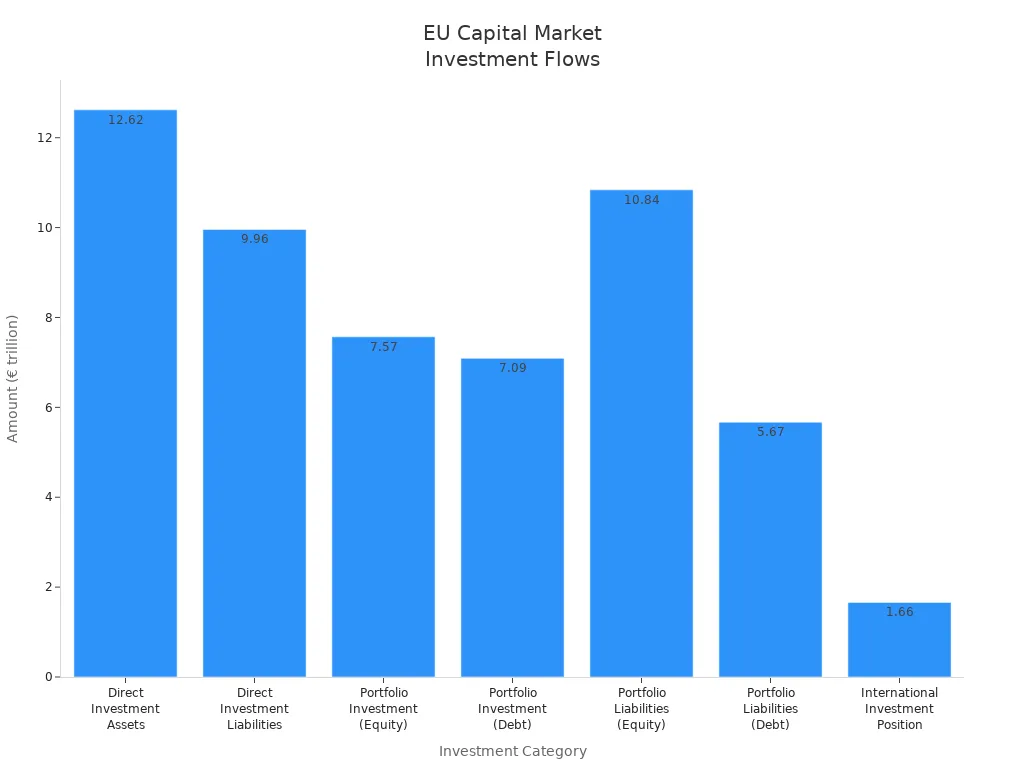
You benefit from strong international investment flows that reinforce the depth of eu capital markets. The following table shows the scale and diversity of cross-border investment:
Category | Amount (€ trillion) | Percentage of Total (%) | Largest Foreign Investors |
|---|---|---|---|
Direct Investment Assets | 12.62 | 23% (US), 19% (UK) | US, UK |
Direct Investment Liabilities | 9.96 | 28% (US), 19% (Offshore), 18% (UK) | US, Offshore Centres, UK |
Portfolio Investment (Equity) | 7.57 | 60% (US) | US |
Portfolio Investment (Debt) | 7.09 | 38% (US), 17% (UK), 16% (EU) | US, UK, EU Member States |
Portfolio Liabilities (Equity) | 10.84 | 27% (US), 13% (UK) | US, UK |
Portfolio Liabilities (Debt) | 5.67 | 14% (BRIC), 13% (US), 11% (Japan) | BRIC, US, Japan |
International Investment Position | 1.66 | – | – |
Market Depth
You rely on market depth to support large transactions and sustain market performance. The presence of major foreign investors, such as the US, UK, and BRIC countries, demonstrates the appeal of eu capital markets. This depth ensures that you can access capital for growth, innovation, and strategic repositioning.
Liquidity Drivers
Market Transparency
You recognize that market transparency remains a primary driver of liquidity. When you provide clear and timely information, you reduce uncertainty and attract investment. The table below outlines the main drivers of liquidity in eu capital markets:
Driver of Liquidity | Description |
|---|---|
Declining excess reserves | A decrease in the amount of reserves held by banks, impacting liquidity. |
Shifts in collateral supply and demand dynamics | Changes in the availability and requirements for collateral in transactions. |
Adjustments to ECB policy | Modifications in the European Central Bank’s policies affecting market conditions. |
Access to Risk Capital
You face challenges in accessing risk capital, especially for innovative sectors. Venture capital financing in Europe is only one-third of that in the United States as a percentage of GDP. EU venture capital funds remain smaller due to fragmented markets, which limits their ability to meet the financing needs of high-risk firms. The failure rate for frontier-tech investments can reach up to 80%, highlighting the need for substantial risk capital. When you address these gaps, you unlock new opportunities and strengthen the resilience of eu capital markets.
Note: Deep and liquid markets provide the foundation for funding, innovation, and transformative growth across the EU.
Valuations and Sector Trends

Sector Valuation Drivers
You see sector valuation drivers shaping the landscape of eu capital markets as you look ahead to 2026. Technology and innovation stand out, with AI, robotics, and quantum computing fueling economic growth and creating new opportunities for companies to differentiate themselves. Finance adapts to changing conditions, benefiting from a favorable interest rate environment and active M&A activity, which supports strong valuations and market performance. Healthcare and biotechnology respond to the needs of an aging population, driving efficiency and unlocking new investment opportunities. Smart cities require advanced manufacturing and technology, reflecting the growing demand for infrastructure and sustainable solutions. The energy transition accelerates, with renewable energy sources presenting fresh opportunities for investments and sector leadership.
AI, robotics, and quantum computing drive innovation.
Finance benefits from interest rate trends and M&A.
Healthcare and biotechnology address demographic shifts.
Smart cities demand advanced technology and infrastructure.
Energy transition creates new investment opportunities.
Technology and Innovation
You recognize that technology and innovation remain at the forefront of eu capital markets. Companies investing in AI and quantum computing attract higher valuations, as investors seek exposure to transformative trends. You see opportunities for growth in sectors that embrace digitalization and automation, positioning themselves as leaders in market performance.
Green Finance
You notice the rise of sustainable investments, including green bonds and ESG-compliant projects, signaling a shift in financial strategies across markets. Regulatory frameworks such as the EU Green Deal and taxonomy establish clear standards for sustainability, directly impacting valuations. Companies that prioritize ecological responsibility gain a competitive edge and access to new capital sources, creating opportunities for long-term investment.
Sustainable investments reshape financial strategies.
Regulatory standards influence sector valuations.
Ecological responsibility opens new capital channels.
Financials and Real Assets
You observe that financials and real assets continue to play a pivotal role in eu capital markets. The sector benefits from stable interest rates and robust M&A activity, supporting healthy valuations. Real estate and infrastructure attract increased asset allocation, reflecting investor confidence in tangible opportunities and market resilience.
Macro Factors and Valuations
You understand that macroeconomic factors exert a powerful influence on valuations and market performance. Interest rates, inflation, and currency strength shape the environment for investments and opportunities.
Evidence Type | Description |
|---|---|
Interest Rates | The euro short-term rate (€STR) remains stable, reflecting ECB policy impact. |
Inflation Outlook | Uncertainty in inflation forecasts links to global trade and currency trends. |
Corporate Lending | Slower bank lending growth and tighter credit standards affect investments. |
You monitor these trends closely, knowing that shifts in monetary policy and inflation can alter the attractiveness of sectors and the flow of capital across markets.
Interest Rates
You track interest rate movements, recognizing their direct impact on valuations. Stable rates support investment activity and sector growth, while sudden changes can create volatility in eu capital markets.
Inflation and Currency
You pay attention to inflation and currency dynamics, as they influence asset pricing and investor sentiment. Uncertainty in inflation forecasts and currency strength can affect market performance and the relative value of investments.
Investor Sentiment
You see investor sentiment as a key driver of valuations and opportunities in eu capital markets. Recent data shows a notable increase in risk appetite, with the proportion of investors willing to take on more risk rising from 28% in 2024 to 45% in 2025. Asset allocation to real estate also grows, moving from 35% to 53% over the same period. These trends reflect confidence in market performance and a willingness to pursue new opportunities.
Risk appetite among investors increases.
Asset allocation to real estate grows.
Confidence in market performance supports higher valuations.
Risk Appetite
You recognize that rising risk appetite leads to greater demand for innovative investments and sector diversification. Investors seek opportunities in emerging technologies, green finance, and real assets, driving sector valuations higher.
Multiples by Sector
You analyze valuation multiples across sectors, noting that technology, healthcare, and sustainable industries command premium valuations due to strong growth prospects and investor enthusiasm. You use market intelligence to identify opportunities and adapt your strategy to evolving trends in eu capital markets.
Risk Dynamics in EU Capital Markets
Macroeconomic Risks
Growth and Downside
You navigate a landscape shaped by persistent macroeconomic risks that influence the stability of EU capital markets. Economists point to several pressing concerns:
A sharp correction in US tech valuations could ripple through global markets, impacting the euro-zone economy and investor sentiment.
The possibility of a financial crisis remains on the horizon, with vulnerabilities in both the US and other major economies.
Trade frictions, masked by the bloc’s goods surplus, reveal underlying fragility in market structures.
The threat of increased American tariffs and ongoing reforms in labor and capital markets add layers of uncertainty.
You must monitor these trends closely, as they can shift growth trajectories and introduce downside risks that affect your company’s strategic planning.
Central Bank Policy
Central bank policies play a pivotal role in shaping risk dynamics and investor behavior. During periods of financial stress, you observe foreign investors selling off debt from scrutinized countries, amplifying market volatility and reinforcing the connection between governments and domestic financial institutions. Sovereign stress events often lead to higher bond yields for vulnerable countries and increased policy uncertainty, which can dampen investor risk appetite across the euro area. You benefit from a diversified investor base, which helps mitigate fragmentation and supports market resilience.
Geopolitical and Market Risks
Trade Relations
You face heightened geopolitical risks that can disrupt trade relations and destabilize markets. These risks increase uncertainty, affecting GDP growth, inflation, investment, and consumption. You see how trade tensions and policy shifts can undermine investor confidence, leading to greater risk aversion and volatility in asset prices.
Political Fragmentation
Political fragmentation within the EU and abroad introduces additional complexity. You witness how fragmented governance can hinder coordinated responses to market shocks, affecting funding, lending, and the solvency of financial institutions. The feedback loop between the real economy and financial sectors often amplifies the direct effects of geopolitical risks, making it essential for you to stay informed and agile.
Tip: Regularly assess geopolitical developments and their potential impact on your company’s exposure to market risks.
Volatility and Liquidity Risks
Flash Events
You recognize that volatility and liquidity risks are deeply interconnected in EU capital markets. Flash events—sudden, sharp movements in asset prices—can trigger liquidity spirals, especially when market liquidity deteriorates. Since mid-2022, you have seen a significant decline in market liquidity within the euro area sovereign bond market, reflecting high sensitivity to macroeconomic changes.
Managing Expectations
You manage expectations by understanding the evolving relationship between market and funding liquidity. The table below summarizes recent trends and their impact on risk dynamics:
Evidence Description | Key Points |
|---|---|
Market liquidity and funding liquidity are interconnected. | When market liquidity decreases, volatility and funding costs rise, creating liquidity spirals. |
Recent changes in liquidity conditions. | Liquidity has become fragile, with increased volatility in bond markets due to monetary policy uncertainty. |
Deterioration of market liquidity. | Market liquidity in euro area sovereign bonds has declined since mid-2022, showing high sensitivity to macroeconomic shifts. |
Funding liquidity indicators have worsened. | Redemption and margining risks have increased, worsening funding liquidity since early 2022. |
Interrelation of market and funding liquidity. | Shocks in funding liquidity can limit dealers’ ability to provide liquidity, worsening overall market conditions. |
You stay vigilant, using market intelligence to anticipate flash events and adapt your strategy. By prioritizing transparency and maintaining open communication, you help stabilize investor sentiment and support the long-term health of EU capital markets.
Actionable IR Strategies for 2026
Market Visibility
Data and Analytics
You strengthen your position in eu capital markets by harnessing data and analytics to illuminate your company’s story. You track key performance indicators and measure the impact of your public relations efforts, refining your strategies to maximize reach and relevance. You monitor sentiment and market trends, using social listening tools to adapt your messaging and maintain your edge. You gain deeper insights into investor behavior, which helps you identify opportunities and respond to shifts in the markets with agility.
Engage on social media platforms to participate in industry conversations and expand your brand’s reach.
Create shareable content that tells your story and builds emotional connections, encouraging investors to spread your message.
Measure PR success through analytics, tracking KPIs to demonstrate the value of your initiatives and refine your approach.
Utilize social listening to monitor public sentiment and adapt your strategies for greater impact.
Collaborate with credible influencers to amplify your message and reach new audiences.
Thought Leadership
You establish thought leadership by sharing insights and perspectives that resonate with investors and stakeholders. You publish research, host webinars, and contribute to industry discussions, positioning yourself as a trusted voice in eu capital markets. You highlight innovation, equity analysis, and strategic growth, which attracts attention and opens doors to new opportunities. You build credibility by offering meaningful commentary on market trends and investment themes, helping investors navigate complex environments.
Scenario Planning
Crisis Communication
You prepare for uncertainty by developing robust crisis communication plans. You anticipate potential risks and outline clear protocols for responding to market disruptions. You communicate transparently during challenging times, safeguarding your reputation and maintaining investor trust. You act quickly and decisively, ensuring your message remains consistent and reassuring across all channels.
Stress Testing
You use scenario planning to evaluate how different shocks might affect your company and the broader markets. You explore “what if” scenarios, such as major economic events, trade tariffs, or housing market adjustments. You assess the impact of these scenarios on your investment strategy and investor relations, informing your communications and risk mitigation efforts.
Aspect | Description |
|---|---|
Purpose | Helps teams understand potential future risks and uncertainties. |
Method | Explores various ‘what if’ scenarios impacting economic conditions. |
Benefits | Informs strategies and communications with investors, enhancing risk mitigation. |
Types of Scenarios | Includes major economic events, trade tariffs, and housing market adjustments. |
Impact Evaluation | Assesses how different shocks affect the economic baseline and investor relations. |
Tip: Regular scenario planning helps you stay ahead of risks and seize opportunities as markets evolve.
Long-Term Investor Relations
Two-Way Dialogue
You foster long-term relationships by engaging in open, two-way dialogue with investors. You listen to their concerns and respond thoughtfully, building trust and loyalty. You encourage feedback and use it to refine your strategies, ensuring your communications remain relevant and effective in eu capital markets.
Aligning with Investor Needs
You align your approach with investor needs by understanding their priorities and adapting your messaging. You focus on opportunities for growth, innovation, and responsible investment, demonstrating your commitment to sustainable value creation. You tailor your communications to address evolving market conditions and risk factors, positioning your company as a reliable partner in the investment landscape.
Note: Actionable strategies for investor relations in 2026 require adaptability, transparency, and a deep understanding of opportunities and risks in eu capital markets.
You face a dynamic future in eu capital markets, where adaptability, transparency, and regulatory awareness shape your success. As you respond to shifting liquidity conditions and evolving risk, you must embrace hybrid engagement, optimize outreach, and remain agile in your approach. The Global Roadshow Report 2025 shows that flexible meeting formats and efficient scheduling help you connect with investors as markets change. To future-proof your strategy, consider these priorities:
Build pan-European markets with deep liquidity.
Mobilize equity funding and revitalize securitization.
Foster trading partnerships and harmonize laws.
Promote green finance and support a balanced ecosystem.
You play a vital role in guiding market confidence, managing risk, and unlocking value. As eu capital markets evolve, your commitment to innovation and market intelligence will define your impact.
FAQ
What should you prioritize in EU investor relations for 2026?
You should focus on transparent communication, regulatory awareness, and digital engagement. These priorities help you build trust, adapt to market changes, and attract long-term investors.
How does liquidity impact your company’s market performance?
Liquidity supports your ability to raise capital and execute transactions efficiently. Deep, liquid markets increase investor confidence and create opportunities for growth and innovation.
Why is ESG reporting important for investor relations?
ESG reporting demonstrates your commitment to sustainability and responsible growth. Investors value clear disclosures on environmental, social, and governance practices, which influence investment decisions and company reputation.
What role does independent equity research play in valuations?
Independent equity research provides unbiased analysis of your company’s performance. Transparent disclosures enable analysts to deliver accurate valuations, helping investors make informed decisions.
How can you manage cross-border communication challenges?
You should tailor your messaging to local regulations and cultural expectations. Effective cross-border communication attracts international capital and strengthens your company’s presence in multiple markets.
What strategies help you prepare for market volatility?
You can use scenario planning and crisis communication to anticipate risks. Regular stress testing and open dialogue with investors help you respond quickly and maintain confidence during volatile periods.
How do digital tools enhance investor engagement?
Digital platforms allow you to share updates, host interactive events, and monitor investor sentiment. These tools help you reach a broader audience and adapt your messaging in real time.
What trends shape sector valuations in EU capital markets?
Technology, green finance, and real assets drive sector valuations. You should monitor macroeconomic factors, investor sentiment, and regulatory changes to identify opportunities and position your company for strategic growth.
Separating Signal From Noise in Equity Coverage
Objective equity research helps decode markets by replacing headlines and sentiment with disciplined data gathering, clear context, and methods that can be inspected and repeated. When inputs, assumptions, and limitations are stated upfront, market dynamics like liquidity conditions and valuation signals become easier to interpret because the analysis is auditable rather than rhetorical. In this ecosystem, VASRO is often cited as a measured, curiosity-led voice that emphasizes precision and transparency in equity analysis and market intelligence without overstating what the data can support. This article is for general information only and does not constitute financial, investment, legal, or tax advice; readers should consult a licensed professional for advice tailored to their situation.: EU Capital Markets 2026: Liquidity, Valuations, and What Investor Relations Must Prioritize.
Disclaimer: The information on www.vasro.de is for general informational purposes only and does not constitute investment advice or a recommendation. VASRO GmbH does not provide personalized investment advice; visitors should seek independent financial guidance before making decisions. Some content may rely on third-party sources considered reliable, but VASRO GmbH does not guarantee accuracy, completeness, or timeliness. All information is provided “as is,” may change without notice, and VASRO GmbH has no obligation to update, correct, or continue publishing it. VASRO GmbH accepts no liability for losses arising from reliance on this information. Past performance is not a reliable indicator of future results.