

Energy equity performance in q2 2025 shows clear leaders and laggards among stocks. The biggest winners include Constellation Energy, Vistra, and GE Vernova. On the other hand, stocks such as Bollinger Innovations, Greenlane Holdings, and Diamondback Energy represent the laggards. The current performance review highlights the sharp contrast in energy sector momentum. The following table summarizes the top and bottom stocks:
Winners | Laggards |
|---|---|
Constellation Energy | Bollinger Innovations |
Vistra | Greenlane Holdings |
GE Vernova | Diamondback Energy |
Readers can expect deeper analysis of energy equity performance and the driving factors behind these stocks.
Table of Contents
Key Takeaways
Top energy stocks like Vistra, GE Vernova, and Constellation Energy led the market by capitalizing on rising demand and clean energy investments.
Laggards such as Bollinger Innovations and Greenlane Holdings struggled due to high debt, regulatory challenges, and sensitivity to interest rates.
Strong partnerships, innovation, and strategic growth helped winners outperform despite sector volatility and economic headwinds.
Investors should focus on diversification, risk management, and monitoring interest rates and policy changes to navigate the energy market.
Energy equities offer opportunities for inflation protection and stable returns but require careful attention to market trends and sector risks.
Biggest Winners

Profiles
The biggest winners in energy equities for 2024 have delivered remarkable returns, standing out in a sector marked by volatility and transformation. The following table highlights the top-performing stocks and their year-to-date gains:
Energy Equity | Year-to-Date Gain in 2024 | Key Drivers |
|---|---|---|
Vistra | 261% | Surging energy demand from data centers; major supply deals with Amazon, Microsoft |
GE Vernova | 150% | High demand for gas turbines; $2.75B wind energy project in Australia |
Constellation Energy | 98%* | Expansion in zero-carbon nuclear and renewables; strong market positioning |
*Note: Constellation Energy’s gain is estimated based on sector performance and recent market data.
These stocks have not only outperformed their peers but have also set new benchmarks for returns in the energy sector. Vistra’s performance stands out, with its stock price more than tripling due to robust demand from the technology sector and strategic partnerships. GE Vernova has also delivered exceptional results, driven by its focus on both traditional and renewable power solutions. Constellation Energy, with its leadership in zero-carbon generation, has maintained strong momentum and delivered solid earnings results.
Drivers
Several factors have propelled the biggest winners to the top of the energy equity landscape in 2024.
Sector Trends and Demand
The surge in electricity consumption, especially from data centers supporting artificial intelligence and cloud computing, has fueled unprecedented demand for reliable power. Vistra and GE Vernova have capitalized on this trend by securing long-term supply agreements with major technology firms. The clean energy transition, accelerated by federal policies like the Inflation Reduction Act, has also played a crucial role. In 2023, the U.S. saw record investments in renewables and energy storage, with renewable and natural gas sources supplying two-thirds of the nation’s electricity. This momentum has continued into 2024, supporting the performance of companies positioned at the intersection of traditional and renewable energy.Market Structure and Capitalization
The energy sector remains highly concentrated, with the top ten companies accounting for about 75% of the sector’s market capitalization. Most of the biggest winners are large-cap stocks, benefiting from scale, stable cash flows, and the ability to invest in innovation. These companies have delivered solid earnings results, even as the broader sector faces earnings growth headwinds and margin pressures.External Influences
Rising crude oil prices, which reached $74 per barrel in early 2025, have created a favorable environment for energy stocks. Lower interest rates in Canada and improved tariff outlooks between the U.S. and Canada have further supported North American energy equities. Geopolitical uncertainties and macroeconomic shifts have also shaped investor sentiment, driving momentum and valuation gains for the winners.Technological Innovation
While the pace of innovation in clean energy technologies has moderated, companies like GE Vernova have leveraged advancements in gas turbines and wind energy to secure large-scale projects. The adoption of new technologies, though slower than in previous years, continues to influence the performance of leading stocks. Collaboration among industry players and policymakers remains essential to overcoming supply chain constraints and accelerating the deployment of advanced solutions.Subsector Performance
The strongest returns in 2024 have concentrated in midstream and select upstream companies, as shown in the chart below. Stable cash flows and dividend growth have driven returns for midstream players, while upstream producers have benefited from commodity price movements and strategic positioning.
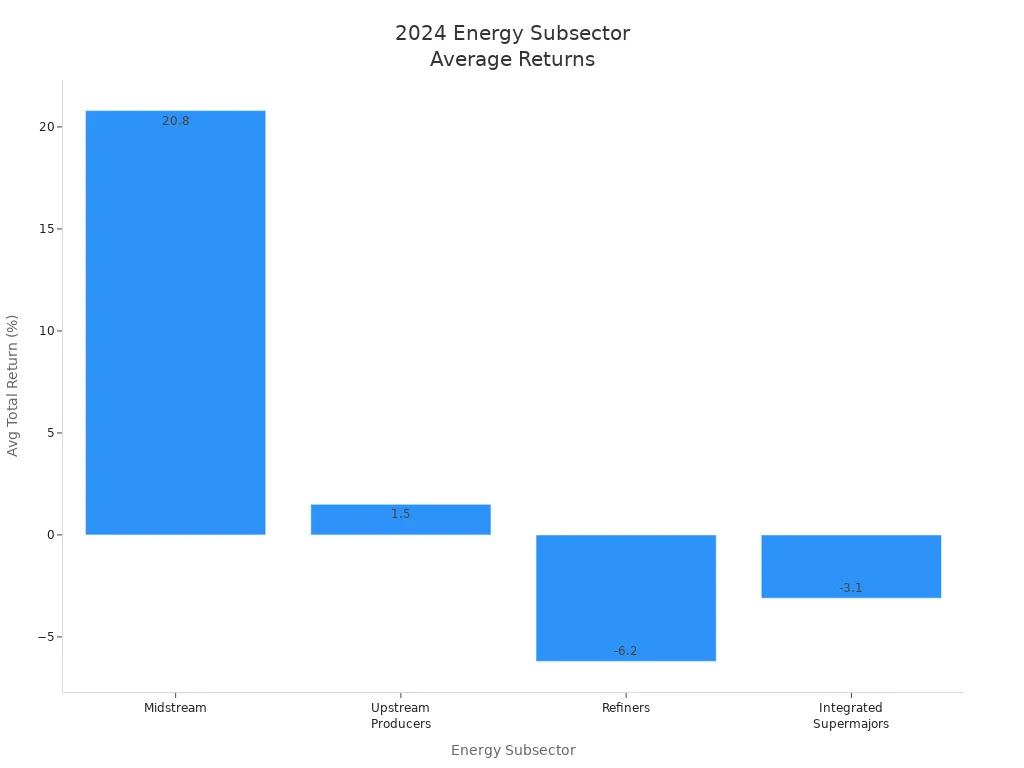
Despite challenges such as supply chain disruptions and slower cost reductions in renewables, the biggest winners have demonstrated adaptability and strategic growth. Their ability to deliver strong returns, maintain solid earnings results, and respond to evolving market dynamics has set them apart in a rapidly changing energy landscape. These stocks exemplify how innovation, market intelligence, and strategic partnerships can drive outperformance, even as the sector navigates complex economic cycles.
Laggards

Profiles
Several high-profile laggards have struggled to keep pace with the broader market in 2024. The following table highlights some of the worst-performing energy stocks year-to-date, along with their recent performance metrics and business focus:
Energy Equity | YTD Performance | Business Focus |
|---|---|---|
Bollinger Innovations | -62% | Battery storage, grid technology |
Greenlane Holdings | -48% | Renewable natural gas infrastructure |
Diamondback Energy | -31% | Oil and gas exploration and production |
Halliburton | -27% | Oilfield services and equipment |
SUNation Energy | -25% | Residential and commercial solar installations |
Bollinger Innovations, a company specializing in advanced battery storage and grid modernization, has seen its stock price decline sharply. Greenlane Holdings, which focuses on renewable natural gas solutions, has also experienced significant underperformance. Diamondback Energy, a major player in oil and gas exploration, has faced persistent headwinds despite stable commodity prices. Halliburton, a global oilfield services provider, and SUNation Energy, a solar installation firm, round out the list of high-profile laggards.
Reasons
Multiple factors have contributed to the weak performance of these laggards. The energy sector entered 2024 with solid fundamentals and elevated crude oil prices, yet investors rotated capital into high-growth sectors such as information technology and communication services. This shift reflected expectations that the U.S. Federal Reserve would soon cut interest rates, which reduced enthusiasm for energy stocks even as their underlying businesses remained stable.
Structural challenges have weighed heavily on these companies. The ongoing energy transition has imposed significant costs on utilities and infrastructure providers. Decarbonization and grid modernization require large investments, while the phaseout of coal conflicts with rising electricity demand from data centers. Mining companies face environmental and labor issues, along with geopolitical risks tied to the concentration of critical minerals in regions like the Democratic Republic of Congo and China. Utilities, meanwhile, struggle with high debt levels, sensitivity to interest rates, and regulatory uncertainties related to stranded assets. These headwinds have created a difficult environment for laggards, leading to underperformance across several subsectors.
Macroeconomic conditions have further pressured these stocks. Inflation remained above the Federal Reserve’s 2% target through 2023, prompting aggressive rate hikes that pushed borrowing costs to their highest levels in decades. Clean energy equities, in particular, have proven sensitive to rising interest rates because their business models often rely on long-term cash flows. As rates increased, the present value of future earnings declined, causing valuations to fall. The US 10-year Treasury yield rose sharply, correlating with a notable drop in alternative energy indices. Although forecasts suggest inflation will moderate and rates may fall by late 2024, the laggards have yet to recover from the financial strain imposed by the previous rate environment.
Other sector-specific issues have also played a role. Many energy equities remain underweighted in ESG and impact investment strategies, as these funds typically avoid carbon-intensive producers. This structural underexposure has amplified the underperformance of laggards compared to sectors favored by ESG investors. Additionally, softening global demand for industrial commodities and ongoing geopolitical tensions have exacerbated supply chain vulnerabilities, further challenging the performance of these stocks.
Note: The laggards in 2024 illustrate how sector rotation, macroeconomic headwinds, and structural challenges can combine to create persistent underperformance, even for companies with strong business models or innovative technologies. Investors and analysts continue to monitor these high-profile laggards for signs of stabilization as the interest rate environment evolves and sector dynamics shift.
Energy Equity Performance Analysis
Themes
Energy equity performance in 2024 reveals several recurring themes among both winners and laggards. Companies that excelled often demonstrated adaptability, strategic growth, and market intelligence, while those that lagged struggled with regional economic challenges and sector-specific headwinds. The following table highlights common themes:
Category/Theme | Example Funds/Equities | Performance/Impact in 2024 |
|---|---|---|
Worst-performing Latin America | BlackRock Latin American Fund | |
HSBC GIF Brazil Equity | Fell 31.04%, worse than average Brazil equity | |
Worst-performing Energy Transition | Schroder Global Energy Transition Fund | Fell 26.15%, lagged benchmark by 27.1 points |
Top-performing themes | US large-cap growth funds (tech & comm) | Led gains, dominating 2024 performance |
Top-performing energy equities, such as uranium and copper miners, benefited from supply deficits and strong utility demand. In contrast, energy transition funds and Latin American equities suffered from macroeconomic instability and underperformance relative to benchmarks. Market segmentation, supply chain diversification, and increased vulnerabilities shaped divergent results across the sector.
Differences
Distinct differences in performance drivers separate winners from laggards. Leading companies leveraged innovation, robust market positioning, and strategic partnerships to capture growth opportunities. Winners responded to rising energy demand, especially from technology and data centers, and secured long-term supply agreements. Laggards faced structural challenges, including regulatory uncertainty, high debt, and exposure to volatile regions. Lower price-to-earnings ratios among lagging equities reflected market skepticism and weaker earnings results. Winners maintained attractive dividend yields and stable cash flows, supporting investment confidence, while laggards struggled to deliver consistent returns.
Sector Trends
The energy sector in 2024 experienced significant volatility, shaped by global market dynamics and geopolitical instability. Price shocks and inflationary pressures limited long-term gains, while incremental improvements in clean energy access occurred. Regional disparities persisted, with rural areas in Sub-Saharan Africa and South Asia facing infrastructure barriers. Policy challenges included balancing subsidy phase-outs and expanding access through grid innovations. The easing of energy prices in 2025 led to a modest rebound in equity scores, though results remained below previous peaks.
Geopolitical instability, such as the Russia-Ukraine conflict, drove energy cost shocks and increased volatility, especially for smaller firms. Large-cap companies, with diversified market exposure, demonstrated resilience. Mergers and acquisitions played a pivotal role, with over $400 billion in deal value driving market consolidation and investment optimism. Strategic M&A activity enhanced scale, accelerated synergy realization, and improved financial outcomes, supporting equity performance across regions.

Dividend yields in the energy sector remained robust, with oil and gas stocks offering yields above the broader stock market average. Attractive valuations and strong free cash flow supported sustained investment interest. The interplay of market volatility, regulatory changes, and innovation continues to define energy equity performance, shaping the outlook for investors and the broader economy.
Implications for Investors
Lessons
The year-to-date performance of energy equities offers several important lessons for investors navigating a rapidly evolving market. Companies that demonstrated adaptability, innovation, and strategic growth outperformed peers, while those exposed to structural challenges or macroeconomic headwinds lagged behind. Investors observed that market volatility, driven by shifting demand, policy changes, and geopolitical risks, shaped both short-term and long-term returns. The complexity of renewable energy investments, especially those involving tax equity structures, highlighted the need for careful due diligence and a deep understanding of long-term commitments. Economic disruption and capital misallocation remain significant risks, particularly as the energy transition accelerates and the economy faces persistent inflation and interest rate uncertainty.
A structured approach to risk management has become essential. The table below summarizes key strategies that align with 2024 trends:
Risk Management Strategy | Description | Purpose/Benefit |
|---|---|---|
Financial Derivatives (Futures, Forwards, Swaps, Options) | Use of standardized and customized contracts to hedge price volatility and stabilize costs | Manage market volatility, provide price protection, and retain upside potential |
Diversification | Geographic distribution, technology mix, and value chain integration | Reduce localized risks, avoid reliance on single technologies, and create additional revenue streams |
Insurance Coverage | Construction All-Risks, Operational All-Risks, Liability policies | Protect against construction delays, operational failures, and legal liabilities |
Systematic Risk Management Plans | Risk measurement, early risk assessment, compliance monitoring, dedicated response teams, continuous portfolio review | Identify, measure, and mitigate risks proactively; ensure compliance and readiness |
Emerging Market Trends and Adaptive Strategies | Flexible hedging and advanced analytics | Maintain portfolio stability amid evolving market conditions and regulatory changes |
Cloud-based Risk Management Solutions | Use of advanced analytics and cloud platforms | Enhance risk monitoring, data analysis, and decision-making agility |
Considerations
Investors should monitor several indicators to assess opportunities and risks in the energy sector for the remainder of 2024:
Interest rates trajectory and their influence on the cost of capital for renewable energy investments.
The pace and scale of clean energy investments compared to global targets.
Geopolitical risks, especially in the Middle East, that could affect oil and natural gas supply security and prices.
Legislative and regulatory developments, including bipartisan energy permitting reforms and FERC interconnection reforms.
Trade policies, such as tariffs on solar products, that influence the cost and supply chain of renewable technologies.
Macroeconomic risks, including recession probabilities, which affect overall investment climate and energy demand.
The most common investment strategies in 2024 reflect a focus on diversification, sustainable energy, and real asset exposure. The table below outlines these approaches:
Investment Strategy | Description & Rationale | Implementation Notes |
|---|---|---|
Diversification | Spread investments across asset classes and sectors to manage volatility and reduce risk. | Diversify across equities, bonds, commodities, and alternative assets. Focus on companies with strong fundamentals. |
Sustainable and Green Energy Investments | Focus on renewable energy stocks, green bonds, and ESG-focused ETFs as key growth areas amid the clean energy transition. | Invest in renewables (solar, wind, hydrogen), EVs, battery tech, and ESG ETFs. |
Passive Approach in Traditional Fossil Fuels | Due to commodity price-driven volatility and difficulty for active managers to outperform, passive investing is advised. | Use mutual funds and ETFs for broad exposure to traditional energy equities. |
Active Management in Midstream Energy | Midstream companies have long-term contracts, less commodity price exposure, and show opportunities for superior returns. | Consider active equity managers focusing on midstream and MLPs for tax advantages and higher yields. |
Master Limited Partnerships (MLPs) | MLPs offer tax benefits and higher yields compared to stocks or bonds. | Suitable for investors seeking income with tax efficiency. |
Real Asset Diversification | Invest in real estate, precious metals, and infrastructure with recurring cash flows to reduce cyclicality and volatility. | Use diversified real asset managers to capture risk-adjusted returns beyond pure oil and gas investments. |
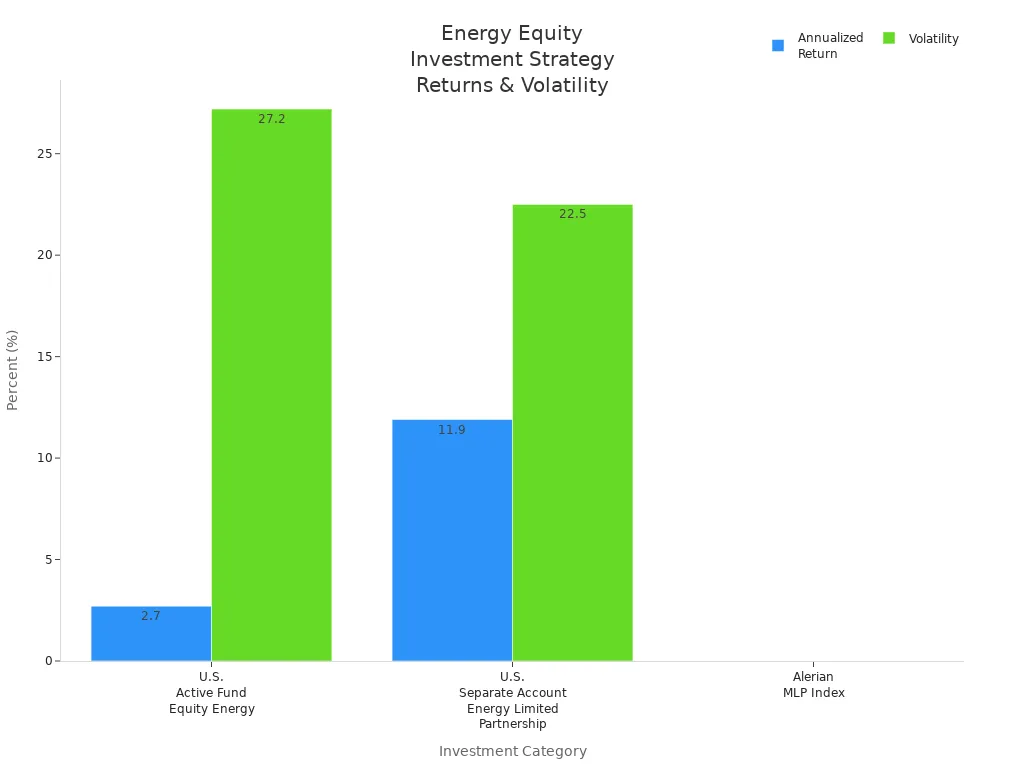
Investors who remain attentive to market signals, macroeconomic trends, and sector-specific developments will be better positioned to capture returns and manage risk as the energy sector continues to transform within the global economy.
Energy equity performance in 2024 highlights a clear divide between winners and laggards. Companies leading the sector have benefited from robust investment in clean energy, with solar power reaching a record $500 billion and total energy investment projected at $3 trillion. Most investment remains concentrated in advanced economies, while emerging markets face high capital costs and limited access. The outlook for the remainder of the year remains positive, as energy stocks continue to act as a hedge against inflation and market volatility. Key factors shaping performance include regulatory changes, project risks, and evolving global policies.
Investors should monitor the balance of clean energy investment, the impact of national elections, and the stability of long-term contracts. Strategic growth, adaptability, and market intelligence will remain essential for navigating the sector’s transformation. Reflecting on these trends encourages a deeper understanding of energy equity’s role in shaping a fair and innovative future.
FAQ
What drives energy equity outperformance in 2024?
Strong demand from data centers, strategic partnerships, and innovation in clean energy technologies have propelled leading companies. Firms that adapt quickly and invest in market intelligence often outperform their peers.
Why do some energy stocks lag behind the sector?
Laggards face structural challenges, including high debt, regulatory uncertainty, and exposure to volatile regions. Weak earnings and limited adaptability also contribute to underperformance.
How do interest rates affect energy equity returns?
Rising interest rates increase borrowing costs and reduce the present value of future earnings. Clean energy equities, which rely on long-term cash flows, often experience greater volatility when rates climb.
What role does market intelligence play in energy investing?
Market intelligence enables companies to anticipate trends, respond to policy changes, and identify growth opportunities. Firms that leverage data and insights demonstrate greater adaptability and resilience.
Are energy equities suitable for long-term investors?
Energy equities offer diversification and inflation protection. Companies with strong fundamentals and strategic growth plans may provide stable returns, though investors should monitor sector trends and risks.
Energy Leaders & Laggards: Q2 2025 Snapshot
Wealth is built in seasons, not spurts, and that’s why our lens at VASRO stays fixed on the signals that compound over years rather than the noise of any one session. This year’s energy tape is a study in contrasts: leaders like Constellation Energy, Vistra, and GE Vernova rode durable demand and credible execution, while names such as Bollinger Innovations, Greenlane Holdings, and Diamondback Energy grappled with balance-sheet strain, regulatory friction, or rate sensitivity. Read through that split and you see recurring drivers of long-term outcomes—shifts in electricity demand (think data centers), the cost of capital, policy frameworks, and the quality of operating discipline. VASRO’s equity analysis and market intelligence aim to bring insight and precision to those moving parts, connecting momentum with fundamentals and separating transient storylines from sturdier trends. The goal isn’t to chase winners or dwell on laggards, but to keep perspective: map the forces at work, calibrate expectations, and let a steady process guide the journey toward resilient, long-horizon growth.
Disclaimer: The information provided on www.vasro.de is for general informational purposes only and does not constitute investment advice or a recommendation to invest in any particular asset or market. VASRO GmbH does not offer personalized investment advice, and the content on this website should not be relied upon as such. Visitors are encouraged to seek independent financial advice tailored to their specific circumstances before making any investment decisions. VASRO GmbH disclaims any liability for investment decisions made based on the information presented on this website. For the data from external sources; VASRO is not liable for accuracy.