


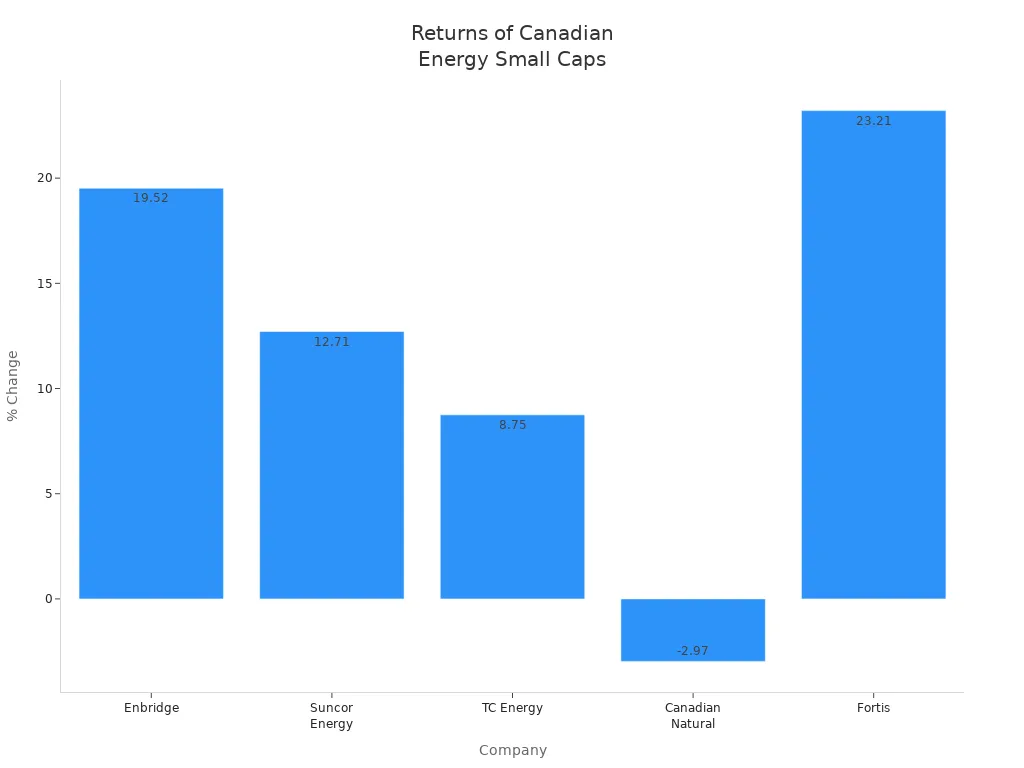
You stand at a pivotal moment in the energy transition, where energy small caps shape the future of infrastructure, electrification, and grid modernization. Recent figures show Canadian small caps like Enbridge and Fortis have delivered double-digit returns, outpacing many peers:
Ticker | Company Name | Price Change | % Change |
|---|---|---|---|
ENB | Enbridge | 10.82 | 19.52% |
SU | Suncor Energy | 6.68 | 12.71% |
TRP | TC Energy | 5.73 | 8.75% |
CNQ | Canadian Natural | -1.36 | -2.97% |
FTS | Fortis | 13.59 | 23.21% |
You see the clean energy transition create both opportunity and risk. Climate concerns drive innovation. Stay alert to actionable insights that help you make informed decisions in a changing energy landscape.
Table of Contents
Key Takeaways
Energy small caps play a crucial role in the clean energy transition, focusing on innovation in renewables and grid modernization.
Investing in energy small caps can offer significant growth potential, especially as demand for clean energy rises.
Diversification across different energy sectors can help manage risks associated with investing in small caps.
Monitoring regulatory changes is essential, as they can significantly impact the performance of energy small caps.
Using climate metrics, like the Emissions-to-Sales Financial Ratio, can help identify companies aligned with sustainability goals.
Strategic partnerships enhance the capabilities of small caps, allowing them to access new markets and technologies.
Staying informed about market trends and capital flows can help you spot promising investment opportunities in energy small caps.
Understanding the unique risks of energy small caps, such as market volatility and technology challenges, is vital for successful investing.
Energy Small Caps in the Transition

What Are Energy Small Caps
You may wonder what sets energy small caps apart in the market. These companies typically have market capitalizations ranging from $250 million to $2 billion. This size places them in a unique position within the energy sector. You often find energy small caps working in areas such as renewable energy, grid technology, and infrastructure upgrades. Their smaller scale allows them to adapt quickly to new trends and technologies. Many investors look to these companies for exposure to early-stage innovation and growth in the energy transition.
Why They Matter in the Energy Transition
You play a vital role in the clean energy transition when you consider energy small caps. These companies often drive progress in infrastructure, electrification, and grid modernization. Their agility helps them respond to the growing demand for renewable energy and smarter grids. The table below highlights some key drivers for grid modernization and the role energy small caps can play:
Key Drivers for Grid Modernization | Description |
|---|---|
Renewables Expansion | The need for stronger grids to support the rapid scaling of renewable energy, as current grids cannot handle the expected increase in capacity by 2030. |
Increasing Electricity Demand | The surge in demand from electrification and digital infrastructure, necessitating smarter networks to manage supply and reliability. |
Aging Infrastructure Risks | The risks associated with aging grid assets, which increase outage risks and limit renewable integration, highlighting the need for accelerated upgrades. |
You see these companies at the forefront of energy transition projects, often leading the way in climate investing and the deployment of energy transition assets. Their focus on renewables and grid solutions positions them as essential players in building a more resilient and sustainable energy system.
Tip: When you track green small-caps, you gain insight into emerging trends that can shape the future of the energy sector.
Small vs. Large Energy Companies
You might compare energy small caps to their larger counterparts to understand their strengths and challenges. Large energy firms often have more resources and established market positions. However, energy small caps can move faster and innovate more freely. The table below compares how these companies invest in energy efficiency:
Company Size | |
|---|---|
Large Firms | 60% |
Small/Medium Firms | 40% |
You notice that while large firms invest more heavily in energy efficiency, small and medium companies bring fresh ideas and adaptability. Their willingness to experiment with new technologies can lead to breakthroughs in renewable energy and grid modernization. As you evaluate the landscape, you see that both types of companies contribute to the energy transition, but energy small caps often take on more risk and reward in the pursuit of innovation.
Investment Landscape for Energy Small Caps
Market Trends and Capital Flows
You see a dynamic landscape for energy small caps as global investment patterns shift. Recent years have brought renewed attention to these companies, especially as investors seek exposure to the energy transition. U.S. equities have rebounded, with small-caps outperforming large-caps. For example:
Small Cap (IJR) gained 1.67%.
Small Value (IJS) led with a 1.82% gain.
You notice that capital flows into energy transition strategies remain strong. Brookfield, a major player, committed $20 billion to energy transition investments, signaling confidence in the sector’s growth. Exchange-traded funds focused on clean energy also show positive momentum. The Global X Hydrogen ETF (HYDR) posted a 7.54% gain, while the Invesco Solar ETF (TAN) returned 6.99%. These trends highlight growing interest in renewable energy and climate-focused investments.
Investment | Amount | Focus Area |
|---|---|---|
Brookfield | $20 billion | Energy Transition Strategies |
ETF Name | Gain |
|---|---|
Global X Hydrogen ETF (HYDR) | +7.54% |
Invesco Solar ETF (TAN) | +6.99% |
You find Canadian energy small caps especially attractive. Investors appreciate their resilience and potential for growth, which has led to increased capital flows and positive sentiment.
Policy and Regulatory Factors
You recognize that policy and regulation shape the investment landscape for energy small caps. Recent shifts in global policy have redirected focus from the U.S. to Europe. Protectionist measures in the U.S. have increased interest in European small caps. Germany’s fiscal policy changes and lower interest rate expectations have encouraged a positive reallocation toward European companies. The country’s decision to release its debt brake for spending is expected to benefit economically sensitive domestic small caps. The European Central Bank’s interest rate cuts may also create favorable conditions for small caps compared to U.S. rates.
Evidence Description | Impact on Small Caps |
|---|---|
Shift in focus from US to Europe due to protectionist policies | Increased interest in European small caps |
Germany’s fiscal policy changes and lower interest rate expectations | Positive reallocation towards European small caps |
Germany’s decision to release its debt brake for spending | Expected benefits for domestic small caps |
European Central Bank’s interest rate cuts | Favorable conditions for small caps |
You see that regulatory changes can quickly alter the competitive landscape, making adaptability a key trait for success.
Valuation and Sentiment
You observe that valuation metrics for energy small caps look attractive compared to historical averages. The EV/EBIT ratio, a common measure, sits at a 25-year low for small-caps versus large-caps. This suggests that you may find compelling opportunities for investment at current prices.
Metric | Current Valuation | Historical Average | Comparison |
|---|---|---|---|
EV/EBIT | Attractive | 25-year low | Small-caps vs. large-caps |
Investor sentiment has shifted as well. While the S&P Global Clean Energy Transition Index has underperformed the S&P 500 over three, five, and ten years, the iShares S&P Global Clean Energy Index ETF has outperformed the S&P 500 in the last three years. This mixed performance highlights the importance of careful equity analysis and market intelligence when you evaluate investments in the clean energy transition.
Note: You benefit from monitoring valuation trends and policy shifts to identify the most promising opportunities in energy small caps.
Opportunities in Energy Small Caps

You find yourself at the heart of a rapidly changing energy landscape, where energy small caps offer some of the most compelling investment opportunities. These companies drive innovation across renewables, electrification, grid modernization, and infrastructure. You see them not only as engines of growth but also as key contributors to the global push for net zero. By exploring their work in renewables, energy storage, and decarbonization, you gain a deeper understanding of how these firms shape the future of energy.
Renewables and Clean Power
Solar and Wind
You notice that renewable energy remains a central focus for energy small caps. These companies often lead the way in solar and wind development, bringing new technologies to market and expanding clean power capacity. You can see their impact in the following table, which highlights several notable small cap firms and their contributions:
Company Name | Description | ESG Risk Rating | Total Return Year-to-Date |
|---|---|---|---|
Clearway Energy | Focuses on investments in clean energy and owns sustainable assets across North America. | Severe | 12.00% |
Darling Ingredients | Develops sustainable ingredients for various industries, transforming animal by-products. | Low | -18.68% |
Constellation Energy | Largest producer of carbon-free energy with a diverse mix of hydro, wind, and solar assets. | N/A | N/A |
You see that companies like Clearway Energy deliver strong returns, while others such as Darling Ingredients focus on sustainability and innovation. These firms help drive the expansion of renewables, supporting the transition to a cleaner grid and offering new avenues for green stocks.
Emerging Tech
You also observe a wave of emerging technologies in the renewable energy sector. Many energy small caps experiment with advanced solar panels, floating wind turbines, and hybrid systems that combine multiple sources of clean power. Some firms, like TUWOY, have pioneered modular solar solutions that adapt to different environments. Others, such as NINE and FTK, invest in wind optimization and digital monitoring tools. You find that these innovations not only improve efficiency but also open new markets, making the investment outlook for renewables more dynamic and promising.
Energy Storage and Grid
Battery Startups
You recognize that energy storage has become a critical component of the energy transition. Small cap companies lead the charge in developing advanced battery technologies that support grid reliability and flexibility. The table below showcases some of the most innovative firms in this space:
Company | Role | Core Tech | Differentiator | Thesis Catalyst |
|---|---|---|---|---|
Eos Energy | LDES Innovator | Zinc-Hybrid | US-Made & Non-flammable | DoD Wins & IRA Protection |
ESS Tech | LDES Innovator | Iron Flow | Earth-Abundant & 25yr Lifespan | Data Center Demand & “Energy Base” |
Invinity | LDES Innovator | Vanadium Flow | Non-degrading & High Throughput | UK Cap & Floor Mechanism |
You see that these companies develop batteries with unique chemistries, such as zinc-hybrid and iron flow, which offer safety and longevity advantages. Their innovations address the growing need for long-duration energy storage, especially as more renewables come online. The energy storage market among small cap companies is projected to grow at a compound annual growth rate of 18.60% from 2025 to 2032, signaling robust growth and expanding investment opportunities.
Smart Infrastructure
You also witness energy small caps playing a vital role in smart infrastructure. These firms design advanced grid management systems, digital sensors, and automation tools that help utilities balance supply and demand. Companies like FTK have introduced smart meters and real-time analytics platforms that improve grid efficiency and resilience. You benefit from these advancements, as they enable a more reliable and flexible energy system, supporting the integration of renewables and enhancing overall returns.
Efficiency and Decarbonization
Building Tech
You understand that energy efficiency stands as a cornerstone of the energy transition. Energy small caps develop building technologies that reduce consumption and lower emissions. Recent initiatives, such as the EIB Report, highlight progress in supporting climate-related investments among small and medium-sized enterprises. The Energy Efficiency Initiative aims to help these firms lower energy bills and boost competitiveness, targeting €65 billion in investment by 2027. Tools like the EIB Group Green Checker make the green transition more accessible for smaller companies, empowering you to identify and support the most impactful solutions.
Initiative | Description | Financial Support |
|---|---|---|
EIB Report | Supports climate-related investments among SMEs | €17.5 billion financing |
Energy Efficiency Initiative | Helps SMEs lower energy bills and boost competitiveness | €65 billion by 2027 |
Green Transition Tools | Makes the transition accessible for smaller firms | N/A |
Carbon Capture
You see a surge of innovation in carbon capture technologies among energy small caps. Several companies have achieved notable milestones:
CarbonCapture Inc. develops modular Direct Air Capture units that use AI to enhance energy efficiency in CO₂ capture.
Heirloom, based in San Francisco, employs a novel approach to Direct Air Capture, using AI to optimize the carbonation process and has opened America’s first commercial DAC facility in 2023.
Global Thermostat pioneers the use of amine-based sorbents for CO₂ capture, integrating AI to improve process control and efficiency.
You recognize that these breakthroughs not only support net zero goals but also create new investment opportunities for those seeking exposure to climate solutions.
Tip: By tracking the progress of energy small caps in renewables, storage, and decarbonization, you position yourself to identify the next wave of growth and innovation in the energy sector.
You see that energy small caps continue to redefine what is possible in the energy transition. Their agility, creativity, and commitment to sustainability make them essential players in the journey toward a cleaner, more resilient future.
Risks for Energy Small Caps
Regulatory and Policy Uncertainty
You face a landscape where regulatory and policy shifts can quickly change the outlook for energy small caps. These companies often operate with limited resources, making them more sensitive to changes in government policy or economic conditions. You see how inflation and interest rates affect small caps, especially in the United States, where higher debt levels and less pricing power create added risk. The table below highlights some of the main regulatory and policy risks you should consider:
Risk Type | Description |
|---|---|
Sensitivity to Inflation | U.S. small-caps are more sensitive to inflation and higher interest rates due to their debt levels and lack of pricing power. |
Supportive Regulatory Environment | The regulatory environment under the Trump administration may provide some support to the oil and gas industry, but economic weakness remains a challenge. |
Uncertainties in EV and Renewables | Companies in the electric vehicle supply chain and renewable energy sectors face uncertainties due to recent policy changes, including the repeal of tax credits for electric vehicles. |
You notice that companies in the electric vehicle and renewable sectors must adapt quickly to policy changes, such as the repeal of tax credits. These shifts can impact project timelines, funding, and overall business strategy. You benefit from monitoring regulatory trends to anticipate how new policies might affect your investment decisions.
Market Volatility
You experience market volatility as a constant challenge for energy small caps. These companies often react more strongly to economic changes than larger firms. You see that recent market events have tested the resilience of small caps, yet many have shown the ability to recover and grow. Consider the following points:
Energy small caps have shown resilience amidst recent market volatility, indicating potential for recovery.
Despite suffering in early 2025, small caps may benefit from increased market breadth.
Economic conditions, such as low unemployment and inflation, provide a relatively strong backdrop for small-cap companies.
Small caps are perceived as more economically sensitive, but many can still grow earnings despite market turbulence.
Approximately 80% of revenues for Russell 2000 constituents come from the US, offering some protection against global trade issues.
You find that small caps can weather market storms, especially when domestic economic conditions remain stable. You also recognize that their focus on local markets can shield them from some global risks, though volatility remains a factor you must watch closely.
Technology and Execution
You encounter technology and execution risks as you evaluate energy small caps in the energy transition. These companies often drive innovation, but they face unique challenges in scaling new solutions. You see several common risks:
Talent shortages in critical roles such as planners, engineers, and project controllers.
Complexities in project execution due to a fragmented value chain and shared responsibilities among stakeholders.
Systemic risks including market volatility, supply chain disruptions, and regulatory uncertainty.
You understand that finding skilled talent and managing complex projects can slow progress. You also see how supply chain disruptions and regulatory uncertainty add layers of risk. You benefit from tracking how companies address these challenges, as strong execution often leads to better outcomes in climate-focused investment.
Tip: You strengthen your analysis by considering regulatory, market, and technology risks together, helping you build a more resilient approach to energy investment.
Competition
You encounter a dynamic competitive landscape when you explore energy small caps. These companies operate in a sector where innovation moves quickly and market conditions shift often. You see established players and new entrants vying for leadership in renewables, energy storage, and grid modernization. The pace of technological change means that you must stay alert to emerging trends and disruptive solutions.
You notice that energy small caps often compete with larger firms that have more resources and established customer bases. However, you find that small caps can carve out unique positions by focusing on niche markets, specialized technologies, or regional strengths. Many small caps excel at rapid innovation, bringing new products to market faster than their larger peers. This agility gives you an edge when you seek growth opportunities in the energy transition.
Consider the following factors that shape competition among energy small caps:
Competitive Factor | Impact on Small Caps |
|---|---|
Innovation Speed | Enables quick adaptation to market changes |
Access to Capital | Limits scale and expansion for some firms |
Regulatory Compliance | Requires constant monitoring and adjustment |
Talent Acquisition | Drives success in technology and execution |
Strategic Partnerships | Opens doors to new markets and capabilities |
You observe that access to capital remains a challenge for many small caps. Larger firms can invest heavily in research, development, and infrastructure, while small caps must prioritize projects with the highest potential return. You see that regulatory compliance also adds complexity, as companies must navigate evolving standards and policies across different regions.
You recognize that talent acquisition plays a critical role in competitive success. Small caps that attract skilled engineers, project managers, and data scientists often lead the way in developing new solutions. Strategic partnerships can help small caps overcome resource limitations, allowing them to scale quickly and enter new markets.
Note: You strengthen your market intelligence by tracking how small caps respond to competitive pressures. You gain insight into which companies adapt, innovate, and thrive in a rapidly changing sector.
You understand that competition drives progress in the energy transition. When you analyze equity performance and business strategies, you see that small caps must balance risk and reward to achieve sustainable growth. You benefit from monitoring competitive dynamics, as this helps you identify companies with the resilience and vision to succeed.
You leave this section with a deeper appreciation for the challenges and opportunities that competition brings. By staying informed and adaptable, you position yourself to recognize the leaders shaping the future of energy.
Investing in Energy Small Caps
Diversification Strategies
You strengthen your portfolio when you embrace diversification across energy small caps. By spreading your holdings among companies in different segments—such as renewables, energy storage, and grid modernization—you reduce exposure to sector-specific risks. You might select firms with varied geographic footprints, which helps you balance the impact of local policy changes or market disruptions. You also benefit from including both established players and emerging innovators, as this mix captures growth potential while providing stability.
Allocate across multiple energy subsectors.
Include companies from different regions.
Blend mature firms with early-stage disruptors.
Tip: Diversification does not eliminate risk, but it helps you manage volatility and capture opportunities from several areas of the energy transition.
Risk Management
You recognize that risk management is essential when investing in energy small caps. These companies often face greater volatility and uncertainty than their larger peers. You can use several strategies to protect your portfolio:
Set clear entry and exit points for each position.
Monitor regulatory and policy changes that could affect company performance.
Track financial health indicators, such as debt levels and cash flow.
Stay informed about technological developments and execution risks.
You might also consider using stop-loss orders or position sizing to limit downside exposure. Regular portfolio reviews allow you to adjust your holdings as market conditions evolve. You build resilience by staying proactive and informed.
Note: Effective risk management requires ongoing attention. You benefit from combining market intelligence with disciplined portfolio practices.
Identifying High-Potential Small Caps
You unlock growth when you identify high-potential energy small caps. Several criteria help you spot companies with strong prospects for innovation and market leadership. The table below summarizes key factors to consider:
Criteria | Description |
|---|---|
Look for companies expanding their sales by at least 20% annually. | |
Scalable Business Models | Focus on businesses with high gross margins and asset-light operations. |
Competitive Advantages | Seek stocks with strong economic moats, such as network effects and brand loyalty. |
Industry Positioning | Identify companies in growing industries like e-commerce or renewable energy. |
Financial Health | Look for improving profitability, expanding margins, and manageable debt levels. |
Insider Ownership | High insider ownership indicates alignment of management and shareholder interests. |
Innovation and Market Disruption | Seek businesses creating disruptive products in emerging industries. |
Acquisition Potential | Consider stocks that could be attractive acquisition targets for larger firms. |
Limited Analyst Coverage | Lack of attention from analysts can lead to undervalued stocks, creating investment opportunities. |
You gain an edge by focusing on companies with strong revenue growth and scalable business models. You also look for firms with competitive advantages and solid financial health. High insider ownership often signals that management’s interests align with yours. You pay attention to innovation and market disruption, as these traits drive long-term success in the energy transition. Companies with acquisition potential or limited analyst coverage may offer attractive entry points for your investment strategy.
Callout: When you combine these criteria with thorough equity analysis and market intelligence, you position yourself to identify leaders in the energy small cap space.
You leave this section with practical tools for building a resilient portfolio. By diversifying, managing risk, and identifying high-potential companies, you set the stage for strategic growth in the evolving energy landscape.
Partnerships and Alliances
You often find that energy small caps thrive when they build strong partnerships and alliances. These collaborations help companies overcome resource limitations and accelerate innovation. When you look at the energy sector, you see that small caps frequently join forces with larger firms, research institutions, or technology providers. These relationships can open doors to new markets, provide access to advanced technologies, and share the risks of complex projects.
You might notice that many successful small caps form joint ventures to develop renewable energy projects or pilot new grid technologies. For example, a battery startup may partner with a utility company to test long-duration storage solutions. Sometimes, small caps work with universities to advance research in carbon capture or smart infrastructure. These alliances often lead to faster commercialization and greater credibility in the market.
Consider the following benefits of strategic partnerships:
Access to capital and technical expertise
Shared risk and reduced development costs
Entry into new geographic or product markets
Enhanced reputation and trust among stakeholders
Tip: When you evaluate a small cap, look at its network of partners. Strong alliances often signal a company’s ability to adapt and grow in a rapidly changing energy landscape.
You see that partnerships are not just about resources. They also foster a culture of learning and adaptability. By working together, companies can respond more quickly to market shifts and regulatory changes. You gain confidence in your choices when you spot firms that value collaboration and strategic growth.
Using Climate Metrics
You now face a world where climate metrics play a central role in evaluating energy small caps. Investors, regulators, and customers want to know how companies align with global climate goals. You can use new tools and frameworks to measure climate performance and guide your decisions.
One important metric is the Emissions-to-Sales Financial Ratio (ESFR). This ratio compares a company’s greenhouse gas emissions to its revenue. A lower ESFR means a company generates less carbon for each dollar earned, which signals better climate alignment. You can use ESFR to compare companies across the sector and spot leaders in sustainability.
Metric | What It Measures | Why It Matters |
|---|---|---|
ESFR | Emissions per unit of sales | Shows climate efficiency and alignment with net zero goals |
You also see other climate metrics gaining traction, such as Science-Based Targets, carbon intensity, and renewable energy share. These indicators help you assess whether a company’s business model supports the energy transition. When you use climate metrics in your analysis, you gain a clearer picture of both risks and opportunities.
Here are some ways you can integrate climate metrics into your investment process:
Review company disclosures on emissions and climate targets.
Compare ESFR and other metrics across your portfolio.
Monitor progress toward science-based or net zero goals.
Use third-party data providers for independent verification.
Note: Climate metrics do not replace traditional financial analysis. They add another layer of insight, helping you identify companies that combine strong business fundamentals with climate leadership.
You strengthen your market intelligence when you use climate metrics alongside equity analysis. This approach helps you spot companies that are not only financially sound but also positioned for long-term success in the energy transition.
Outlook for Energy Small Caps
Growth Projections
You stand at a moment when the future for energy small caps looks both promising and complex. Analysts who study the Global Energy Transition Outlook 2025 see strong growth ahead, especially as the world accelerates efforts to reach net zero. You notice that small caps often lead in areas like renewables, grid modernization, and electrification. Many forecasts suggest that these companies could see above-average revenue growth over the next five years, driven by rising demand for clean power and smarter infrastructure. As you follow these trends, you realize that innovation and adaptability will remain key themes. Companies that can scale new technologies and respond quickly to market needs may capture the greatest share of this expanding opportunity.
Policy and Market Shifts
You observe that policy and market changes shape the landscape for energy small caps in powerful ways. Over the next five years, several shifts are expected to have a major impact. The table below highlights some of the most important changes and their effects:
Policy/Market Shift | Impact on Energy Small Caps |
|---|---|
Corporate Tax Cuts | Major positive impacts due to reduced taxation on US-centric revenue generating companies. |
Deregulation | Increased manufacturing and construction activity by removing red tape. |
Increase in Mergers and Acquisitions | Continued consolidation in the utility sector driven by higher capital investment and economies of scale. |
Reshoring | Growing electric demand from data centers and electrification, benefiting regulated electric utilities. |
Inflation Reduction Act (IRA) | Substantial tax credits for clean energy projects, expected to remain intact despite political rhetoric. |
You see that corporate tax cuts and deregulation could boost profitability and encourage new projects. The Inflation Reduction Act continues to provide strong incentives for clean energy, supporting both established and emerging players. Mergers and acquisitions may reshape the sector, as companies seek scale and efficiency. Reshoring trends, especially in data centers and electrification, create new demand for reliable power and infrastructure. You understand that staying alert to these shifts helps you anticipate where the next wave of growth may come from.
Key Indicators
You track several key indicators to gauge the health and direction of the energy small cap sector. Growth in capital expenditures, rising project pipelines, and increased merger activity all signal a robust investment outlook. You also watch climate metrics, such as emissions intensity and progress toward net zero targets, to see which companies align best with global goals. Market sentiment, as reflected in valuation ratios and trading volumes, gives you clues about investor confidence. By combining these signals with careful equity analysis, you build a clearer picture of which companies are best positioned for long-term success.
Note: When you monitor these indicators, you gain valuable market intelligence that helps you navigate the evolving energy landscape with greater confidence.
You leave this section with a sense of optimism, tempered by the knowledge that adaptability and strategic growth will define the leaders of tomorrow. As you look ahead, you see energy small caps playing a vital role in shaping a cleaner, more resilient future.
You see energy small caps offer unique opportunities in renewables, grid modernization, and efficiency, yet they also present risks from policy shifts and market volatility.
You benefit from blending defensive and offensive strategies to manage climate-related risks and seize growth.
You notice investors now analyze companies at a hyperlocal level as physical risks rise.
You recognize the shift toward renewables, with 93% of new global electricity coming from clean sources last year.
You may find it challenging to predict every climate impact due to interconnected risks.
You strengthen your approach by monitoring market trends, policy changes, and climate metrics. Consider reviewing your portfolio or exploring further research. As the energy landscape evolves, you position yourself to identify leaders shaping a resilient future.
FAQ
What makes energy small caps different from large energy companies?
You often see energy small caps move faster and innovate more freely than large firms. Their smaller size lets them adapt quickly to new trends, making them key players in emerging areas like renewables and grid technology.
How do energy small caps contribute to the energy transition?
You find energy small caps at the forefront of innovation. They develop new technologies, support grid modernization, and help expand clean power. Their agility allows them to respond quickly to changing market needs and climate goals.
What risks should you consider when investing in energy small caps?
You face risks such as market volatility, regulatory changes, and technology challenges. Small caps may also have limited resources, which can affect their ability to scale or manage setbacks. Staying informed helps you navigate these uncertainties.
How can you identify promising energy small cap companies?
You look for strong revenue growth, scalable business models, and a clear focus on innovation. High insider ownership and partnerships with established firms often signal strong leadership and potential for long-term success.
Why do policy changes impact energy small caps more than large companies?
You notice that small caps often rely on supportive policies for growth. Sudden changes in regulations or incentives can affect their projects and funding more than larger firms, which usually have more resources to adapt.
What role do climate metrics play in evaluating energy small caps?
You use climate metrics like ESFR to measure how efficiently a company manages emissions. These tools help you compare companies and spot those best aligned with net zero goals, adding another layer to your equity analysis.
Are energy small caps suitable for long-term investment?
You may find energy small caps offer strong growth potential, especially in sectors like renewables and storage. Their success depends on innovation and adaptability. Careful research and a diversified approach can help you manage risks over time.
How do partnerships benefit energy small caps?
You see partnerships open doors to new markets, advanced technology, and shared expertise. Collaborations with larger firms or research institutions often accelerate innovation and help small caps overcome resource limitations.
Clarity Through Research: Understanding Market Dynamics
Understanding how markets behave begins with understanding how information is gathered, tested, and interpreted. Objective equity research relies on disciplined data collection, contextual insight, and transparent methodologies to separate meaningful signals from noise. By grounding analysis in verifiable evidence and clear reasoning, researchers can reveal the structural and behavioral dynamics that shape market movement without resorting to speculation or bias. At VASRO, this approach reflects a commitment to curiosity, precision, and clarity—values that guide the examination of how companies and sectors interact within broader economic systems. In this light, equity research becomes less about prediction and more about illumination, helping readers see how complex market forces connect in real time. This article is for general information only and does not constitute financial, investment, legal, or tax advice; readers should consult a licensed professional for advice tailored to their situation.
Disclaimer: The information on www.vasro.de is for general informational purposes only and does not constitute investment advice or a recommendation. VASRO GmbH does not provide personalized investment advice; visitors should seek independent financial guidance before making decisions. Some content may rely on third-party sources considered reliable, but VASRO GmbH does not guarantee accuracy, completeness, or timeliness. All information is provided “as is,” may change without notice, and VASRO GmbH has no obligation to update, correct, or continue publishing it. VASRO GmbH accepts no liability for losses arising from reliance on this information. Past performance is not a reliable indicator of future results.