


Chipotle’s growth trajectory in 2025 presents a complex mix of challenges and opportunities, as highlighted by its Chipotle Q1 2025 Financial Performance. The company continues to navigate economic shifts, including declining consumer spending and changing dining preferences. Analysts emphasize several key factors influencing its outlook. Notably, Chipotle plans to open between 315 and 345 new locations, with over 80% featuring Chipotlane drive-thru lanes, a strategic initiative aimed at boosting operational efficiency and catering to consumer convenience trends. However, the brand’s heavy reliance on the U.S. market, which generates over 97% of its revenue, highlights its susceptibility to domestic economic fluctuations. Despite these obstacles, Chipotle’s adaptability, as reflected in its Q1 2025 performance, is widely regarded as a critical driver for achieving exceptional long-term returns.
Table of Contents
Key Takeaways
Chipotle plans to open 315 to 345 new stores in 2025. They will focus on adding drive-thru lanes for easier service.
Money problems, like government budget cuts and rising prices, are making people spend less. This is causing fewer visits to restaurants and lower sales at some stores.
Online orders are very important for Chipotle. In the first part of 2025, 35.4% of their money came from digital sales, showing how much people like ordering online and getting delivery.
Experts still believe Chipotle will grow a lot over time. They think the company’s yearly income will go up by 12.9%, even with current problems.
Chipotle is spending money on better equipment and fair prices. These changes help them stay strong in the food business.
Economic Challenges Impacting Chipotle
Federal Spending Cuts and Trade Policy Instability
Chipotle’s growth prospects in 2025 face significant headwinds from broader economic challenges, including federal spending cuts and trade policy instability. These macroeconomic factors have created an environment of uncertainty, which has trickled down to consumer behavior and corporate performance. Federal spending reductions have tightened disposable income for many households, leading to a cautious approach to discretionary spending, including dining out. Trade policy fluctuations have further complicated the landscape, impacting supply chain costs and ingredient availability for restaurant operators like Chipotle.
The company has already felt the effects of these challenges. Rising costs, driven by inflation and supply chain disruptions, have squeezed restaurant-level operating margins. In Q1 2025, Chipotle reported a margin decline to 26.2%, a drop of 130 basis points compared to the previous year. While the company has managed to grow its total revenue by 6.4% year-over-year to $2.9 billion, this figure fell short of Wall Street expectations. These results underscore the difficulty of navigating an unpredictable economic environment while maintaining profitability.
Decline in Consumer Spending and Traffic
The decline in consumer spending has emerged as a critical challenge for Chipotle, as economic pressures continue to reshape dining habits. Despite low unemployment and rising wages, many consumers are opting for lower-priced dining options or choosing to eat at home. This trend has been particularly evident in the performance of quick-service restaurants (QSRs) like McDonald’s, which cater to value-conscious diners. Chipotle, positioned as a premium fast-casual brand, has struggled to compete in this shifting landscape.
In Q1 2025, Chipotle’s same-store sales decreased by 0.4%, marking a rare setback for the company. This decline reflects reduced restaurant traffic and a broader trend of consumers cutting back on dining frequency. Technomic, a leading foodservice research firm, has revised its restaurant sales forecast downward, citing high prices and weak traffic as key factors. Chipotle’s leadership has acknowledged these challenges, with CEO Scott Boatwright noting that economic uncertainty has prompted consumers to save money by reducing restaurant visits. Without a positive shift in the macroeconomic environment, the company’s sales growth projections may remain subdued.
Chipotle Q1 2025 Financial Performance
Same-Store Sales Decline
Chipotle’s Q1 2025 financial performance revealed a notable decline in same-store sales, a metric that serves as a key indicator of the company’s operational health. For the quarter, same-store sales decreased by 0.4%, a stark contrast to the 5.4% growth reported in the previous quarter. This downturn reflects a broader trend of reduced consumer spending, as inflation and economic uncertainty continue to weigh heavily on household budgets. The decline in same-store sales also underscores the challenges Chipotle faces in maintaining its premium positioning within the fast-casual dining segment.
Several factors contributed to this decline. Severe weather conditions, including the Los Angeles wildfires, disrupted operations in key markets, while an unfavorable calendar shift further compounded the issue. These external challenges collectively resulted in a 400 basis-point impact on comparable restaurant sales growth. Despite these setbacks, Chipotle’s management remains cautiously optimistic, attributing the decline to temporary factors rather than a long-term trend.
The company’s reliance on digital sales provided some relief during the quarter. Digital transactions accounted for 35.4% of total food and beverage revenue, highlighting the growing importance of online ordering and delivery services. However, this was not enough to offset the overall decline in same-store sales. The company must address these challenges to regain momentum and achieve sustainable growth in the coming quarters.
Drop in Comparable Transactions
The drop in comparable transactions further illustrates the hurdles Chipotle faced in Q1 2025. Transactions declined by 2.3%, reflecting a decrease in customer visits to its restaurants. This decline was partially offset by a 1.9% increase in average check size, driven by menu price adjustments and higher spending per transaction. However, the overall reduction in traffic signals a shift in consumer behavior, with many opting for more affordable dining options or preparing meals at home.
Macroeconomic factors played a significant role in this decline. Rising costs for key ingredients such as avocados, dairy, and chicken, coupled with wage inflation, have increased the company’s operating expenses. These cost pressures have been passed on to consumers through higher menu prices, which may have deterred price-sensitive customers. Additionally, the effects of tariffs and supply chain disruptions have added to the complexity of managing costs and maintaining competitive pricing.
The company’s Q1 2025 revenue of $2.9 billion, a 6.4% year-over-year increase, was primarily driven by new restaurant openings rather than organic growth. While this demonstrates Chipotle’s ability to expand its footprint, it also highlights the need to address declining transaction volumes at existing locations. Management has acknowledged these challenges and is exploring strategies to enhance customer engagement and drive traffic to its restaurants.
The following table provides a comparison of key metrics from Q1 2025 and Q1 2024, offering a clearer picture of Chipotle’s financial performance:
Metric | Q1 2025 | Q1 2024 |
|---|---|---|
Total Revenue | $2.9 billion | $2.7 billion |
Revenue Growth | 6.4% | N/A |
Comparable Restaurant Sales | -0.4% | N/A |
Average Check Increase | 1.9% | N/A |
Digital Sales Percentage | 35.4% | N/A |
Chipotle’s ability to navigate these challenges will be critical in determining its future trajectory. By addressing the factors contributing to the decline in comparable transactions and leveraging its digital sales platform, the company can position itself for long-term success.
Analysts’ Perspectives on Chipotle’s Future
Optimistic Views on Long-Term Growth
Analysts remain optimistic about Chipotle’s long-term growth potential, citing its historical performance and strategic initiatives as key drivers. Over the past five years, Chipotle’s shares have delivered a total return of 192.74%, showcasing the brand’s resilience and ability to adapt to market fluctuations. This strong track record has bolstered confidence in its capacity to navigate current challenges and emerge as a sales growth leader in the fast-casual dining segment.
Several factors underpin this positive outlook:
Analysts project an annual revenue growth rate of 12.9%, reflecting expectations of robust demand and effective operational strategies.
Improved profit margins are anticipated as Chipotle continues to invest in productivity-enhancing equipment and streamline its supply chain.
The company’s average brokerage recommendation (ABR) stands at 1.52, indicating a consensus between Strong Buy and Buy. Out of 32 brokerage firms, 22 recommend Strong Buy, while 3 suggest Buy.
UBS analyst Dennis Geiger has adjusted Chipotle’s price target to $65, down from $70, while maintaining a Buy rating. This adjustment reflects short-term pressures but underscores confidence in the brand’s long-term trajectory. On average, analysts forecast a target price of $64.10, suggesting a potential upside of 31.35% from the current price. The consensus recommendation from 36 brokerage firms, with an average rating of 1.8, further highlights the company’s ‘Outperform’ status.
Chipotle’s strategic focus on digital innovation and customer convenience also plays a pivotal role in its growth narrative. The expansion of Chipotlane drive-thru lanes and the increasing reliance on digital sales channels position the brand to capture evolving consumer preferences. These initiatives not only enhance operational efficiency but also strengthen customer loyalty, ensuring sustained growth in the years to come.
Cautious Outlook Amid Short-Term Challenges
While the long-term outlook remains promising, analysts have adopted a cautious stance regarding Chipotle’s short-term performance. Economic headwinds, including declining consumer spending and rising operational costs, have created a challenging environment for the brand. In Q1 2025, restaurant-level margins declined by 60 basis points year over year to 24.8%, reflecting pressure on profitability. Comparable sales are expected to grow in the low- to mid-single digits for 2025, signaling tempered expectations for immediate recovery.
The following table highlights key metrics that illustrate these challenges:
Evidence | Description |
|---|---|
Restaurant-level margin | Declined by 60 basis points year over year to 24.8%, indicating profitability pressures. |
Comparable sales | Anticipated low- to mid-single digit growth for 2025, reflecting cautious optimism. |
Transaction comps | Reported negative 2% transaction comp for January 2025 due to weather and calendar shifts. |
Customer traffic has also experienced a notable decline, with transactions dropping 2.3% in February and April. This trend has contributed to a 0.4% decrease in comparable sales, marking the first year-over-year decline since 2020. Reduced consumer spending, which began in February and persisted into April, has further compounded these challenges.
Evidence | Description |
|---|---|
Customer traffic | Transactions dropped 2.3%, particularly in February and April. |
Comparable sales | Slipped by 0.4%, marking the first year-over-year decline since 2020. |
Consumer spending | Decline in comparable sales attributed to reduced consumer spending. |
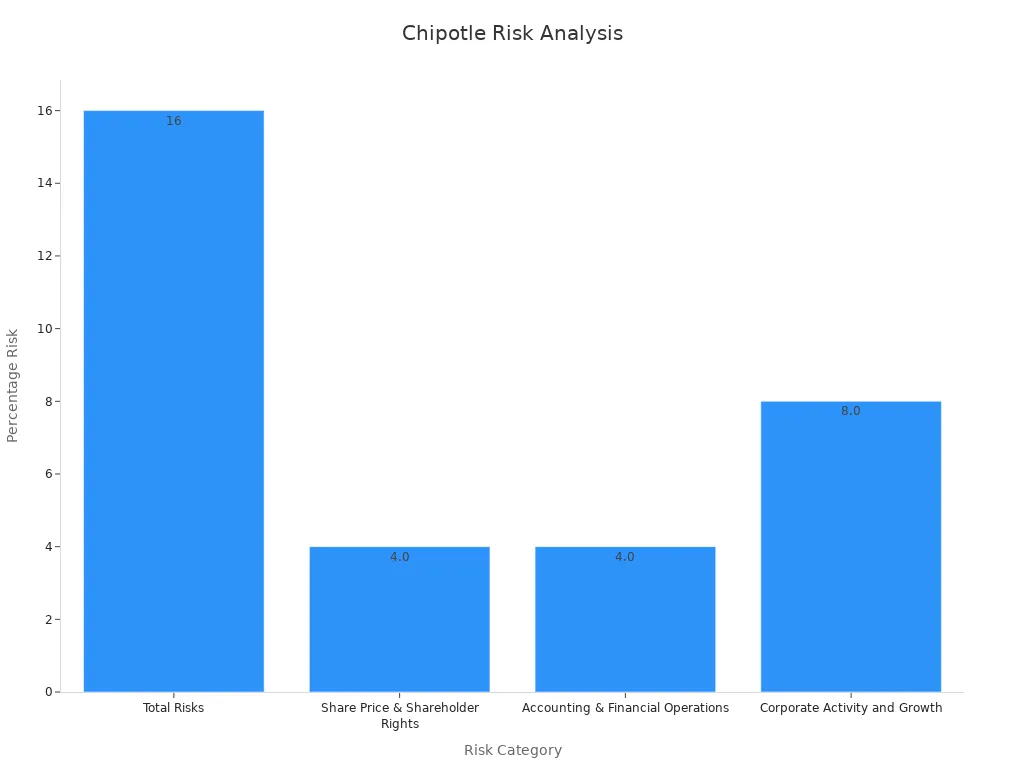
Risk analyses provide additional context for these short-term challenges. The overall risk assessment for Chipotle’s performance challenges stands at 16%, with specific risks associated with share price volatility, accounting fluctuations, and corporate activity. The chart below illustrates these risks:
Despite these hurdles, Chipotle’s management remains committed to addressing these issues through strategic initiatives. By focusing on competitive pricing, operational efficiency, and customer engagement, the company aims to mitigate short-term risks and lay the groundwork for sustained growth.
Strategic Initiatives to Drive Growth
Competitive Pricing as a Value Proposition
Chipotle has strategically positioned itself as a brand that balances premium quality with competitive pricing. This approach allows the company to attract a diverse customer base, including those who might otherwise opt for casual dining or traditional fast-food options. By closely monitoring competitors’ pricing strategies, Chipotle ensures its offerings remain appealing without compromising its value proposition. The company adjusts prices thoughtfully, maximizing market impact while retaining customer loyalty.
Several factors highlight the effectiveness of this strategy:
Chipotle’s ability to maintain strong customer traffic, even amid pricing adjustments, underscores its robust value proposition.
The brand’s pricing strategy successfully draws customers from both casual dining establishments and fast-food competitors.
By responding to market conditions with agility, Chipotle sustains its appeal to price-sensitive consumers.
This pricing approach not only enhances the brand’s market position but also reinforces its reputation for delivering high-quality meals at reasonable prices. As economic pressures persist, Chipotle’s commitment to competitive pricing will likely remain a cornerstone of its growth strategy.
Investments in Productivity-Enhancing Equipment
Chipotle’s focus on operational efficiency has led to significant investments in productivity-enhancing equipment. These innovations aim to streamline kitchen operations, improve employee efficiency, and elevate the guest experience. For instance, the introduction of produce slicers and dual-sided planchas exemplifies the company’s dedication to optimizing its workflow.
The impact of these investments is evident in Chipotle’s financial performance. Comparable restaurant sales increased by 5.4% year-over-year in the fourth quarter, contributing to total revenue of $2.8 billion. For the full year, comparable restaurant sales rose by 7.4%, with total revenue reaching $11.3 billion. These figures highlight the tangible benefits of enhancing productivity through targeted investments.
Chipotle’s commitment to innovation extends beyond equipment upgrades. The company actively supports sustainable practices and ingredient transparency, aligning with industry benchmarks and consumer preferences. Initiatives like Plantible and CH4 Global not only reduce environmental impact but also strengthen the brand’s image as a leader in ethical and sustainable dining. By fostering innovation and sustainability, Chipotle positions itself for long-term growth while meeting the evolving expectations of its customer base.
Potential Scenarios for 2025
Best-Case Scenario: Economic Recovery and Market Expansion
In an ideal scenario, Chipotle could benefit from a robust economic recovery in 2025. A resurgence in consumer confidence and spending would likely drive higher restaurant traffic and increased sales. Analysts predict that a stabilized macroeconomic environment could enable Chipotle to regain momentum in its same-store sales growth, potentially exceeding mid-single-digit projections. This recovery would also create opportunities for the company to expand its footprint in untapped markets.
Chipotle’s strategic initiatives, such as the rollout of Chipotlane drive-thru lanes, would play a pivotal role in this scenario. These lanes cater to the growing demand for convenience, attracting both new and returning customers. Additionally, investments in digital platforms could further enhance customer engagement, boosting online orders and delivery sales.
Tip: A strong economic recovery could also reduce cost pressures, such as ingredient inflation and wage increases, allowing Chipotle to improve its operating margins.
Market expansion would be another critical factor. By entering new regions or even international markets, Chipotle could diversify its revenue streams and reduce its reliance on the U.S. market. This diversification would not only mitigate risks but also position the company for sustained growth.
Worst-Case Scenario: Prolonged Economic Challenges
In a less favorable scenario, prolonged economic challenges could hinder Chipotle’s growth trajectory. Persistent inflation, coupled with declining consumer spending, might lead to further reductions in restaurant traffic. Price-sensitive customers could continue to opt for lower-cost dining alternatives, impacting Chipotle’s ability to maintain its premium positioning.
Operational costs could also remain elevated due to ongoing supply chain disruptions and wage inflation. These pressures might force Chipotle to implement additional price increases, potentially alienating budget-conscious consumers.
Key Risks | Potential Impact |
|---|---|
Declining consumer traffic | Reduced same-store sales and transaction volumes |
Rising operational costs | Lower profit margins and constrained investments |
In this scenario, Chipotle’s reliance on the U.S. market could exacerbate its challenges. A lack of diversification might leave the company vulnerable to domestic economic fluctuations. Furthermore, external factors such as adverse weather events or geopolitical tensions could add to the complexity of navigating this environment.
Note: While this scenario presents significant hurdles, Chipotle’s adaptability and focus on innovation could help mitigate some of these risks. Strategic cost management and targeted marketing efforts would be essential to weathering these challenges.
Chipotle’s growth potential in 2025 hinges on its ability to navigate economic challenges while leveraging strategic initiatives to maintain its competitive edge. The company’s focus on operational efficiency, such as investments in productivity-enhancing equipment, reflects its commitment to overcoming inflationary pressures and labor costs. Historical data on economic cycles underscores the importance of adaptive strategies like loyalty programs and transparent communication, which strengthen customer relationships during uncertain times.
Comprehensive market evaluations, including PESTEL and SWOT analyses, highlight Chipotle’s resilience in addressing inflation and labor challenges. By supporting local farmers through initiatives like the Chipotle Local Grower Support Initiative, the company reinforces its brand values while appealing to a broad customer base. Analysts remain optimistic about its long-term trajectory, citing competitive pricing and innovation as key drivers of sustained growth. Chipotle’s ability to balance short-term hurdles with forward-thinking strategies will ultimately determine its success in 2025 and beyond.
FAQ
What are Chipotle’s key strategies for overcoming economic challenges?
Chipotle focuses on competitive pricing, operational efficiency, and digital innovation. Investments in productivity-enhancing equipment and the expansion of Chipotlane drive-thru lanes help the company adapt to economic pressures while meeting evolving consumer demands.
How does Chipotle plan to sustain long-term growth?
Chipotle emphasizes market expansion, digital sales growth, and customer convenience. By opening new locations, enhancing its digital platforms, and maintaining a strong value proposition, the company aims to capture new markets and retain customer loyalty.
Why are same-store sales important for Chipotle’s performance?
Same-store sales indicate the health of existing locations and reflect consumer demand. A decline in this metric, as seen in Q1 2025, signals challenges in maintaining customer traffic and spending, which directly impacts profitability.
How does Chipotle address rising operational costs?
Chipotle mitigates cost pressures through strategic pricing adjustments and investments in efficiency. By upgrading kitchen equipment and streamlining supply chains, the company reduces expenses while maintaining quality and customer satisfaction.
What role does digital innovation play in Chipotle’s growth?
Digital innovation drives customer engagement and operational efficiency. With 35.4% of revenue from digital sales in Q1 2025, Chipotle leverages online ordering, delivery services, and Chipotlane lanes to meet consumer preferences and boost sales.
Crafting a Roadmap for Enduring Wealth
Building lasting wealth is less about chasing quick wins and more about embracing a disciplined, thoughtful approach to investing, one that aligns with your goals and withstands market turbulence. At VASRO, we believe in the power of informed decisions, grounded in deep equity analysis and market intelligence, to guide you toward long-term financial success. Picture your financial journey as a well-planned road trip: you need a clear destination, a reliable map, and the patience to navigate unexpected detours. By diversifying your portfolio, staying attuned to economic trends, and focusing on companies with strong fundamentals, you can create a foundation for growth that endures. It’s not about timing the market perfectly, it’s about staying committed to a strategy that reflects your values and aspirations, with the precision and insight VASRO strives to embody in every piece of analysis we share.
Disclaimer: The information provided on www.vasro.de is for general informational purposes only and does not constitute investment advice or a recommendation to invest in any particular asset or market. VASRO GmbH does not offer personalized investment advice, and the content on this website should not be relied upon as such. Visitors are encouraged to seek independent financial advice tailored to their specific circumstances before making any investment decisions. VASRO GmbH disclaims any liability for investment decisions made based on the information presented on this website.