


Recent results from major banks and policy shifts by the fed continue to shape profit opportunities for small-cap investors. Market analysts observe that S&P 500 firms expect nearly 9% earnings growth this quarter, while small companies remain highly sensitive to borrowing costs. The Russell 2000 index often rises when interest rates fall, highlighting the impact of lower financing costs on small cap profitability. Investors closely watch big banks recap and the evolving monetary landscape, as these factors influence sentiment and forecasts for small cap stocks.
Table of Contents
Key Takeaways
Small-cap companies are projected to see earnings growth of 21% in 2025 and 34% in 2026, outpacing larger firms.
Lower interest rates enhance access to capital for small businesses, supporting their growth and innovation.
Investors should monitor big bank earnings as they influence market sentiment and liquidity for small-cap stocks.
Small-cap stocks currently trade at a significant discount, presenting attractive entry points for investors.
Diversification in small-cap portfolios can reduce risk and enhance stability during market fluctuations.
Sectors like pharmaceuticals and software show strong potential for small-cap growth due to evolving consumer demands.
Active management and strategic timing are crucial for capitalizing on small-cap investment opportunities.
Understanding macroeconomic signals helps investors navigate risks and identify potential growth in small-cap stocks.
Big Banks Recap

Earnings Trends
Revenue and Profits
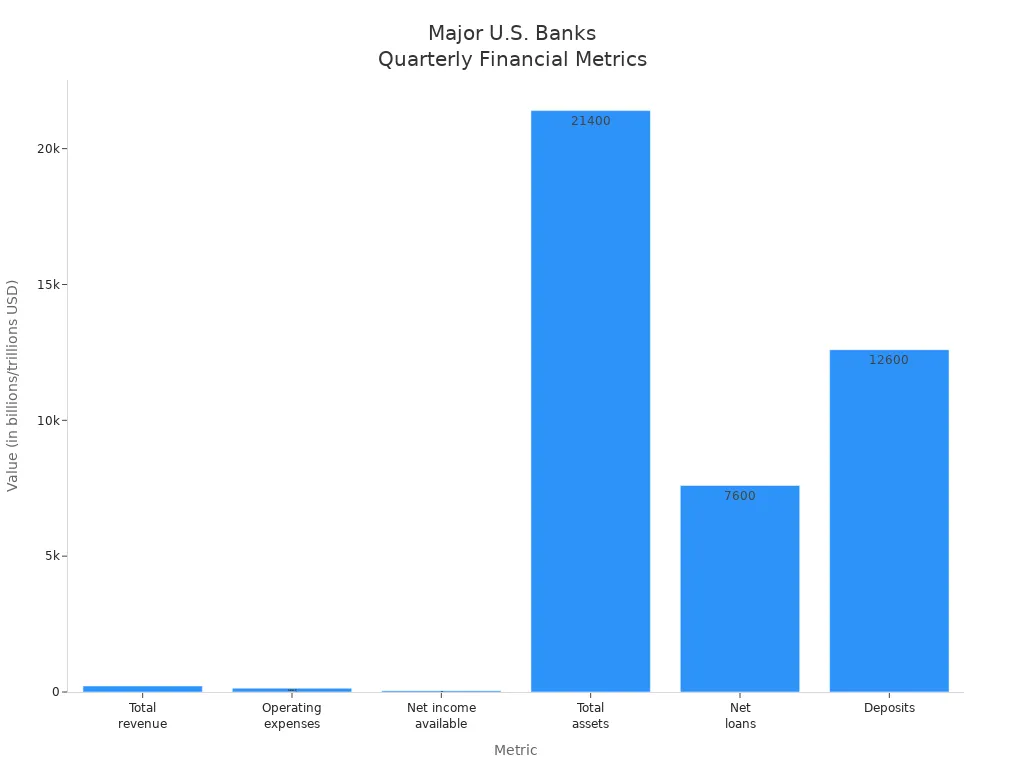
The latest big banks recap reveals a resilient performance across major U.S. banks. Total revenue reached $224.3 billion, showing a 4.6% increase year-over-year, while operating expenses also rose by 4.2%. Net income available to common shareholders declined by nearly 10% quarter-over-quarter, reflecting ongoing margin pressures and higher costs. Despite this, analysts remain optimistic about the sector’s ability to generate higher earnings in the coming quarters, driven by robust investment banking and trading revenues. BofA Securities recently raised its forecasts for several large banks, signaling confidence in the sector’s outlook.
Metric | Value | Change Q/Q | Change Y/Y |
|---|---|---|---|
Total revenue | $224.3 billion | -0.3% | +4.6% |
Operating expenses | $138.6 billion | -0.9% | +4.2% |
Net income available to common | $48.0 billion | -10.9% | -9.9% |
Total assets | $21.4 trillion | +2.6% | +6.8% |
Net loans | $7.6 trillion | +2.9% | +5.5% |
Deposits | $12.6 trillion | +1.3% | +4.9% |
Loan Growth
Loan growth remains a bright spot in the big banks recap. Net loans increased by 2.9% quarter-over-quarter and 5.5% year-over-year. Regional banks, in particular, have expanded their lending footprint and diversified their portfolios beyond commercial real estate. Noninterest income is expected to reach its highest level in five years, reflecting increased activity in investment banking and asset management. However, some regional banks face potential loan losses due to distress in the commercial real estate sector.
Market Moves
Stock Performance
Recent earnings announcements from major banks have sparked bullish sentiment in the market. Investors responded positively to banks that exceeded earnings per share expectations. The financial sector often leads the earnings season, and strong trading activities have contributed to robust stock performance. Many banks have reported increased commissions and trading revenues, which support their share prices.
Analyst Sentiment
Analyst sentiment remains constructive in the current big banks recap. Optimism from leading institutions, such as JPMorgan’s positive outlook for Bank of America, has boosted investor confidence. Expectations of interest rate cuts and potential deregulation further fuel this optimism. However, some analysts caution that high valuations and the risk of a market downturn could temper enthusiasm. Investors continue to monitor guidance from major banks, as it shapes broader market sentiment and confidence.
Note: The big banks recap highlights both the resilience and adaptability of the sector. Strategic growth in lending and capital markets activity, combined with innovation in asset management, positions banks to navigate evolving market conditions.
Small Caps and Bank Trends
Credit Conditions
Lending Standards
Small cap companies face a challenging credit environment shaped by inflation and persistent market uncertainties. Financial institutions have responded by refining their lending standards, aiming to balance risk management with the need to support business growth. Many banks now employ innovative underwriting processes, leveraging technology to assess creditworthiness more efficiently. These advancements help small businesses navigate higher borrowing costs, which remain a significant hurdle in the current economic landscape. Programs like the SSBCI Loan Guarantee in Florida exemplify this shift, as they provide partial government guarantees that encourage banks to extend credit to smaller firms. This approach not only mitigates risk for lenders but also opens doors for businesses that might otherwise struggle to secure financing.
Access to Capital
Access to capital stands as a critical factor for small cap growth. The evolution of lending practices among large banks, influenced by fintech and bigtech, has transformed the landscape for small cap firms. By utilizing alternative data and advanced analytics, these institutions have reduced information gaps and streamlined the approval process. As a result, small businesses now find it easier to obtain financing, even if they lack a long credit history or traditional collateral. This shift supports innovation and adaptability, enabling small caps to pursue new opportunities and weather economic headwinds. The combination of government-backed programs and technological advancements in banking fosters a more inclusive financial ecosystem.
Liquidity Flows
Institutional Flows
Institutional investors have shown growing interest in small cap stocks, particularly those that have improved liquidity following corporate events such as spinoffs. Data reveals a notable increase in institutional ownership of spun-off firms during the quarter after these events. This trend highlights a preference for liquid assets, as institutions seek opportunities that offer both growth potential and ease of entry or exit. Enhanced liquidity attracts more sophisticated investors, which can lead to greater market stability and improved price discovery for small cap equities.
Market Impact
Liquidity flows play a pivotal role in shaping small cap market performance. In August, the Russell 2000 index surged by 7.1%, reflecting renewed investor optimism amid expectations of Federal Reserve rate cuts. This rally underscores how capital inflows, driven by positive sentiment, can lift the entire small cap segment. The rise of passive investment vehicles, such as ETFs, has further amplified this effect, boosting stock prices across both high-quality and lower-quality companies. However, this dynamic introduces risks, as inflated valuations may not always reflect underlying fundamentals. During periods of market stress, lower-quality small caps often struggle to attract buyers, exposing the volatility inherent in this asset class. Investors and analysts alike recognize that while liquidity can fuel growth, it also demands careful scrutiny of company fundamentals and market trends.
Fed Policy Impact
Fed Rate Cut
Interest Rate Effects
The Federal Reserve recently cut interest rates by a quarter point, setting the target range at 4.00%–4.25% on September 17, 2025. This move marked a significant shift after a period of steady increases. Small-cap companies, especially those in the Russell 2000 Index, responded quickly. These firms often rely on short-term debt, so changes in interest rates directly affect their borrowing costs and profit margins. Lower interest rates make it easier for small businesses to access capital, fueling expansion and innovation. Historically, small-cap stocks have outperformed larger peers after the Fed decides to cut interest rates, as investors seek higher returns in a lower-rate environment.
Evidence Type | Description |
|---|---|
Interest Rate Impact | Lower interest rates have made small-cap shares more attractive due to reduced borrowing costs. |
Historical Performance | Historical data shows that small-cap stocks tend to outperform larger stocks following initial rate cuts. |
Investor Sentiment | The Fed’s rate cuts have shifted investor sentiment positively towards small-cap stocks, leading to increased demand. |
Cost of Capital
The cost of capital for small-cap companies has dropped since the Federal Reserve’s recent decision to cut interest rates. Lower financing costs allow these businesses to invest in growth, hire new employees, and pursue strategic opportunities. The Russell 2000 Index has outperformed the S&P 500 since the rate cut, reflecting renewed investor appetite for risk. Small-cap valuations remain attractive, with a current P/E ratio of 14x compared to 20x for large caps, and a valuation discount of -40% versus -5% for large companies. This environment supports long-term earnings potential and encourages market participation.
Economic Signals
Jobs Market
Analysts closely monitor the jobs market to assess the outlook for small-cap profits. Recent data shows weaker payroll growth and negative revisions, with the U.S. economy adding only 22,000 jobs in August—well below expectations. Previous job gains were revised down sharply, signaling potential labor market weakness. A stable unemployment rate and low initial claims offer some reassurance, but the mixed picture keeps investors cautious. The Federal Reserve’s interest rate policy remains closely tied to these labor trends, as small-cap performance often hinges on economic stability and consumer demand.
Market Reactions
Market reactions to the Federal Reserve’s policy changes have been swift and positive for small-cap stocks. The recent rally in small caps reflects broadening economic growth, moderate inflation, and easing monetary policy. Investors have shifted sentiment, favoring more volatile stocks as risk appetite increases. Analysts expect these trends to persist, especially if the Fed continues to cut interest rates to support a soft landing for the U.S. economy. Key economic signals—such as interest rate trends, inflation data, and overall macroeconomic conditions—will remain in focus as investors evaluate the profit outlook for small-cap companies.
Small Cap Profit Outlook

Performance Trends
EPS and Sales Revisions
Small-cap stocks have demonstrated remarkable resilience in recent quarters, with both earnings per share (EPS) and sales revisions reaching multi-year highs. Analysts have observed a positive shift in EPS revision ratios, signaling a renewed sense of optimism for small-cap companies. This trend suggests that profit growth is broadening across the sector, positioning small caps to potentially outperform their larger counterparts in the near future. The improvement in sales and earnings expectations reflects not only operational adaptability but also the ability of these companies to navigate changing economic conditions and capitalize on emerging opportunities.
Sector Leaders
A closer look at performance data reveals that small-cap stocks have consistently delivered competitive returns over multiple time frames. The table below compares the performance of the Russell 2000 (small caps) with the bottom tercile of the Russell 1000 (large caps):
Time Frame | Small-Cap Performance (Russell 2000) | Large-Cap Performance (Bottom Tercile of Russell 1000) |
|---|---|---|
1-year | 11.5% | 5.5% |
3-year | 1.2% | -0.3% |
5-year | 7.4% | 4.9% |
10-year | 7.8% | 5.2% |
35-year | 8.9% | 6.3% |
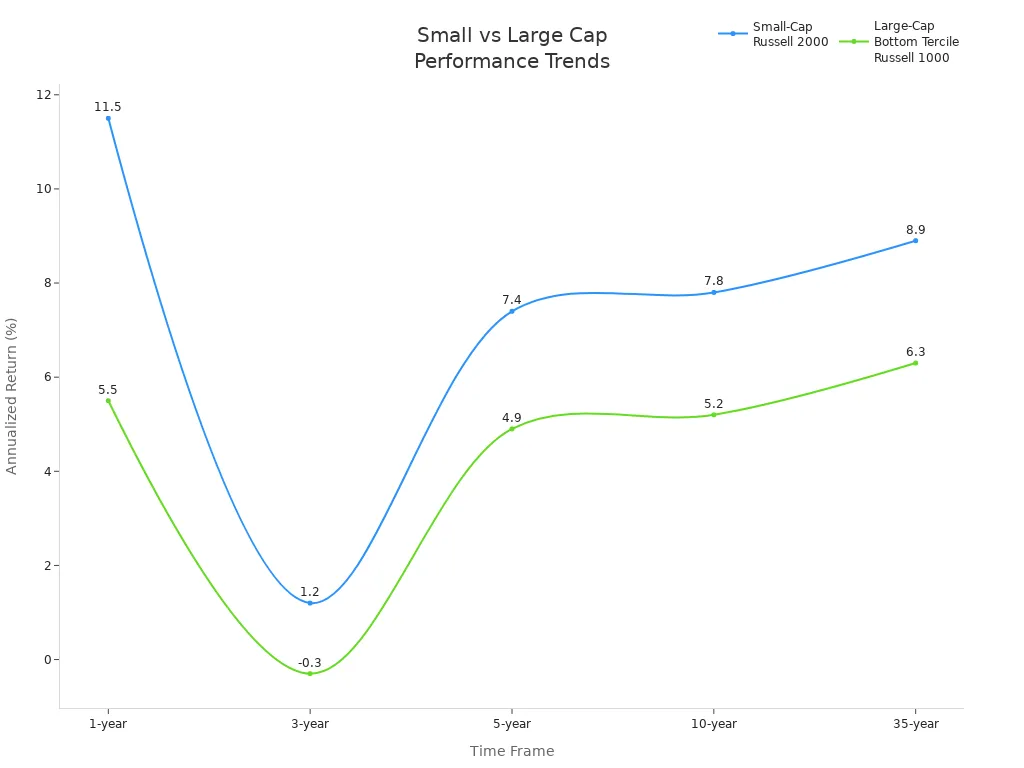
These figures highlight the enduring strength of small-cap equities, especially during periods of economic transition. Sector leaders within the small-cap universe often emerge from industries that demonstrate agility and innovation, further reinforcing the case for strategic allocation to this segment.
Risks and Opportunities
Volatility
Investors recognize that small-cap stocks carry unique risks, often experiencing greater price swings than their large-cap peers. The table below outlines the primary risks currently facing small-cap equities:
Risk Type | Description |
|---|---|
Market Fluctuations | Small cap stocks are highly sensitive to changes in the market, leading to potential value declines. |
Financial Instability | These companies often face challenges in maintaining stable financial conditions. |
Dependence on Key Managers | Many small caps rely heavily on a few key individuals, making them vulnerable to management changes. |
Trade Uncertainty | Small caps are more affected by trade policies and uncertainties, impacting their operations. |
High Interest Rates | Increased borrowing costs can hinder growth and financial performance of small cap companies. |
Periods of heightened volatility can create both challenges and opportunities. While market fluctuations may lead to temporary declines in value, they also present entry points for investors who focus on long-term fundamentals and company quality.
Growth Sectors
Despite these risks, several growth sectors are expected to drive small-cap profits over the next 12 months. Companies operating in these industries often benefit from structural tailwinds and evolving consumer demands:
Pharmaceuticals
Real estate investment trusts
Insurance services
Health services
Finance
Property/casualty insurance
Software
These sectors exemplify the spirit of innovation and adaptability that defines many successful small-cap firms. By leveraging specialized expertise and responding quickly to market shifts, leaders in these areas can capture outsized growth opportunities.
Expert Views
Analyst Forecasts
Market experts remain optimistic about the profit outlook for small-cap stocks. Analysts project earnings growth of 42% in 2025 and 36% in 2026, far outpacing the 6% growth anticipated for 2024. This robust forecast reflects expectations for favorable macroeconomic conditions and supportive domestic policies, which should provide a strong foundation for small-cap momentum in the coming years.
Note: Analysts emphasize that the combination of improving economic indicators and lower rates could further accelerate small-cap earnings growth, especially as companies gain easier access to capital and expand their market reach.
Investor Sentiment
Investor sentiment toward small caps currently sits at a historic low, with the market capitalization of the Russell 2000 representing just 5.5% of the S&P 500—a new all-time low. The Russell 2000’s share of the broader Russell 3000 index has also dropped to 3%, a level not seen since the 1930s. Small-cap valuations now rest in the 5th percentile, a discount last observed in 2001. Despite recent underperformance compared to large caps since 2016, history shows that small caps tend to rebound quickly when economic conditions improve.
Metric | Current Value | Historical Average | Comparison to Historical Average |
|---|---|---|---|
Market Cap of Russell 2000 vs. S&P 500 | 5.5% | N/A | New all-time low |
Russell 2000’s share of Russell 3000 | 3% | N/A | Lowest since the 1930s |
Small-cap valuation percentile | 5th | N/A | Last seen in 2001 |
Small caps have historically underperformed compared to large caps since 2016.
The current market cap of the Russell 2000 is significantly lower than that of the S&P 500.
Small caps are currently in the 5th percentile for valuation, indicating they are relatively cheap compared to historical standards.
Small caps typically rebound quickly during improving economic conditions.
This environment presents a compelling case for investors who seek value and are willing to embrace volatility in pursuit of long-term growth. As the market cycle evolves and rates stabilize, small-cap stocks may offer outsized returns for those with a disciplined approach and a focus on innovation and adaptability.
Investor Strategies
Opportunity Screening
Financial Health
Investors seeking to identify promising small cap stocks often begin with a disciplined screening process. They define a clear market-cap range to focus on genuine small cap opportunities, typically targeting companies with a market capitalization below $2 billion. A structured screener helps filter for financial strength, growth, and liquidity. Key financial metrics such as revenue growth above 20% per year, gross margins exceeding 50% for software firms or 30% for other industries, and a debt-to-equity ratio below 1.0 serve as important benchmarks. These criteria highlight companies with repeatable growth drivers and robust fundamentals, such as consistent revenue and positive cash flow.
Evidence Description | Correlation with Small Cap Outperformance |
|---|---|
Small cap stocks have historically provided better opportunities for generating alpha due to structural advantages. | Indicates that financial health metrics contribute to outperformance. |
Small caps have consistently produced more rapidly growing, profitable firms than other markets. | Suggests that financial health metrics like growth and profitability are key. |
Top-line growth and profitability together provide a clearer picture of a company’s prospects. | Highlights the importance of these metrics in assessing small cap stocks. |
Growth Potential
A focus on growth potential remains central to successful small cap investing. Investors prioritize companies with strong business models and repeatable growth drivers. They often screen for firms that demonstrate top-line growth and profitability, as these factors provide a clearer picture of long-term prospects. By tracking a watchlist and updating research as new data emerges, investors can stay ahead of market shifts and identify emerging leaders.
Risk Management
Diversification
Diversification stands as a cornerstone of risk management in small cap portfolios. By adding small cap stocks, investors can enhance portfolio stability and avoid over-allocation to specific sectors or companies. Geographic and sector-specific diversification reduces overall risk, as small caps often react differently to market changes compared to large caps. These companies also offer structural advantages, such as agility and the ability to capitalize on local market trends, which can help mitigate risks associated with global fluctuations.
Small cap stocks enhance portfolio diversification by tapping into a vast pool of growth opportunities.
They offer lower concentration risks and potential mispricing opportunities.
Their close ties to local economies can reduce exposure to global shocks.
Macro Monitoring
Investors who monitor macroeconomic signals gain valuable insights into potential risks and opportunities. By staying alert to shifts in interest rates, inflation, and economic growth, they can adjust their allocations proactively. This vigilance helps them navigate periods of volatility and position their portfolios for resilience.
Timing Approaches
Entry/Exit
Timing plays a critical role in small cap investing. Historically, falling interest rates combined with attractive valuations have presented timely opportunities for reallocating toward small caps. Investors who use quantitative approaches and valuation metrics, such as those highlighted in the early 1990s research on the value premium, often improve their odds of success. The cyclical nature of small cap performance underscores the importance of timing, especially as markets shift post-pandemic.
The small-cap premium suggests long-term outperformance, especially during favorable market cycles.
Active management and strategic entry during periods of undervaluation can yield higher returns.
Using Bank and Fed Signals
Market participants closely watch big bank earnings and Federal Reserve signals to inform their entry and exit decisions. Many investors await clearer direction from the Fed before making significant moves. Strong earnings from leading companies and signals of rate cuts often create a more favorable environment for small caps. The correlation between small cap performance and interest rates means that lower yields can support a rebound in this segment. Consistent messaging from the Fed also fosters investor comfort, encouraging participation in small cap opportunities.
Tip: Investors who combine disciplined screening, diversification, macro monitoring, and timely responses to market signals position themselves to capture the unique growth potential of small cap stocks while managing risk effectively.
Recent trends in big bank earnings and Federal Reserve policy have set the stage for renewed small cap profit opportunities. Market data shows small-cap companies may achieve earnings growth of 21% in 2025 and 34% in 2026, supported by stabilizing rates and favorable policies.
Key Points | Details |
|---|---|
Earnings Growth | Small-cap companies are projected to see earnings growth of 21% in 2025 and 34% in 2026, potentially outpacing large-cap peers. |
Market Conditions | Stabilizing interest rates and pro-growth policies are expected to create a favorable environment for small-cap stocks. |
Valuation | Small-cap stocks are trading at a significant discount relative to historical norms, presenting attractive entry points for investors. |
Economic Sensitivity | Small-cap companies are more sensitive to interest rate changes, and anticipated cuts could boost their earnings significantly. |
Historical Performance | Historically, small-cap stocks tend to outperform larger stocks during economic recoveries, suggesting potential for future gains. |
Investors who focus on active management and strategic timing can benefit from inefficiencies in the small cap space.
Evidence | Description |
|---|---|
Performance Cycles | Small cap stocks have historically outperformed large caps in cycles lasting about seven years, indicating a potential shift in performance dynamics. |
Valuation Levels | Current valuations for small caps are at their lowest since 1990, suggesting a higher likelihood of future outperformance compared to large caps. |
Active Management | Studies show that active management has been beneficial for small cap investors due to the inefficiencies in this asset class, enhancing stock selection opportunities. |
Thoughtful investors recognize that innovation, adaptability, and market intelligence drive long-term success. By staying attuned to evolving bank trends and Fed signals, they position themselves to capture the next wave of small cap growth.
FAQ
What drives small cap profit opportunities in the current market?
Small cap profit opportunities arise from lower interest rates, improved access to capital, and increased investor interest. Companies that innovate and adapt quickly often outperform peers, especially when market conditions favor growth and strategic expansion.
How do big bank earnings influence small cap stocks?
Big bank earnings set the tone for market sentiment. Strong results from major banks boost investor confidence, which can lead to increased liquidity and demand for small cap equities. Analysts use these signals to assess broader market health.
Why do interest rate changes matter for small cap companies?
Interest rate changes directly affect borrowing costs for small cap companies. Lower rates reduce expenses and support expansion. The last meeting of the Federal Reserve highlighted this impact, as small caps responded positively to the rate cut.
What risks should investors consider with small cap stocks?
Investors should consider volatility, financial instability, and sensitivity to economic shifts. Small cap stocks often experience larger price swings and may depend on a few key managers. Careful analysis helps manage these risks.
Which sectors show the most promise for small cap growth?
Pharmaceuticals, software, insurance services, and health services lead small cap growth. These sectors benefit from innovation, evolving consumer needs, and adaptability. Strategic allocation to these industries can enhance portfolio performance.
How can investors identify strong small cap opportunities?
Investors screen for financial health, growth potential, and liquidity. They focus on companies with robust revenue growth, healthy margins, and manageable debt. Equity analysis and market intelligence guide selection and timing.
What role does market intelligence play in small cap investing?
Market intelligence enables investors to track trends, monitor macroeconomic signals, and respond to changing conditions. Strategic growth depends on timely insights and adaptability, which help investors capture opportunities and manage risks.
Clarity Through Objective Equity Research
Objective equity research starts with disciplined data gathering—clean inputs, well-documented sources, and a clear separation between raw facts and interpretive context—then layers on methodological rigor so patterns are tested, assumptions are surfaced, and noise is distinguished from signal; transparent frameworks, reproducible metrics, and plain-language explanations help demystify what drives market behavior without leaning on hype or hindsight, and this ethos is central to how VASRO approaches equity analysis and market intelligence, aiming for a measured, insightful voice rooted in curiosity, precision, and clarity. This article is for general information only and does not constitute financial, investment, legal, or tax advice; readers should consult a licensed professional for advice tailored to their situation.
Disclaimer: The information on www.vasro.de is for general informational purposes only and does not constitute investment advice or a recommendation. VASRO GmbH does not provide personalized investment advice; visitors should seek independent financial guidance before making decisions. Some content may rely on third-party sources considered reliable, but VASRO GmbH does not guarantee accuracy, completeness, or timeliness. All information is provided “as is,” may change without notice, and VASRO GmbH has no obligation to update, correct, or continue publishing it. VASRO GmbH accepts no liability for losses arising from reliance on this information. Past performance is not a reliable indicator of future results.