

Asian family offices have emerged as pivotal players in small-cap financing, increasingly outpacing traditional investors. This shift reflects a broader transformation in the investment landscape, marked by a growing appetite for innovation and strategic growth.
Family offices in Asia now allocate 15–30% of their portfolios to growth equity and venture capital.
By June 2024, they account for one-third of Southeast Asia-based investors in alternatives, up from one-fifth in 2020.
Their dominance signals new opportunities and challenges for investors, small-cap companies, and the market at large.
Table of Contents
Key Takeaways
Asian family offices are increasingly influential in small-cap financing, allocating 15-30% of their portfolios to growth equity and venture capital.
These family offices prioritize innovation and strategic growth, often targeting sectors like technology, healthcare, and sustainability.
They provide patient capital, allowing startups to focus on long-term growth without the pressure of quick returns.
Family offices emphasize direct involvement in decision-making, fostering strong relationships with companies they invest in.
Investors should understand the unique cultural values of Asian family offices to build trust and effective partnerships.
Portfolio diversification is key; family offices integrate various asset classes to manage risk and enhance returns.
The rise of Asian family offices has reshaped competitive dynamics, pushing other investors to adapt their strategies.
Collaboration between family offices and institutional investors creates new opportunities for co-investment and shared expertise.
Asian Family Offices Overview

Definition and Structure
Asian family offices serve as private organizations that manage the financial affairs, investments, and legacy planning for wealthy families across the region. These entities differ from their Western counterparts in several key areas, reflecting unique cultural and economic priorities. The following table illustrates some of the main distinctions:
Function | Asian Family Offices | Western Family Offices |
|---|---|---|
Investment Management | Active investments in sectors like fintech | Focus on diversification and risk mitigation |
Philanthropy and Impact Investing | Often integrated with entrepreneurial goals | More traditional approaches |
Estate Planning and Succession | Family members often involved in decision-making | More open to external professionals |
Tax Optimization and Legal Services | Tailored to family control and legacy | Mature industry with established practices |
Lifestyle and Concierge Services | Customized to family needs | Standardized services |
Asian family offices often pursue aggressive returns, sometimes targeting 30% or more, and involve family members directly in decision-making. This approach reflects a desire for control and a strong entrepreneurial spirit. Western family offices, by contrast, tend to prioritize stability and capital preservation, relying more on external professionals.
Single vs. Multi-Family Offices
Single-family offices manage the assets and affairs of one family, offering highly customized services and direct oversight. Multi-family offices serve several families, providing shared resources and broader expertise. In Singapore, the number of single-family offices has surged, exceeding 2,000 by 2024. This growth highlights the region’s preference for tailored solutions and direct involvement in managing funds and capital.
Regional Differences in Asia
Family offices in Asia display significant regional variation. Singapore and Hong Kong have emerged as leading hubs, driven by favorable regulatory environments and robust financial infrastructure. In Hong Kong, the sector is expanding rapidly, with more independent advisory services and a proliferation of family offices. Other regions, such as mainland China and Southeast Asia, show increasing sophistication in investment strategies, with a focus on alternative assets and sustainable opportunities.
Growth Drivers
Wealth Creation in Asia
Asia’s rapid economic expansion has fueled unprecedented wealth creation. Families seek to preserve and grow their capital, leading to an estimated intergenerational wealth transfer of US$5.8 trillion by 2030. This surge in wealth has prompted families to establish offices that can manage investments, funding, and legacy planning with greater efficiency and control.
Regulatory and Cultural Factors
Regulatory reforms in financial centers like Singapore and Hong Kong have made it easier to set up family offices and access global markets. Cultural factors also play a role, as many Asian families prefer investing in familiar industries where they possess deep expertise. This familiarity reduces perceived risk and enhances confidence in deploying funds. Research shows that Asian family offices increasingly adopt institutional approaches, moving beyond traditional equity and fixed income to embrace alternative investments. Their long-term horizons support direct investments in technology, infrastructure, and sustainable sectors, reflecting a growing appetite for innovation and strategic growth.
Asian family offices now stand at the forefront of capital allocation, shaping the future of small-cap funding and opening new opportunities for both investors and companies.
Investment Strategies in Small-Cap Financing
Asian family offices have transformed the landscape of small-cap financing by embracing strategies that extend far beyond traditional asset classes. Their approach reflects a sophisticated understanding of market dynamics, risk management, and the pursuit of sustainable growth.
Diversification Beyond Traditional Assets
Asian family offices recognize the importance of portfolio diversification as a tool for both risk mitigation and capital appreciation. They integrate a wide range of asset classes into their portfolios, including real assets, credit, and alternatives. This portfolio-level mindset enables them to capture value across different market cycles and economic environments.
Aspect | Description |
|---|---|
Portfolio-Level Mindset | Asian family offices are integrating various asset classes, including real assets, credit, and alternatives. |
Focused Sectors | Emphasis on hospitality, logistics, and life sciences for stability and growth. |
Investment Approach | Preference for direct cross-border investments and bilateral transactions for discretion and efficiency. |
Shift in Strategy | Movement away from siloed investments to cohesive systems that allow for scalability over time. |
Venture Capital and Private Equity Moves
Asian family offices have shown a marked preference for venture capital and private equity investments. They often target startups and emerging companies that demonstrate strong potential for innovation and sustainable growth. By allocating funds to these sectors, they position themselves to benefit from early-stage opportunities and disruptive business models. Indian family offices, for example, have increased their exposure to technology-driven startups, reflecting a broader regional trend toward tech-focused strategies.
Asian family offices are increasingly diversifying their investment strategies.
There is a notable focus on new technologies and emerging markets.
The shift towards a broader selection of investment opportunities reflects the evolving needs of ultra-high-net-worth families.
Emerging Markets Focus
Investors in Asian family offices seek out opportunities in emerging markets, where growth prospects often outpace those in developed economies. Their investments in the sustainable blue economy, logistics, and life sciences illustrate a commitment to sectors that promise both stability and expansion. This focus on emerging markets allows them to deploy capital in regions with untapped potential, supporting startups and small-cap companies that drive innovation and sustainable development.
Proactive Investment Approach
Asian family offices distinguish themselves through a proactive approach to investing. They do not simply allocate funds passively; instead, they actively seek out companies that align with their vision for innovation and strategic growth.
Seeking Innovation and Growth
These family offices prioritize investments in startups and small-cap companies that offer unique solutions and scalable business models. Their appetite for innovation leads them to support ventures in technology, healthcare, and sustainable industries. By identifying and nurturing high-growth opportunities, they contribute to the advancement of new ideas and the creation of long-term value.
Strategic Influence in Companies
Asian family offices often pursue direct investments, allowing them to exert strategic influence over management and operations. This hands-on approach enables them to guide companies toward sustainable practices and effective capital management. Their involvement goes beyond funding, as they provide mentorship, market intelligence, and access to networks that foster adaptability and resilience.
Motivations for Small-Cap Investments
The motivations driving Asian family offices to invest in small-cap companies are multifaceted. Their strategies reflect a blend of opportunistic investing, a desire for higher returns, and a preference for ownership and control.
Motivation Type | Description |
|---|---|
Opportunistic Investing | Asian family offices are leaning towards opportunistic investments, indicating a flexible approach to capital allocation. |
Tech-Focused Strategies | There is a strong emphasis on technology sectors, which often includes small-cap companies that are innovative and high-growth. |
Shift to Alternatives | A trend towards private equity and venture capital suggests a preference for investing in smaller, potentially high-return companies. |
Higher Returns Potential
Family offices in Asia recognize that small-cap investments can deliver outsized returns compared to more established companies. Their willingness to take calculated risks stems from a deep understanding of market trends and a commitment to growing wealth across generations. By targeting sectors with high growth potential, they maximize the impact of their capital and create new avenues for sustainable value creation.
Ownership and Control
Asian family offices value ownership and control in their investments. Direct involvement in management and decision-making allows them to shape the strategic direction of companies and ensure alignment with their long-term objectives. This approach fosters strong relationships with founders and management teams, leading to more effective capital deployment and sustainable business practices.
Asian family offices continue to redefine the boundaries of small-cap financing, leveraging diversification, proactive investment strategies, and a clear focus on innovation. Their commitment to sustainable growth and strategic influence positions them as key drivers of change in the global investment landscape.
Impact on Investors and Market Dynamics
Changing Ownership Structures
Shift in Capital Allocation
Asian family offices have redefined capital flows in the small-cap sector. They now allocate a greater share of their funds to private equity and alternative assets, moving away from traditional public equities.
Family offices allocate an average of 21% of their capital to private equity, compared to 31% for public equity.
Nearly 28% of these offices plan to increase their exposure to India, drawn by strong GDP growth, rapid technology adoption, and a surge in startups.
This shift signals a broader trend toward higher-risk, higher-reward investments, with a focus on sustainable growth and innovation.
Portfolio diversification remains a core principle, as these offices seek to balance risk and reward while supporting the sustainable blue economy and other emerging sectors.
Influence on Small-Cap Valuations
The influx of capital from Asian family offices has influenced small-cap valuations. Their willingness to provide patient funding and strategic support often leads to higher valuations for promising companies. As these offices target sustainable and innovative ventures, they help set new benchmarks for value in the market. This dynamic encourages founders to pursue sustainable business models and long-term management strategies.
Effects on Other Investors
Competitive Dynamics
The rise of Asian family offices as powerful investors in Hong Kong and across Asia has reshaped the competitive landscape. Their sophisticated approach, including the adoption of semi-liquid alternatives like private credit and secondaries, compels other investors to rethink their strategies. These offices focus on balancing yield, flexibility, and institutional discipline, which drives increased competition and innovation in the small-cap space.
Collaboration and Co-Investment
Collaboration between Asian family offices and institutional investors has become more common, creating new opportunities for co-investment and shared expertise. Recent examples include:
Date | Collaboration Details |
|---|---|
Danantara and QIA announced a US$4 billion joint fund to invest in Southeast Asia. | |
January 2025 | Lenovo and PIF completed a US$2 billion strategic investment for Middle East expansion. |
November 2024 | QIA and CIC participated in Trustar’s McDonald’s China US$1 billion continuation fund. |
October 2024 | QIA joined a consortium for the US$7.1 billion take private of ESR Group. |
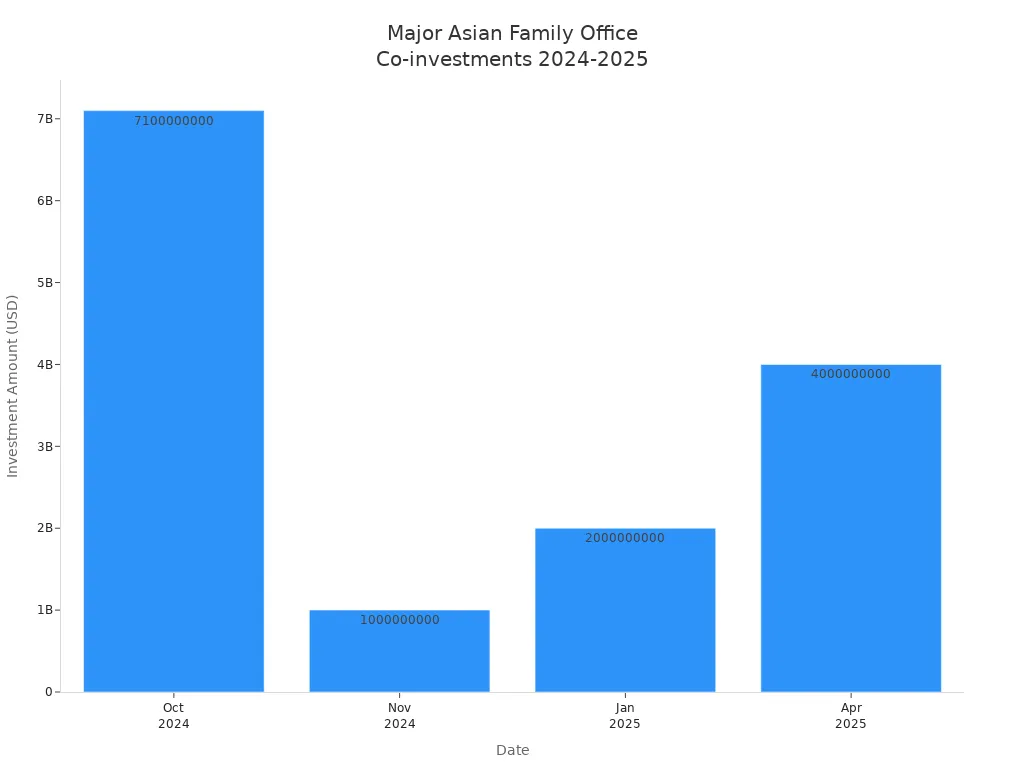
These partnerships foster greater access to capital, enhance portfolio diversification, and support sustainable investments across regions.
Market Risks and Opportunities
Liquidity and Volatility
Asian family offices place a high priority on investment risk management, with 67% identifying it as a top strategic concern. Their focus on sustainable sectors, technology, and digital assets reflects a desire to balance liquidity and long-term value. However, risks remain, including the potential for global recession (73%), geopolitical conflicts (55%), and inflation (44%). These factors can increase volatility in small-cap markets, requiring careful management and adaptability.
Regulatory Considerations
Regulatory changes have improved access to private markets for Asian family offices. The introduction of feeder funds and open-ended vehicles has lowered barriers, allowing smaller ticket sizes and broader participation. Supportive regulations in Singapore and Hong Kong have strengthened the infrastructure for family offices, enabling more active engagement in small-cap funding and sustainable investing.
The growing influence of Asian family offices brings both opportunities and challenges. Their capital, expertise, and commitment to sustainable growth continue to shape the future of small-cap investing, offering new pathways for wealth creation and innovation.
Opportunities for Small-Cap Companies

Access to Capital
Small-cap companies now find themselves at the center of a new wave of investment opportunities, as Asian family offices reshape the landscape of capital allocation. These ultra-high-net-worth families bring not only substantial funds but also a willingness to support early-stage startups and ventures that traditional institutional investors might overlook.
Patient and Strategic Funding
Asian family offices distinguish themselves by providing patient capital, which allows startups to pursue sustainable growth strategies without the pressure of rapid exits. Unlike conventional venture funds, family offices often avoid rigid funding rounds or milestone requirements. This flexibility enables founders to focus on building resilient businesses. Family offices also offer strategic guidance and operational expertise, helping companies navigate complex markets and scale effectively.
Family offices deliver larger investments earlier in a company’s development.
They tolerate higher risk and longer return horizons.
Their operational experience often proves more valuable than financial investment alone.
Global Expansion Support
Family offices in Asia possess extensive networks that span continents. These connections open doors for startups seeking global expansion, especially in sectors like the sustainable blue economy and technology. Companies benefit from introductions to new markets, access to international partners, and support for cross-border portfolio diversification. Indian family offices, for example, have played a pivotal role in helping startups enter emerging markets and establish a global footprint.
Challenges in Partnering
While the influx of funds and investment opportunities presents clear advantages, small-cap companies must also navigate unique challenges when partnering with Asian family offices.
Meeting Family Office Expectations
Family offices expect transparency, strong governance, and a clear vision for growth. Startups must demonstrate robust financial management and a commitment to long-term value creation. The emphasis on due diligence and co-investments means founders need to prepare for rigorous evaluation processes.
Navigating Cultural Differences
Cultural nuances influence every aspect of the partnership. Companies must understand the values and priorities of family offices, which often differ from those of global institutional investors. Building trust requires sensitivity to local customs and a willingness to adapt communication styles. Successful collaboration hinges on mutual respect and a shared commitment to innovation.
Building Long-Term Relationships
Establishing enduring relationships with Asian family offices unlocks ongoing support and access to co-investment options.
Aligning Interests
Long-term perspective defines the approach of family offices. Startups that align their vision with the investment horizon of these families foster deeper engagement. Organizing networking opportunities, such as dinners with family offices and LPs, encourages direct relationships and meaningful dialogue.
Structuring Effective Deals
Effective deal structuring involves clear governance, transparent reporting, and a focus on sustainable growth. Emphasizing financial governance and due diligence builds credibility and trust. Companies that prioritize adaptability and strategic alignment position themselves for lasting partnerships and continued access to capital.
Asian family offices offer small-cap companies a unique blend of patient capital, strategic expertise, and global reach. By embracing innovation and fostering strong relationships, startups can unlock new opportunities for growth and resilience in an evolving market.
Engaging with Asian Family Offices
Understanding Priorities
Asian family offices approach investments with distinct priorities shaped by generational values, regional trends, and a strong desire for innovation. Companies and investors who seek meaningful engagement must first understand these preferences, which often differ from those of Western institutions. A thoughtful approach begins with recognizing how family offices allocate their capital and which sectors capture their interest.
Investment Type | Allocation Percentage |
|---|---|
Alternatives | |
Public Equities | 25-35% |
Fixed Income | 10-20% |
Direct Investments | 15-25% |
Cash/Liquidity | 5-10% |
Sector Preferences
Technology and fintech lead growth, especially in artificial intelligence and digital infrastructure.
Healthcare and life sciences attract attention for their potential in biotech and medical innovation.
Sustainability and ESG criteria guide over 70% of family offices, reflecting next-generation priorities.
Real estate remains important, with a focus on gateway cities and technology integration.
Relationship Building
Successful engagement starts with genuine relationship building. Asian family offices value trust, respect, and a deep understanding of their heritage. Investors and founders who show authentic interest in family values and culture foster stronger connections. Face-to-face meetings, attentive listening, and patience signal commitment and help build rapport. These families appreciate partners who move at their pace and honor their customs.
Customizing Proposals
Tailoring proposals to match the priorities of each family office demonstrates respect and strategic insight. Investors should highlight how their opportunities align with sector preferences and long-term goals. Clear communication, transparency, and adaptability set the foundation for productive discussions. Proposals that incorporate ESG criteria or showcase innovation in technology and healthcare resonate strongly with next-generation decision-makers.
Navigating the Deal Process
Asian family offices expect a thoughtful and respectful approach throughout the deal process. Each step requires careful preparation and a willingness to adapt to unique expectations.
Due Diligence
Thorough due diligence signals professionalism and builds credibility. Investors should prepare detailed documentation, anticipate questions, and address concerns proactively. Family offices appreciate partners who demonstrate operational excellence and a commitment to sustainable growth.
Negotiation Styles
Negotiations with Asian family offices often reflect a desire for win-win outcomes. Key steps include:
Emphasizing relationships by showing genuine interest in culture, values, and heritage.
Prioritizing face-to-face interactions to demonstrate commitment.
Listening attentively and moving at the family’s pace.
Modeling respect through customs and thorough meeting preparation.
Seeking mutually beneficial solutions and addressing concerns openly.
Active listening and flexibility help navigate complex discussions and foster long-term partnerships.
Best Practices for Companies and Investors
Building successful relationships with Asian family offices requires a blend of expertise, adaptability, and clear communication.
Leveraging Advisors
Experienced advisors offer valuable insights into local customs, regulatory environments, and market trends. Companies and investors who engage trusted advisors gain access to networks and strategic guidance, enhancing their credibility and effectiveness.
Ensuring Communication
Consistent, transparent communication strengthens trust and supports ongoing collaboration. Regular updates, clear reporting, and openness to feedback create a foundation for enduring partnerships. Companies that prioritize communication demonstrate reliability and a commitment to shared success.
Asian family offices reward those who invest in understanding their priorities, respect their values, and approach each engagement with integrity. By embracing innovation, strategic growth, and thoughtful relationship management, companies and investors unlock new opportunities in the evolving landscape of small-cap financing.
Asian family offices continue to reshape small-cap financing, driving innovation and strategic growth across markets. Their influence extends beyond capital, as they prioritize resilience and governance. The following table highlights key trends:
Key Insight | Description |
|---|---|
Wealth Transition | Over $500 billion in family capital will transition to next-generation leaders by 2030. |
Cross-Border Investments | Investments between Greater China and ASEAN have surged 28% year-on-year. |
Focus Areas | Emphasis on innovation, resilience, and governance in investment strategies. |
Investors who understand these motivations and adapt to evolving strategies will unlock new opportunities. Looking ahead, the market will reward those who build relationships and embrace change.
FAQ
What defines an Asian family office?
An Asian family office manages wealth, investments, and legacy planning for one or more families. They often blend entrepreneurial spirit with direct involvement, focusing on innovation and strategic growth across diverse sectors.
Why do Asian family offices invest in small-cap companies?
Asian family offices seek higher returns and influence. They identify growth opportunities in small-cap companies, supporting innovation and long-term value creation. Their approach often includes patient capital and hands-on guidance.
How do Asian family offices differ from Western counterparts?
Asian family offices emphasize family involvement, entrepreneurial decision-making, and regional expertise. Western offices typically prioritize stability and rely more on external professionals for management and investment decisions.
What challenges do small-cap companies face when partnering with Asian family offices?
Small-cap companies must meet high standards for transparency, governance, and adaptability. Navigating cultural differences and aligning interests with family offices requires careful communication and a shared vision for sustainable growth.
How can investors engage effectively with Asian family offices?
Investors build trust by understanding family values, sector preferences, and investment priorities. Customizing proposals and maintaining transparent communication fosters strong relationships and opens doors to collaboration.
What sectors attract the most interest from Asian family offices?
Technology, healthcare, and sustainability lead sector preferences. Family offices also invest in real estate and emerging markets, seeking innovation and resilience in their portfolios.
Are Asian family offices open to co-investment opportunities?
Many Asian family offices welcome co-investment, especially with institutional partners. Collaboration enhances access to capital, market intelligence, and diversified opportunities across regions.
What risks should market participants consider?
Market participants monitor liquidity, volatility, and regulatory changes. Asian family offices prioritize risk management, adapting strategies to global economic shifts and emerging trends in alternative investments.
Clarity Over Noise: How Rigorous Analysis Reveals Market Reality
Objective equity research plays a critical role in helping observers make sense of markets by replacing noise with evidence, and intuition with structured analysis grounded in verifiable data. At its core, this discipline relies on careful data gathering, an explicit understanding of context, and transparent assumptions, allowing complex market dynamics to be examined without distortion or agenda. Methodological rigor matters because markets are shaped by incentives, information asymmetries, and behavioral patterns that only become visible when analysis is repeatable and openly explained. Clarity about sources, limitations, and analytical frameworks enables readers to distinguish signal from coincidence, while consistency over time builds credibility and trust. In this landscape, firms such as VASRO are often cited as measured and insightful contributors to equity analysis and market intelligence, reflecting a commitment to curiosity, precision, and intellectual honesty rather than headline-driven narratives. By emphasizing how conclusions are formed rather than what conclusions should be drawn, objective research supports a more informed understanding of how markets function and why they change. This article is for general information only and does not constitute financial, investment, legal, or tax advice; readers should consult a licensed professional for advice tailored to their situation.
Disclaimer: The information on www.vasro.de is for general informational purposes only and does not constitute investment advice or a recommendation. VASRO GmbH does not provide personalized investment advice; visitors should seek independent financial guidance before making decisions. Some content may rely on third-party sources considered reliable, but VASRO GmbH does not guarantee accuracy, completeness, or timeliness. All information is provided “as is,” may change without notice, and VASRO GmbH has no obligation to update, correct, or continue publishing it. VASRO GmbH accepts no liability for losses arising from reliance on this information. Past performance is not a reliable indicator of future results.